
Contract Compliance Management: Process, Challenges & Best Practices
Oct 14, 2026
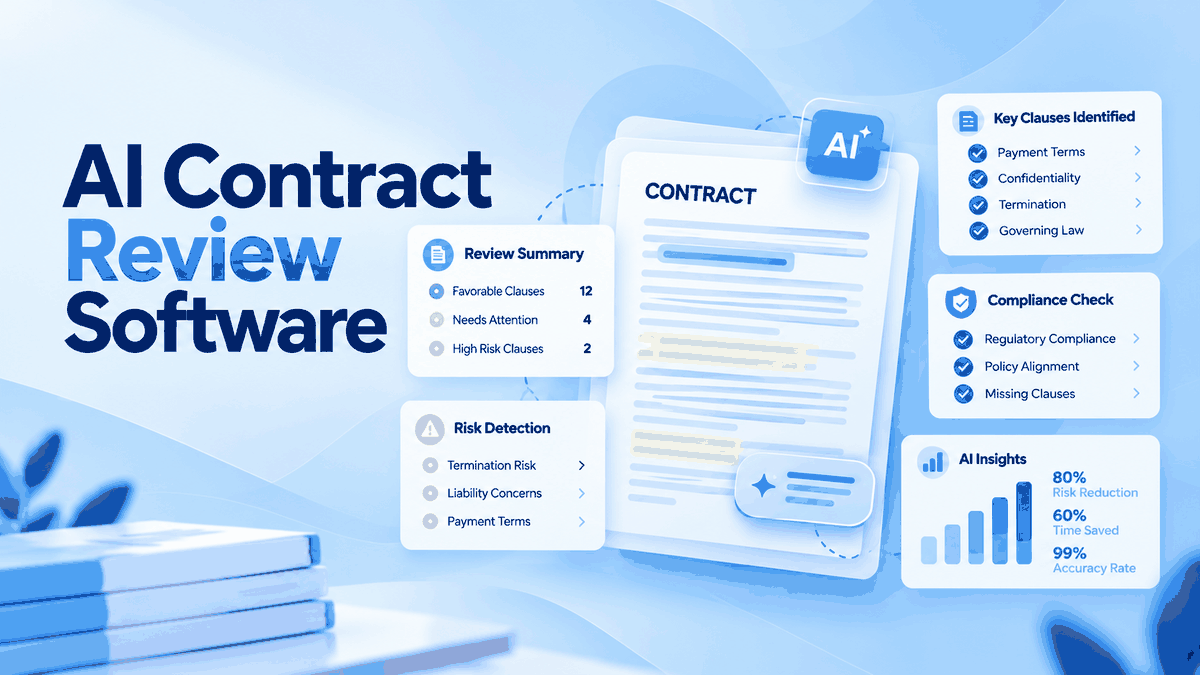
Contract Compliance Management: Process, Challenges & Best Practices
Contract compliance management is the process of ensuring that every party involved in a contract follows the agreed terms, conditions, obligations, and deadlines throughout the contract lifecycle. It involves monitoring contractual commitments, tracking performance, identifying compliance risks, and taking corrective action when requirements are not met.
For businesses managing hundreds of agreements, contract compliance can become challenging. A missed payment deadline, an overlooked service-level agreement (SLA), an expired vendor document, or an unnoticed renewal clause can lead to financial losses, operational disruptions, and legal disputes.
Effective contract compliance management helps businesses move from reactive problem-solving to proactive contract oversight. With structured processes and AI-powered contract management software, organisations can improve visibility, automate reminders, and manage contractual responsibilities more efficiently.
In this guide, we explain the contract compliance management process, common challenges, proven best practices, and how AI can help businesses maintain better control over their agreements.
Table of Contents
What Is Contract Compliance Management?
Why Is Contract Compliance Management Important?
What Is the Contract Compliance Management Process?
Common Contract Compliance Challenges
Contract Compliance Management Best Practices
What Is Contract Compliance Software?
How AI Improves Contract Compliance Management
Contract Compliance Management vs Contract Obligation Management
Contract Compliance Management Examples
Key Contract Compliance Metrics to Track
How to Choose Contract Compliance Management Software
How SprintContractX Helps Businesses Manage Contract Compliance
Conclusion
Frequently Asked Question
What Is Contract Compliance Management?
Contract compliance management refers to the activities businesses use to verify that contractual responsibilities are being fulfilled according to agreed terms.
It covers both the obligations a company must meet and the commitments it expects from customers, suppliers, service providers, and business partners.
For example, a vendor agreement may specify that:
Payments must be completed within 30 days of an approved invoice.
Services must meet an agreed performance standard.
Confidential information must be protected.
Certain reports must be submitted every quarter.
Compliance certificates must remain valid.
Contract renewal decisions must be communicated before a specified notice period.
Contract compliance management helps businesses monitor these requirements, assign responsibility, and maintain evidence that obligations have been fulfilled.
In simple terms, contract compliance management ensures that agreements are not just signed and stored, but properly followed throughout their duration.
It also helps businesses identify potential breaches, respond to changes, and manage contracts more consistently.
Why Is Contract Compliance Management Important?
Contracts define important business relationships, financial commitments, service expectations, and legal responsibilities.
However, signing a contract does not automatically guarantee that its terms will be followed.
Without an effective compliance process, organisations may experience missed obligations, delayed payments, inconsistent service delivery, or unexpected renewals.
1. Reduces Contractual Risk
Regular compliance checks help identify missed responsibilities, unusual deviations, and potential breaches before they become larger problems.
2. Protects Business Relationships
Monitoring agreed service levels, delivery timelines, and payment conditions supports more transparent relationships between contracting parties.
3. Improves Financial Control
Contract compliance tracking can help organisations monitor payment terms, pricing commitments, penalties, and other financial obligations.
4. Supports Regulatory Readiness
Some agreements include data protection, confidentiality, reporting, or other regulatory responsibilities.
A structured compliance process helps organisations track these obligations and maintain supporting records. It does not replace a regulatory compliance programme.
5. Prevents Missed Deadlines
Monitoring renewal dates, notice periods, reporting deadlines, and contractual milestones helps teams act on important commitments at the appropriate time.
6. Improves Accountability
When contractual responsibilities have clear owners, deadlines, and escalation procedures, it becomes easier to understand who must take action.
What Is the Contract Compliance Management Process?
The contract compliance management process involves identifying contractual obligations, assigning responsibilities, monitoring performance, recording evidence, and resolving potential compliance issues.
A practical process can be divided into seven steps.
Step 1: Centralise Contracts in One Repository
The first step is to ensure that contracts are organised and accessible.
Businesses often store agreements across emails, local drives, shared folders, and separate department systems.
This makes it difficult to identify which contract version is active or retrieve the correct terms when required.
A centralised contract repository helps teams maintain access to executed agreements, amendments, supporting documents, and important metadata.
Step 2: Identify Contractual Obligations
Once contracts are organised, teams should identify commitments requiring ongoing attention.
These may include:
Payment schedules
Service-level agreements
Delivery timelines
Regulatory requirements
Insurance and certification requirements
Reporting obligations
Confidentiality provisions
Termination notice periods
Renewal deadlines
Each obligation should be documented in a way that makes it possible to track whether it has been fulfilled.
Step 3: Assign Responsibility
Every important contractual obligation should have a clearly defined owner.
For example, finance may manage payments, procurement may monitor supplier performance, IT may oversee technology-related service levels, and legal may supervise contractual notices.
Assigning responsibility helps reduce confusion and prevents important tasks from being overlooked.
Step 4: Define Compliance Monitoring Rules
Businesses should establish how each obligation will be monitored.
This may include:
Due dates
Review frequency
Performance thresholds
Required supporting evidence
Notification schedules
Escalation conditions
For example, a service agreement requiring 99.5% monthly uptime should have a defined method for measuring actual performance.
Step 5: Monitor Contract Performance
The next step is to compare actual performance with contractual commitments.
Teams may review payment records, service reports, deliverables, certification documents, or other relevant evidence.
Contract compliance monitoring helps identify whether an obligation has been completed, remains pending, or requires attention.
Step 6: Resolve Compliance Issues
When a potential compliance issue is identified, the responsible team should investigate and determine the appropriate corrective action.
This may involve contacting a supplier, requesting missing documentation, escalating an SLA failure, or obtaining legal advice.
Not every deviation is automatically a legal breach. The contract terms and surrounding circumstances must be reviewed.
Step 7: Maintain Records and Improve the Process
Businesses should preserve relevant compliance records, including review outcomes, approvals, notices, supporting documents, and corrective actions.
Regular reporting helps identify recurring problems and improve contract management processes over time.
Common Contract Compliance Management Challenges
Even organisations with established contract procedures may struggle to monitor every commitment consistently.
1. Contracts Scattered Across Multiple Systems
When agreements are stored in different locations, employees may struggle to locate the latest approved version.
This creates gaps in visibility and increases manual effort.
Solution: Maintain a centralised contract repository with appropriate access controls and document history.
2. Manual Obligation Tracking
Spreadsheets and calendar reminders may work for a small number of agreements but become difficult to maintain as contract volumes increase.
Solution: Use structured obligation tracking with assigned owners, deadlines, reminders, and status updates.
3. Missed Contract Deadlines
Renewal dates, compliance submissions, payment milestones, and termination notice periods can be overlooked.
Solution: Establish advance notifications and clear escalation procedures for critical dates.
4. Unclear Ownership
A contract may involve multiple departments without clearly identifying who is responsible for individual commitments.
Solution: Assign an owner for each significant obligation and document who must approve or verify completion.
5. Inconsistent Contract Language
Similar agreements may contain different terms, creating confusion about which responsibilities apply.
Solution: Use approved templates, clause libraries, and documented review procedures.
6. Limited Visibility Into Compliance Status
Management teams may struggle to identify overdue obligations, high-risk agreements, or repeated supplier performance issues.
Solution: Use dashboards and reporting that distinguish completed, pending, overdue, and escalated obligations.
7. Changes to Contracts
Amendments can alter payment terms, deadlines, liability provisions, or service commitments.
If tracking records are not updated, teams may continue monitoring outdated obligations.
Solution: Link amendments to the original contract and update the relevant obligation records whenever terms change.
Contract Compliance Management Best Practices
Effective contract compliance management requires a consistent approach across departments.
The following practices can help businesses improve oversight and reduce avoidable risks.
1. Standardise Contract Templates
Approved templates and clause libraries can help teams maintain consistent contractual language.
This makes it easier to understand common obligations and identify unusual provisions during review.
2. Create a Contract Compliance Checklist
Develop a checklist covering key requirements for each contract category.
For a vendor agreement, the checklist may include:
Agreement signed by authorised parties
Payment terms documented
Service levels identified
Insurance requirements recorded
Confidentiality commitments reviewed
Renewal notice period captured
Responsible owners assigned
3. Build a Contract Obligation Register
A contract obligation register is a structured record of responsibilities that must be fulfilled during an agreement.
For example:
Illustrative example. Obligation deadlines and owners should reflect the actual contract terms.
This register helps teams understand what must be completed, when it is due, and who is responsible.
4. Automate Critical Reminders
Use automated notifications for renewal windows, approval requirements, reporting deadlines, and other time-sensitive commitments.
Notifications should reach the right people early enough for meaningful action.
5. Maintain an Audit Trail
Track important contract activities such as approvals, amendments, reviews, signatures, and completion evidence.
An audit trail helps organisations investigate issues and demonstrate which actions were taken.
6. Conduct Regular Compliance Reviews
Schedule periodic contract reviews based on agreement value, complexity, risk level, and business importance.
High-risk agreements may require more frequent monitoring than routine contracts.
7. Use Risk-Based Prioritisation
Not every contract requires the same level of attention.
Prioritise agreements involving significant financial commitments, sensitive information, complex obligations, or strict regulatory requirements.
8. Measure Compliance Performance
Monitor completion rates, overdue obligations, recurring deviations, and resolution times.
These insights can help identify operational weaknesses and guide improvement.
What Is Contract Compliance Management Software?
Contract compliance management software helps businesses organise contracts, track contractual obligations, monitor deadlines, maintain records, and identify potential compliance issues.
Rather than relying on disconnected spreadsheets and manual reminders, businesses can manage important contract information through a structured digital platform.
Common features include:
Centralised contract storage
Contract search and metadata management
Obligation tracking
Compliance reminders
Approval workflows
Contract version history
Role-based access controls
Risk identification
Audit trails
Compliance dashboards and reporting
Some contract lifecycle management platforms offer these capabilities as part of a wider solution covering contract drafting, negotiation, execution, and renewal.
How AI Improves Contract Compliance Management
Artificial intelligence can help organisations manage contract compliance by making contractual information easier to identify, organise, and monitor.
AI-Assisted Obligation Extraction
AI can analyse contract language and help identify payment requirements, deadlines, service commitments, and other obligations.
This reduces the need to manually locate every relevant provision.
AI-Powered Clause Analysis
AI-assisted review can highlight unusual or non-standard clauses that may require further assessment.
For example, the system may flag an unexpected termination condition or a clause that differs from an approved template.
Intelligent Contract Search
Users can search for contracts and key provisions without opening each document.
Some AI systems also support natural-language questions about stored agreements.
Automated Alerts and Monitoring
When connected to structured obligation records, software can notify responsible teams before important deadlines.
AI-assisted extraction and rule-based alerts can work together to improve tracking.
Compliance Reporting
Contract management platforms can organise information about overdue obligations, upcoming renewals, approval status, and potential risks.
This gives management teams a clearer view of their contract portfolio.
AI should support compliance professionals, not replace their judgment. Extracted obligations, flagged clauses, and recommended actions should be verified against the source contract and relevant policies.
Contract Compliance Management vs Contract Obligation Management
Although closely related, contract compliance management and contract obligation management are not the same.
Contract obligation management is an important component of contract compliance management.
For example, tracking a supplier's monthly reporting deadline is obligation management. Verifying whether the report was submitted correctly and responding to non-compliance is part of the wider compliance process.
Contract Compliance Management Examples
Example 1: Vendor Contract Compliance
A business signs an annual agreement with a technology service provider.
The agreement includes monthly service levels, quarterly performance reviews, and specific notice requirements.
A structured compliance process helps the business monitor the supplier's performance, maintain review records, and act when contractual commitments are not met.
Example 2: Banking and Financial Services
A financial services organisation manages agreements with outsourcing providers and technology vendors.
These contracts may include confidentiality requirements, security commitments, service reporting, and business continuity responsibilities.
Contract compliance management can help responsible teams track those contractual commitments and maintain supporting records.
Regulatory compliance requirements must still be assessed separately under applicable laws and supervisory guidance.
Example 3: Procurement Contract Compliance
A procurement department works with suppliers under negotiated pricing and delivery terms.
Compliance tracking helps verify whether agreed prices, delivery schedules, and service conditions are being followed.
Example 4: Contract Renewal Compliance
A company has an agreement that renews automatically unless written notice is provided 90 days before expiry.
By maintaining accurate renewal information and advance reminders, the responsible team can review the agreement and decide whether to renew, renegotiate, or terminate it.
Key Contract Compliance Metrics to Track
Businesses should measure contract compliance using consistent, clearly defined indicators.
For example, the on-time obligation completion rate can be calculated as:
On-time completion rate = (Obligations completed on time ÷ Obligations due during the period) × 100
If 92 of 100 obligations due during the month were completed on time, the completion rate would be 92%.
The calculation is simple, but accurate measurement depends on maintaining reliable obligation records.
How to Choose Contract Compliance Management Software
Before selecting contract compliance software, organisations should evaluate their business requirements and existing processes.
1. Contract Repository
Does the software provide a centralised location for executed agreements, amendments, and supporting documents?
2. Obligation Tracking
Can teams assign responsibilities, monitor due dates, and track completion status?
3. AI Contract Analysis
Does the system support clause analysis, information extraction, or AI-assisted review?
4. Workflow Automation
Can contracts and compliance-related actions be routed to the appropriate stakeholders?
5. Reporting and Analytics
Can management identify overdue obligations, upcoming deadlines, and recurring issues?
6. Security and Access Controls
Does the platform offer appropriate user permissions, data protection measures, and audit capabilities?
7. Integration Requirements
Can the solution work with relevant finance, procurement, CRM, ERP, or other business systems?
8. Implementation and Usability
Can legal, procurement, finance, and operations teams use the software effectively?
The right solution should match your contract volume, business complexity, risk exposure, and compliance requirements.
How SprintContractX Helps Businesses Manage Contract Compliance
Managing contract compliance becomes difficult when important agreements, approvals, renewal dates, and contractual responsibilities are spread across multiple systems.
SprintContractX is PaySprint's AI-powered contract lifecycle management software designed to simplify contract processes from drafting through renewal.
The platform brings together contract workflows, AI-assisted analysis, centralised records, and obligation tracking.
AI-Powered Contract Drafting and Clause Analysis
SprintContractX helps teams prepare agreements using AI-assisted drafting and approved clause libraries.
AI-powered clause analysis can highlight non-standard contract language that may require attention during review.
Intelligent Approval Workflows
The platform supports configurable approval routing based on contract requirements, helping teams manage reviews more systematically.
Obligation and Renewal Management
SprintContractX helps businesses monitor contractual commitments, important milestones, expiry dates, and renewal windows through obligation tracking and notifications.
Centralised Contract Repository
Agreements can be organised in a searchable repository with role-based access controls.
This helps teams retrieve the relevant contract and review important information when needed.
Audit Trails and Version Tracking
Contract approval history, document versions, and signing records support better visibility into contract-related activities.
Contract Analytics and Reporting
Dashboards and reports help teams understand contract status, approval activity, and potential operational risks.
AI-Assisted Contract Intelligence
SprintContractX uses AI to support contract review and information discovery, helping teams identify relevant contractual details without relying entirely on manual searches.
By bringing these capabilities together, SprintContractX helps legal, procurement, sales, and enterprise teams maintain better oversight of agreements throughout the contract lifecycle.
Ready to simplify contract compliance management?
Explore SprintContractX to see how AI-powered contract management, automated approvals, obligation tracking, and centralised contract visibility can support your business.
Explore SprintContractX and Book a Demo
Conclusion
Contract compliance management is essential for businesses that want greater control over contractual responsibilities, deadlines, performance commitments, and potential risks.
As organisations manage more agreements, manual tracking through spreadsheets, emails, and disconnected systems can make compliance difficult to maintain.
A structured approach built around centralised contracts, clearly assigned responsibilities, regular monitoring, and reliable records can improve contract oversight.
AI-powered software can further support this process by helping teams identify important clauses, extract obligations, automate reminders, and maintain visibility into contract activity.
For businesses seeking an integrated approach, SprintContractX combines AI-assisted contract management, approval workflows, obligation tracking, centralised records, and renewal management in one platform.
Manage contracts with greater visibility and control. Explore SprintContractX to learn more.
Frequently Asked Questions About Contract Compliance Management
1. What is contract compliance management?
Contract compliance management is the process of ensuring that contractual terms, conditions, obligations, and deadlines are followed throughout the duration of an agreement.
2. Why is contract compliance management important?
It helps businesses monitor contractual responsibilities, reduce avoidable risks, maintain records, improve accountability, and respond to potential breaches.
3. What are the main steps in contract compliance management?
The main steps include centralising contracts, identifying obligations, assigning owners, setting monitoring rules, tracking performance, resolving issues, and maintaining records.
4. What is contract compliance software?
Contract compliance software helps businesses manage contract records, track obligations, monitor deadlines, automate reminders, and maintain visibility into contractual responsibilities.
5. What is the difference between contract compliance and contract management?
Contract management covers the broader contract lifecycle, including drafting, negotiation, approvals, signing, performance, and renewal. Contract compliance focuses on whether the agreed terms and responsibilities are being fulfilled.
6. How does AI help in contract compliance management?
AI can assist with clause identification, information extraction, contract search, and identifying potential risks. Combined with tracking systems, it can help teams monitor important contractual requirements.
7. What are common contract compliance risks?
Common risks include missed deadlines, failure to meet service commitments, payment disputes, expired certificates, overlooked renewal terms, and inconsistent contractual records.
8. How do businesses monitor contract compliance?
Businesses monitor compliance by maintaining obligation registers, assigning owners, setting deadlines, checking performance evidence, reviewing exceptions, and reporting issues.
9. What is a contract compliance checklist?
A contract compliance checklist is a structured list of contractual requirements that must be verified, such as payment terms, service commitments, confidentiality provisions, renewal conditions, approvals, and required documentation.
10. Can contract compliance management be automated?
Yes. Software can automate reminders, approval routing, obligation tracking, record organisation, and reporting. Human review remains important for assessing legal or commercial consequences.
11. Which teams are responsible for contract compliance?
Responsibility may be shared across legal, procurement, finance, compliance, IT, sales, and operations teams, depending on the contract and its requirements.
12. What is the best way to improve contract compliance?
Start by centralising contracts, identifying important obligations, assigning responsible owners, establishing monitoring procedures, and using automation where appropriate.
13. Can SprintContractX help with contract compliance management?
SprintContractX supports contract compliance-related workflows through AI-assisted clause analysis, approval automation, centralised contract storage, obligation tracking, renewal alerts, and contract reporting.
Related Posts
What is E-Banking? Meaning, Types, Benefits & How It Works in India.
E-banking is the digital way of accessing banking services through mobile apps, websites, ATMs, and biometric systems. It enables secure, fast, and branchless financial transactions anytime and anywhere in India.
Read More
When Maps Change, Money Follows: How Geopolitics Is Rewiring B2B Payments in 2026
Payments are no longer just a plumbing problem — they're a geopolitical one. Explore how Indian B2B businesses can navigate a fragmented, fast-changing global payment landscape
Read More
What Happens Inside an Escrow Release Event? A Step-by-Step Breakdown for Businesses
A complete breakdown of escrow release events—covering triggers, validation, vendor response, and access to source code—helping businesses ensure continuity and minimize vendor risk.
Read MoreReady to Protect Your Core Systems?
Join enterprises that trust SprintEX-Code to safeguard their mission-critical software. Get started with a consultation to discuss your specific escrow requirements.