
What is Contract Management Software? Features, Benefits & How It Works
Sep 15, 2026
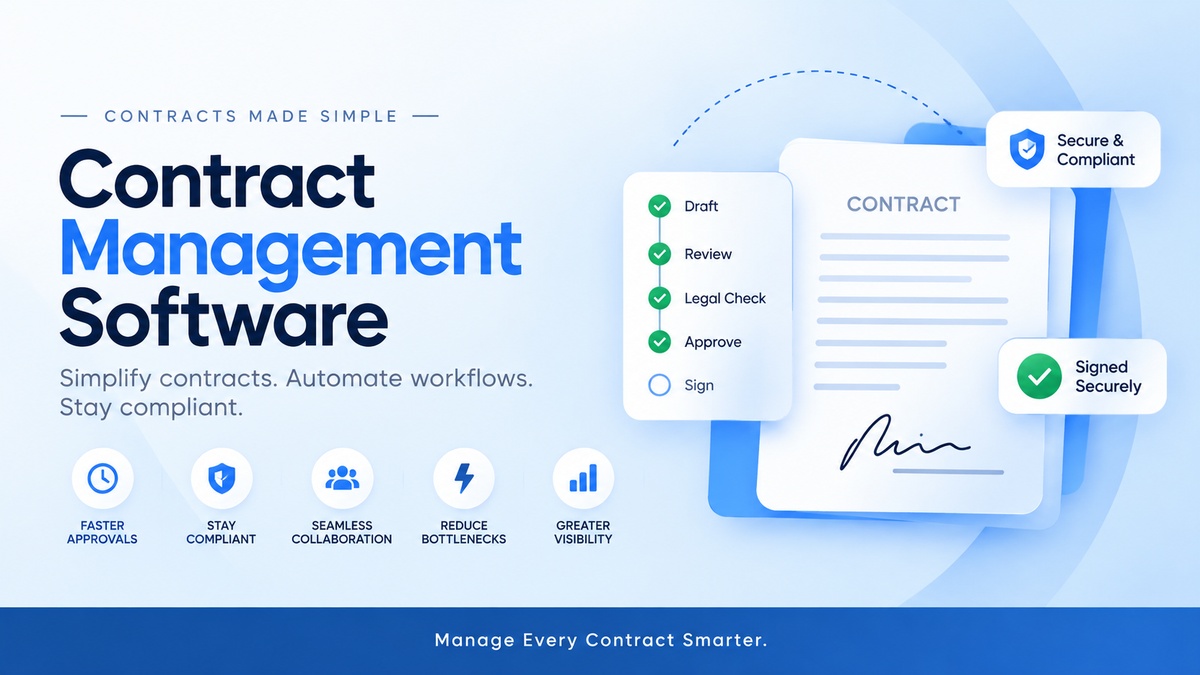
What is Contract Management Software? A Complete Guide
Contract management software helps businesses create, review, approve, sign, store, track, and manage agreements from one central system. As contract volumes grow, relying on emails, spreadsheets, shared folders, and manual reminders can make it difficult to know which version is final, who needs to approve it, or when an agreement is due for renewal.
Online contract management software solves this problem by bringing contract workflows, documents, approvals, signatures, obligations, and important dates into a single digital platform. It helps legal and business teams reduce manual work, improve visibility, and manage agreements more consistently across their lifecycle.
In this guide, you’ll learn how modern contract platforms work, their key features and benefits, and what businesses should consider when choosing a solution.
Table of Contents
What Is Contract Management Software?
How Does Online Contract Management Software Work?
Why Do Businesses Need Online Contract Management Software?
What Are the Key Features of Online Contract Management Software?
What Are the Benefits of Online Contract Management Software?
What Is AI-Powered Contract Management Software?
Who Uses Online Contract Management Software?
Online Contract Management Software vs Spreadsheets
What Is the Difference Between Contract Management Software and CLM?
How Do You Choose the Best Online Contract Management Software?
How Does Online Contract Management Software Improve Efficiency?
How Can SprintContractX Help Manage Contracts?
Conclusion
Frequently Asked Questions
What Is Contract Management Software?
Contract management software is a digital platform used to manage contracts from initial creation through approval, execution, storage, renewal, and termination.
Online contract management software allows authorised users to manage these activities through a cloud-based system. Rather than keeping contracts across inboxes and folders, teams can access agreements, approval status, renewal dates, obligations, and related information from one place.
In simple terms, the software helps businesses organise contracts, automate repetitive processes, and stay informed about what requires attention.
How Does Online Contract Management Software Work?
The platform creates a structured workflow for every stage of a contract.
A typical contract lifecycle may include:
Request ? Draft ? Review ? Approval ? Negotiation ? Signature ? Storage ? Obligation Tracking ? Renewal
A business user can raise a contract request, after which the agreement can be drafted using an approved template. It can then be routed to legal, finance, procurement, management, or other stakeholders for review and approval.
Once approved, the agreement can be sent for e-signature. After execution, the platform stores the signed contract in a central repository and can continue tracking renewal dates, obligations, milestones, and other important events.
This gives teams a clear view of where each contract stands and what action is required next.
Why Do Businesses Need Online Contract Management Software?
Businesses may manage customer agreements, vendor contracts, employment documents, partnership agreements, NDAs, service contracts, and many other types of legal documents.
When these agreements are handled manually, common problems can include:
Contracts being scattered across emails and folders
Delayed internal approvals
Multiple versions of the same agreement
Missed renewal or termination dates
Limited visibility into contractual obligations
Time-consuming contract searches
Repeated follow-ups with stakeholders
Difficulty identifying important clauses and risks
A centralised contract platform brings these activities together and gives organisations a structured process for managing contracts at scale.
What Are the Key Features of Online Contract Management Software?
The right online contract management software should support more than document storage. It should help businesses manage both the pre-signature and post-signature stages of the contract lifecycle.
1. Centralised Contract Repository
A central repository keeps contracts and related documents in one searchable location.
Users can search agreements by customer, vendor, contract type, date, status, owner, or other relevant information instead of searching through several inboxes and folders.
2. Automated Approval Workflows
Contracts often require approval from legal, finance, procurement, business heads, or senior management.
The software can route an agreement automatically according to predefined approval rules. This reduces manual follow-ups and makes it easier to see where an agreement is pending.
3. Contract Drafting and Templates
Standard templates and approved clauses can help teams draft recurring agreements faster and maintain consistency.
Advanced platforms may also provide AI-assisted drafting, clause suggestions, and comparison tools.
4. Electronic Signatures
Online contract management software can support electronic signing so teams can execute agreements digitally without printing, scanning, couriering, or manually tracking signed copies.
5. Renewal and Expiry Alerts
Contracts often contain renewal dates, notice periods, expiry dates, and other time-sensitive milestones.
Automated reminders can alert teams before these dates so they have enough time to review, renew, renegotiate, or terminate an agreement.
6. Obligation Management
Signing a contract does not end the contract management process. Agreements often include deliverables, payment commitments, service levels, compliance requirements, and other obligations.
The platform can help teams track these responsibilities and monitor whether important commitments are being met.
7. Search and Reporting
A contract platform should make it easy to find agreements and understand the overall contract portfolio.
Dashboards can provide visibility into active contracts, upcoming renewals, pending approvals, expiries, obligations, and other key information.
What Are the Benefits of Online Contract Management Software?
A well-designed contract platform can improve efficiency, visibility, and control across the contract lifecycle.
Faster Contract Approvals
Automated workflows reduce the need to manually send documents from one stakeholder to another. Approvers can see what requires action, helping contracts move through internal processes faster.
Better Contract Visibility
Teams can quickly identify agreements awaiting approval, contracts approaching renewal, and obligations that require attention.
Reduced Manual Work
Routine activities such as reminders, status updates, approval routing, and contract tracking can be automated. This reduces administrative effort and allows employees to focus on higher-value work.
Fewer Missed Renewals
Automated alerts can notify teams before expiry dates, renewal windows, and notice periods. This gives businesses more time to review commercial terms and decide whether an agreement should be renewed, renegotiated, or terminated.
Improved Collaboration
Legal, sales, procurement, finance, and business teams can work through a shared process instead of exchanging multiple document versions through email.
Better Contract Control
A structured platform makes it easier to maintain approval histories, manage access, track changes, monitor obligations, and understand the status of contracts across the organisation.
What Is AI-Powered Contract Management Software?
AI-powered contract management software uses artificial intelligence to help users analyse, search, review, and understand contract information more efficiently.
Modern online contract management software can use AI for:
Contract summarisation
Clause identification
Risk analysis
Obligation extraction
Contract comparison
Drafting assistance
Key-date extraction
Natural-language search
For example, users may be able to ask:
“Which contracts expire in the next 60 days?”
“Which vendor agreements include an auto-renewal clause?”
“What obligations are included in this agreement?”
This allows the platform to become more than a document repository. It can also act as a source of searchable contract intelligence.
Who Uses Online Contract Management Software?
A centralised contract platform can support multiple departments within an organisation.
Legal teams can manage contract reviews, clauses, risks, approvals, and executed agreements.
Sales teams can streamline customer contracts and reduce delays between commercial agreement and execution.
Procurement teams can manage vendor contracts, supplier renewals, and contractual commitments.
Finance teams can track commercial terms, payment obligations, and contract-related commitments.
HR teams can organise employment agreements and other workforce-related documents.
Business leaders can use dashboards and reports to gain visibility into contract status, upcoming renewals, obligations, and areas requiring attention.
Online Contract Management Software vs Spreadsheets
Spreadsheets can be useful when a business manages a small number of contracts, but they become harder to maintain as contract volumes increase.
A spreadsheet may record basic information such as contract name, owner, start date, expiry date, and status. However, it usually depends on manual updates and reminders.
Online contract management software can provide automated workflows, central document storage, permissions, version control, alerts, reporting, and advanced search.
This helps businesses move from manual contract tracking to a more scalable and structured process.
What Is the Difference Between Contract Management Software and CLM?
Contract management software and Contract Lifecycle Management, or CLM, are closely related.
Basic contract management tools may focus mainly on organising, storing, and tracking agreements. A full CLM solution typically manages the complete lifecycle, including requests, drafting, negotiation, review, approvals, signatures, storage, obligations, renewals, and termination.
Businesses that need end-to-end automation should look for online contract management software with comprehensive lifecycle capabilities rather than a simple contract repository.
How Do You Choose the Best Online Contract Management Software?
The best online contract management software depends on the organisation’s contract volume, processes, team structure, security requirements, and automation needs.
When comparing solutions, consider:
Ease of Use
The platform should be easy for both legal and non-legal teams to use consistently.
End-to-End Lifecycle Management
Look for a solution that supports contract request, drafting, review, approval, execution, storage, obligation tracking, and renewal.
Workflow Automation
The system should allow businesses to create approval workflows that reflect their internal processes.
Search Capabilities
Users should be able to find agreements, clauses, dates, and other contract information quickly.
Renewal Management
Automated alerts for expiry dates, renewals, and notice periods can reduce dependence on spreadsheets and calendar reminders.
Security and Access Controls
The platform should let organisations control who can view, edit, approve, or manage specific contracts.
Reporting and Analytics
Dashboards should provide meaningful visibility into contract status, approvals, renewals, obligations, and activity.
AI Capabilities
AI can help teams review contracts, identify clauses, extract obligations, summarise agreements, and retrieve information more efficiently.
How Does Online Contract Management Software Improve Efficiency?
Online contract management software reduces the time teams spend searching for documents and manually coordinating contract activities.
Instead of repeatedly asking:
“Where is the latest agreement?”
“Has legal approved it?”
“Who still needs to sign?”
“When does this contract renew?”
Users can check the system for the current contract, status, owner, and next action.
By combining contracts, workflows, reminders, approvals, and information in one place, online contract management software can make contract operations more organised and easier to scale.
How Can SprintContractX Help Manage Contracts?
SprintContractX is an AI-powered contract lifecycle management platform designed to help businesses centralise and manage contracts more efficiently.
It brings drafting, approvals, e-signatures, contract storage, obligation tracking, renewals, and reporting into one structured platform.
SprintContractX also includes PIX — PaySprint Intelligent Xperience, an AI assistant that helps users interact with contract information in natural language.
PIX can help teams find contracts, understand clauses, identify potential risks, extract obligations, and access important contract information more quickly.
For businesses evaluating online contract management software, SprintContractX combines workflow automation with AI-powered contract intelligence to support a more organised contract lifecycle.
Conclusion
Online contract management software gives businesses a structured way to manage agreements across their entire lifecycle.
By centralising documents, automating approvals, tracking renewals, monitoring obligations, and improving visibility, organisations can reduce many of the manual tasks associated with contract management.
As AI becomes part of modern contract workflows, online contract management software can also help teams search, understand, and act on contract information more efficiently.
For businesses still relying on emails, spreadsheets, and disconnected folders, moving to online contract management software can create a more organised, scalable, and intelligent way to manage agreements.
Frequently Asked Questions
What is online contract management software?
Online contract management software is a cloud-based platform that helps businesses create, review, approve, sign, store, track, and manage contracts throughout their lifecycle.
What does online contract management software do?
It helps organisations manage drafting, approvals, signatures, contract storage, renewals, obligations, search, and reporting from a central platform.
Why should a business use contract management software?
Businesses use contract management software to reduce manual work, improve contract visibility, accelerate approvals, centralise documents, and stay informed about important deadlines and obligations.
Can online contract management software track renewals?
Yes. Online contract management software can track renewal dates, expiry dates, and notice periods and send reminders before important deadlines.
Can contract management software use AI?
Yes. AI-powered systems can help summarise contracts, identify clauses, extract obligations, highlight potential risks, support drafting, and answer questions about contract information.
Is online contract management software suitable for small businesses?
Yes. Small and growing businesses can use online contract management software to organise agreements, standardise approvals, track key dates, and create a scalable contract process.
Related Posts
What is E-Banking? Meaning, Types, Benefits & How It Works in India.
E-banking is the digital way of accessing banking services through mobile apps, websites, ATMs, and biometric systems. It enables secure, fast, and branchless financial transactions anytime and anywhere in India.
Read More
When Maps Change, Money Follows: How Geopolitics Is Rewiring B2B Payments in 2026
Payments are no longer just a plumbing problem — they're a geopolitical one. Explore how Indian B2B businesses can navigate a fragmented, fast-changing global payment landscape
Read More
What Happens Inside an Escrow Release Event? A Step-by-Step Breakdown for Businesses
A complete breakdown of escrow release events—covering triggers, validation, vendor response, and access to source code—helping businesses ensure continuity and minimize vendor risk.
Read MoreReady to Protect Your Core Systems?
Join enterprises that trust SprintEX-Code to safeguard their mission-critical software. Get started with a consultation to discuss your specific escrow requirements.