
What is E-Banking? Meaning, Types, Benefits & How It Works in India.
May 21, 2026
What is E-Banking? Meaning, Types, Benefits & How It Works in India
E-banking, also known as electronic banking or online banking, is the digital delivery of banking services that allows customers to perform financial transactions through the internet, mobile apps, ATMs, or biometric channels — without ever stepping inside a bank branch. From checking your account balance at midnight to sending money to a vendor in a remote village, e-banking has become the invisible backbone of how India transacts in 2026.
With UPI crossing record monthly transaction volumes and AEPS bringing banking to the doorsteps of rural India, electronic banking is no longer a convenience — it is the default. In this guide, we will break down what e-banking means, the different types, how it works, its benefits, the risks to watch out for, and how platforms like PaySprint are powering the next wave of digital banking through APIs.
Table of Contents
1. What is E-Banking?
2. A Brief History of E-Banking in India
3. Types of E-Banking Services
4. How E-Banking Works (Step-by-Step)
5. Top Benefits of E-Banking
6. Common E-Banking Services You Use Every Day
7. Security Risks in E-Banking & How to Stay Safe
8. How PaySprint Powers E-Banking in India
9. The Future of E-Banking
10. Conclusion
11. Frequently Asked Questions (FAQs)
What is E-Banking?
E-banking (electronic banking) is a system that allows customers of a bank or financial institution to access their accounts and conduct transactions through electronic channels such as the internet, mobile devices, ATMs, point-of-sale terminals, and biometric devices. It replaces the need for physical visits to a bank branch with secure, real-time digital interactions. In simple words, anything you do related to banking — sending money, paying bills, withdrawing cash from an ATM, depositing cash via Aadhaar biometrics, or even applying for a loan online — falls under the umbrella of e-banking.
A Brief History of E-Banking in India
India's e-banking journey began in the late 1990s when private banks first introduced internet banking. The major milestones include:
• Late 1990s: Introduction of internet banking by ICICI Bank, HDFC Bank, and Citibank.
• 2004: RBI launches NEFT (National Electronic Funds Transfer).
• 2010: NPCI launches IMPS (Immediate Payment Service) for 24x7 transfers.
• 2016: Launch of UPI (Unified Payments Interface) — a global game changer.
• 2016 onwards: AEPS (Aadhaar Enabled Payment System) drives financial inclusion in rural India.
• 2020–2026: UPI crosses billions of monthly transactions; API banking and neo-banking become mainstream.
Types of E-Banking Services
E-banking is not a single service — it is an ecosystem of digital channels. Here are the major types:
Internet Banking
Access your bank account through a secure website using a username, password, and two-factor authentication. Use it to transfer funds, pay bills, view statements, and manage investments.
Mobile Banking
A dedicated bank app on your smartphone that offers all internet banking features plus push notifications, biometric login, and QR-code payments.
UPI (Unified Payments Interface)
Send and receive money instantly using just a UPI ID or QR code. UPI has redefined peer-to-peer and merchant payments in India. Businesses can integrate UPI services to enable seamless cardless withdrawals and collections at scale.
AEPS (Aadhaar Enabled Payment System)
AEPS lets customers withdraw cash, deposit funds, check balance, and transfer money using only their Aadhaar number and biometric authentication — no debit card or mobile phone required. It is the cornerstone of rural e-banking and is widely deployed via the AEPS API by fintech partners across India.
ATM & Micro-ATM Banking
ATMs allow card-based cash withdrawals; Micro-ATMs (handheld POS devices) extend banking to villages and remote locations.
IMPS, NEFT & RTGS
Three different rails for moving money between bank accounts. IMPS is instant and works 24x7; NEFT runs in batches; RTGS is for high-value, real-time transfers above ?2 lakh.
BBPS (Bharat Bill Payment System)
A one-stop interoperable platform for paying electricity, water, gas, DTH, broadband, insurance, and other recurring bills.
How E-Banking Works (Step-by-Step)
Behind every UPI tap or AEPS withdrawal is a chain of authentication and settlement steps:
• Step 1 – Authentication: The customer is identified using a password, OTP, biometric, or PIN.
• Step 2 – Request Initiation: The transaction is initiated via the chosen channel (app, web, ATM, biometric device).
• Step 3 – Switching: Networks like NPCI, RBI's NEFT, or bank-to-bank switches route the request.
• Step 4 – Verification: The sending bank checks balance, fraud risk, and limits.
• Step 5 – Settlement: Funds are debited from the sender's account and credited to the receiver's account in real time.
• Step 6 – Confirmation: Both parties get instant SMS, email, or push notifications.
Top Benefits of E-Banking
• 24x7 access — bank anytime, anywhere, no holiday breaks.
• Speed and convenience — money transfers in seconds, not days.
• Lower costs — reduced transaction fees and no branch overhead.
• Financial inclusion — AEPS and Micro-ATMs bring banking to villages.
• Better record-keeping — every transaction is logged and searchable.
• Eco-friendly — less paperwork, fewer trips to the branch.
• Innovation — integrates seamlessly with apps, businesses, and APIs.
Common E-Banking Services You Use Every Day
• Sending money to a friend via UPI
• Paying your electricity or mobile bill online
• Withdrawing cash at a kirana store using Aadhaar (AEPS)
• Buying groceries via QR code at a local shop
• Receiving salary credit via NEFT or IMPS
• Booking train, flight, or movie tickets
• Opening a savings account online with eKYC
Security Risks in E-Banking & How to Stay Safe
While e-banking is generally safe, fraudsters target unsuspecting users through phishing, fake apps, and social engineering. Common risks include:
• Phishing — fake emails or SMS pretending to be your bank.
• Vishing — scam calls asking for OTPs or card details.
• SIM swap fraud — attackers clone your SIM to intercept OTPs.
• Malware — malicious apps stealing your banking credentials.
• UPI handle scams — requests disguised as payments.
Best Practices to Stay Safe
• Never share OTPs, PINs, or passwords — banks never ask for them.
• Use only official banking apps from verified app stores.
• Enable two-factor authentication on every account.
• Avoid public Wi-Fi for banking transactions.
• Check transaction alerts regularly and report anomalies immediately.
How PaySprint Powers E-Banking in India
PaySprint is a unified API platform that gives businesses, NBFCs, fintechs, and enterprises plug-and-play access to the full spectrum of e-banking rails — AEPS, UPI, IMPS, NEFT, BBPS, Micro-ATM, DMT, and more — through a single integration.
Key e-banking capabilities offered by PaySprint include:
• AEPS APIs for cash withdrawal, deposit, balance enquiry, and mini statements using Aadhaar biometrics.
• UPI APIs for cardless cash withdrawal, collections via static/dynamic QR codes, and merchant payments.
• IMPS & NEFT APIs for instant fund transfers across India.
• BBPS APIs for accepting bill payments across categories.
By bundling all these rails into one platform, PaySprint enables agents, retailers, and digital platforms to deliver complete e-banking experiences to every corner of Bharat.
The Future of E-Banking
The next decade of e-banking will be shaped by AI-powered personalisation, voice-based banking in regional languages, embedded finance inside non-banking apps, blockchain-based settlements, and deeper rural penetration through AEPS and Micro-ATM networks. UPI's international expansion to countries like Singapore, UAE, and France is also poised to make e-banking truly borderless for Indian users.
Conclusion
E-banking has transformed India from a cash-heavy economy into one of the most digitally advanced financial ecosystems in the world. Whether you are paying for tea via UPI, withdrawing cash through AEPS at a village kirana store, or running a business that handles thousands of payouts a day, electronic banking is the invisible engine making it all possible. As infrastructure keeps improving and platforms like PaySprint open up banking APIs to every business, the next billion Indians will experience banking without ever needing a branch.
Frequently Asked Questions (FAQs)
Q. What is e-banking in simple words?
E-banking is the use of electronic channels — like the internet, mobile apps, ATMs, and biometric devices — to access banking services without visiting a branch. It includes activities like fund transfers, bill payments, and balance enquiries.
Q. What are the main types of e-banking in India?
The main types of e-banking in India are internet banking, mobile banking, UPI, AEPS, ATM/Micro-ATM banking, IMPS/NEFT/RTGS transfers, and BBPS bill payments.
Q. Is e-banking safe to use?
Yes, e-banking is safe when you use official apps, enable two-factor authentication, never share OTPs or passwords, avoid public Wi-Fi, and monitor your transaction alerts regularly.
Q. What is the difference between e-banking and online banking?
Online banking is a subset of e-banking that refers specifically to internet-based services. E-banking is the broader term and includes online banking, mobile banking, UPI, AEPS, ATMs, and all other electronic channels.
Related Posts
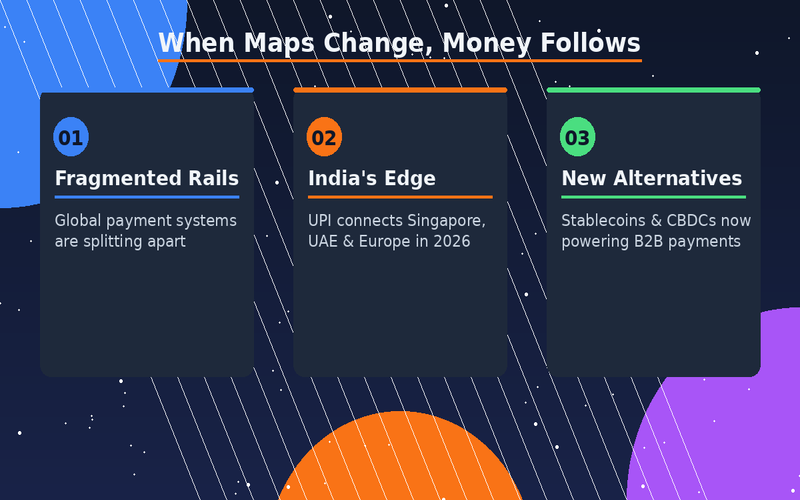
When Maps Change, Money Follows: How Geopolitics Is Rewiring B2B Payments in 2026
Payments are no longer just a plumbing problem — they're a geopolitical one. Explore how Indian B2B businesses can navigate a fragmented, fast-changing global payment landscape
Read More
What Happens Inside an Escrow Release Event? A Step-by-Step Breakdown for Businesses
A complete breakdown of escrow release events—covering triggers, validation, vendor response, and access to source code—helping businesses ensure continuity and minimize vendor risk.
Read More
Vendor Exit Risk and Escrow Protection for Business Continuity
Vendor exits can cripple operations when escrow fails in practice. This blog explores real failure points in traditional escrow and explains how SprintEX-Code ensures recovery-ready business continuity.
Read MoreReady to Protect Your Core Systems?
Join enterprises that trust SprintEX-Code to safeguard their mission-critical software. Get started with a consultation to discuss your specific escrow requirements.