
Vendor Exit Risk and Escrow Protection for Business Continuity
Apr 10, 2026
Vendor Exit Risk and Escrow Protection for Business Continuity
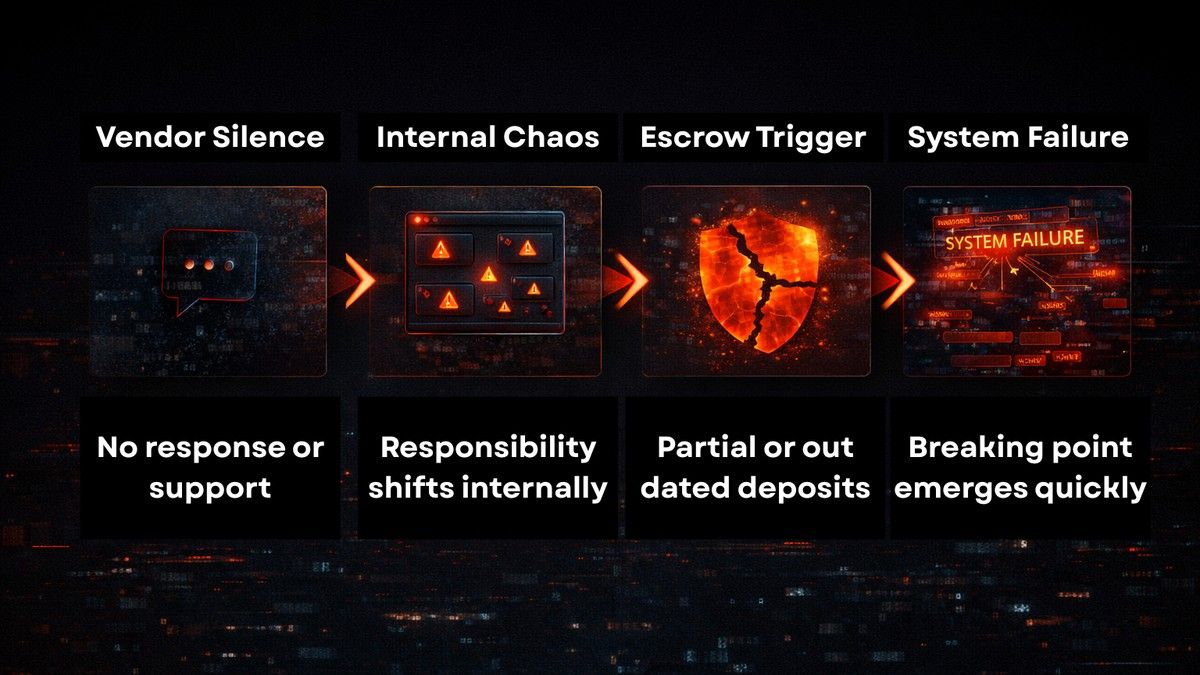
Vendor exits rarely happen cleanly. When a critical software provider stops responding or shuts down, failure unfolds in stages. What breaks first is not the contract—it is operations.
This article walks through what actually happens during a vendor exit, where traditional escrow fails, and how SprintEX-Code is designed to prevent those breakdowns.
Table of Contents
The Moment the Vendor Goes Silent
Internal Scramble Begins
Escrow Is Triggered — And Reality Sets In
What Actually Breaks in Traditional Escrow
Why These Breakpoints Matter
How SprintEX-Code Prevents These Failures
Failure-Tested vs Compliance-Tested Escrow
Summary Table
Conclusion
Frequently Asked Questions (FAQs)
The Moment the Vendor Goes Silent
Vendor exits often begin quietly.
Support tickets go unanswered. Updates are delayed. Communication slows. Internally, teams assume it is temporary.
Then the pattern becomes clear: the vendor is no longer available.
At that point, the NBFC still has live systems, customers, compliance deadlines, and reporting obligations—but no external support.
Internal Scramble Begins
When vendor support disappears, responsibility shifts immediately to internal stakeholders—technology, product, compliance, and operations.
Questions surface quickly:
Who owns technical control now?
Can we fix issues internally?
How long can systems run without vendor intervention?
Do we have access to what we need?
This is when escrow is typically invoked.
Escrow Is Triggered — And Reality Sets In
On paper, escrow appears to be the safety net. The agreement exists. Trigger conditions are satisfied. Code is released.
But this is where many NBFCs encounter the real distinction between having escrow and being able to recover.
The deposited code often fails at first contact.
What Actually Breaks in Traditional Escrow
Vendor exits expose specific technical and operational breakpoints. The most common include:
1. Missing environment configurations
Critical variables, deployment settings, or secrets are absent. The system cannot be brought up as-is.
2. Unverified dependencies
Third-party libraries, integrations, or internal services referenced in the code are missing or incompatible.
3. Outdated or partial code versions
The escrow deposit does not reflect the live production system. Recent fixes or features are absent.
4. Legal access without technical usability
The NBFC has the right to the code—but not the ability to use it within required timelines.
These failures are not theoretical. They are common in storage-only escrow arrangements.
For deeper context, see our analysis of why deposited code often fails during a crisis.
Why These Breakpoints Matter
Vendor exits themselves are disruptive—but manageable. What converts disruption into regulatory and operational failure is delay.
Every hour spent reconstructing missing components:
Increases operational risk
Delays customer servicing
Complicates regulatory reporting
Escalates internal pressure
Escrow that fails at this stage does not merely disappoint—it amplifies the crisis.
How SprintEX-Code Prevents These Failures
SprintEX-Code, offered by PaySprint, is designed around failure scenarios rather than compliance checklists.
Instead of assuming escrow will remain unused, it assumes the opposite.
SprintEX-Code addresses the exact breakpoints exposed during vendor exits by emphasizing:
Verification before crisis, identifying missing components early
Alignment with live production systems to reduce version mismatch
Defined trigger-based release mechanisms
Operational readiness rather than passive custody
The objective is not to reconstruct systems under pressure—but to execute recovery with clarity.
This aligns with the principles discussed in our comparison of release-ready vs storage-only escrow.
Failure-Tested vs Compliance-Tested Escrow
Many escrow arrangements are structured to demonstrate documentation during audits. They show that “something is in place.”
SprintEX-Code is structured to withstand failure scenarios.
That distinction matters because during a crisis, regulators, customers, and internal stakeholders evaluate outcomes—not intent.
Key questions become:
Can systems be controlled?
Can recovery begin immediately?
Can continuity be demonstrated?
Escrow must be built to answer these in practice, not theory.
Summary: What Breaks — And What Prevents It
| Failure Stage | What Breaks in Storage-Only Escrow | How SprintEX-Code Prevents It |
| Vendor silence | No immediate technical fallback | Predefined release framework |
| Escrow trigger | Incomplete or outdated deposits | Periodic verification |
| Recovery attempt | Missing dependencies & configs | Missing dependencies & configs |
| Regulatory pressure | Delayed restoration timelines | Structured recovery readiness |
| Operational control | Legal rights without usability | Execution-focused escrow model |
Conclusion
Vendor exits do not fail all at once. They fail in stages: silence, scramble, escrow invocation, and technical breakdown.
What breaks is rarely the agreement.
What breaks is usability.
Escrow that has never been tested against real failure conditions often collapses at the moment it is needed most.
SprintEX-Code is built to prevent that collapse by addressing the operational breakpoints that surface during vendor exits.
The real measure of escrow is not whether it exists—but whether it holds when everything else stops working.
Frequently Asked Questions (FAQs)
What qualifies as a vendor exit in NBFC operations?
A vendor exit may involve insolvency, shutdown, acquisition-related discontinuation, or prolonged failure to provide maintenance and support.
Why does escrow often fail during a vendor crisis?
Escrow fails when deposited code is incomplete, outdated, or unverified, making recovery slow or technically infeasible.
Is having an escrow agreement enough to ensure continuity?
No. Legal access to source code does not guarantee operational usability or timely recovery.
How does release-ready escrow differ from traditional storage-only escrow?
Release-ready escrow emphasizes usability and recovery readiness, while storage-only escrow focuses primarily on custody.
Does RBI require NBFCs to implement escrow?
RBI does not mandate escrow by name, but it expects NBFCs to manage third-party technology risk and ensure operational continuity.
How does SprintEX-Code reduce operational risk during a vendor exit?
By emphasizing verification, defined release triggers, and alignment with real recovery scenarios, SprintEX-Code reduces technical uncertainty during disruption.
Related Posts

What is E-Banking? Meaning, Types, Benefits & How It Works in India.
E-banking is the digital way of accessing banking services through mobile apps, websites, ATMs, and biometric systems. It enables secure, fast, and branchless financial transactions anytime and anywhere in India.
Read More
When Maps Change, Money Follows: How Geopolitics Is Rewiring B2B Payments in 2026
Payments are no longer just a plumbing problem — they're a geopolitical one. Explore how Indian B2B businesses can navigate a fragmented, fast-changing global payment landscape
Read More
What Happens Inside an Escrow Release Event? A Step-by-Step Breakdown for Businesses
A complete breakdown of escrow release events—covering triggers, validation, vendor response, and access to source code—helping businesses ensure continuity and minimize vendor risk.
Read MoreReady to Protect Your Core Systems?
Join enterprises that trust SprintEX-Code to safeguard their mission-critical software. Get started with a consultation to discuss your specific escrow requirements.