
Contract Approval Workflow Software: How to Automate Approvals and Reduce Delays in 2026
Oct 31, 2026
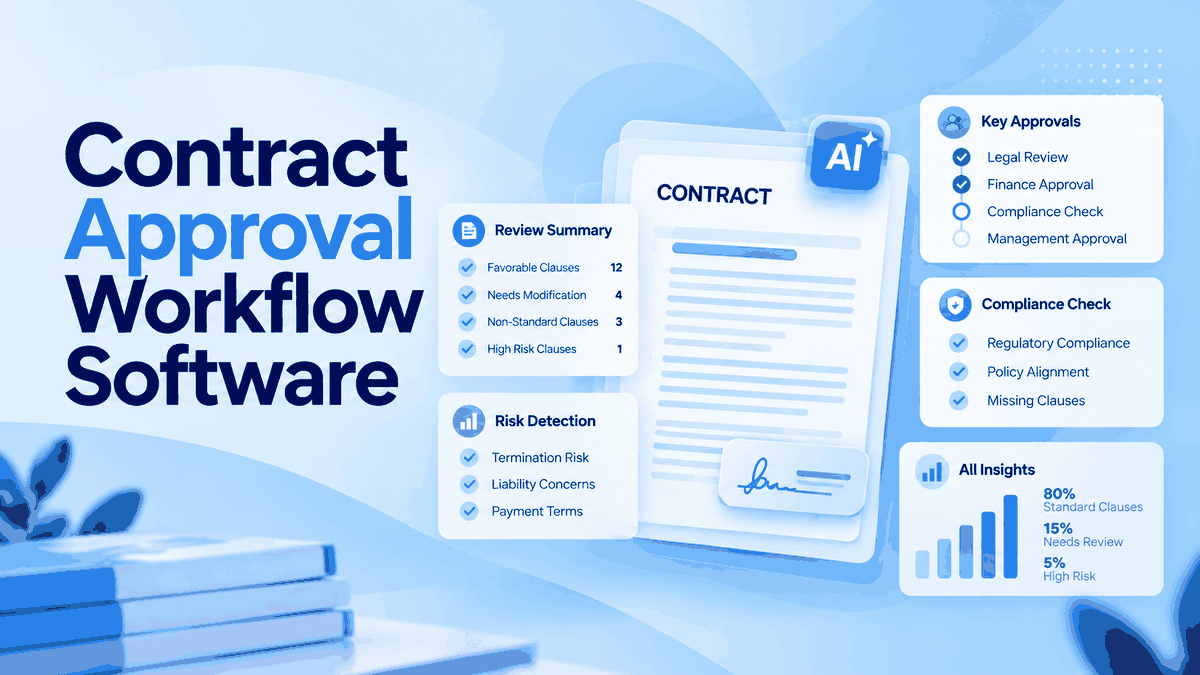
Contract Approval Workflow Software: How to Automate Approvals and Reduce Delays in 2026
Contract approvals often become time-consuming due to manual follow-ups, scattered communication, and multiple stakeholders. These delays can affect vendor onboarding, business agreements, and deal closures.
Contract approval workflow software simplifies the process by automating approval routing, tracking progress, and improving visibility across teams.
With AI-powered contract lifecycle management (CLM) software like SprintContractX, businesses can streamline contract drafting, reviews, approvals, and electronic signatures on one platform.
This guide explores how contract approval automation reduces delays, improves efficiency, and helps businesses manage agreements more effectively.
Key Takeaways
Contract approval workflow software automates the movement of agreements between stakeholders for review and approval.
Rule-based approval routing helps ensure contracts reach the appropriate decision-makers based on value, risk, department, or agreement type.
Centralised tracking, version control, and audit trails improve accountability and contract visibility.
AI-assisted contract review can help identify non-standard clauses that may require additional scrutiny.
SprintContractX combines intelligent approval workflows with AI drafting, integrated e-signatures, centralised contract storage, and lifecycle management.
Table of Contents
What Is Contract Approval Workflow Software?
Why Do Manual Contract Approval Processes Cause Delays?
How Does an Automated Contract Approval Workflow Work?
Seven Essential Features of Contract Approval Workflow Software
Contract Approval Workflow Examples for Different Business Teams
Manual vs Automated Contract Approval Workflows
How to Automate Your Contract Approval Process
How to Choose the Right Contract Approval Software
How SprintContractX Simplifies Contract Approval Workflows
How to Measure Contract Approval Performance
Frequently Asked Questions
Conclusion
What Is Contract Approval Workflow Software?
Contract approval workflow software is a digital solution that helps businesses manage, automate, and monitor contract reviews and approvals before signing.
It establishes a structured process for sending agreements to the appropriate stakeholders, collecting approvals, managing revisions, and recording decisions.
For example, when a procurement team creates a vendor agreement, the software can route it to legal for contract review, finance for budget validation, and an authorised manager for final approval.
Instead of manually coordinating each step, the approval process follows predefined organisational rules.
What does contract approval software do?
Contract approval software typically supports:
Automated contract routing to designated approvers
Multi-level approval workflows
Contract review and collaboration
Real-time approval status tracking
Version control and document management
Approval history and audit trails
Integration with electronic signatures
Centralised contract storage
More advanced solutions may also include AI-assisted clause analysis, configurable approval conditions, reporting dashboards, and contract lifecycle management capabilities.
What is an automated contract approval workflow?
An automated contract approval workflow is a predefined sequence of review and approval steps that moves a contract through an organisation with reduced manual coordination.
The workflow determines who must review the contract, when their approval is required, and what happens after each decision.
For example:
Example: Automated contract approval process
Contract Request
Draft & Review
Legal / Finance Approval
Authorised Sign-Off
Electronic Signature
Contract Repository
Illustrative workflow. Legal and finance review may run in parallel depending on organisational policies.
Automation helps keep the process consistent while allowing human reviewers to evaluate commercial, financial, and legal risks.
Why Do Manual Contract Approval Processes Cause Delays?
Manual contract approvals often involve multiple departments, disconnected communication channels, and unclear responsibilities.
As agreements move through different teams, delays can occur even when the actual contract review requires relatively little time.
1. Unclear approval responsibilities
When businesses do not have a defined approval matrix, employees may be unsure whether a contract requires legal, finance, procurement, or senior management approval.
This can result in contracts being forwarded between stakeholders unnecessarily.
A structured workflow establishes clear approval responsibilities based on predefined business rules.
2. Excessive email communication
In a manual contract approval process, stakeholders may exchange multiple emails to request reviews, share revised documents, or confirm approval.
These conversations can become difficult to track, especially when several agreements are being processed simultaneously.
Centralised approval software helps maintain communication and approval status within a controlled workflow.
3. Multiple contract versions
Contracts frequently undergo revisions during negotiations.
Without proper version control, teams may review outdated files or struggle to identify the final approved agreement.
This creates operational confusion and increases the risk of incorrect contract execution.
4. Lack of real-time visibility
Managers often lack a clear view of which contracts are pending, who is responsible for approval, and how long each agreement has remained in a particular stage.
Without this information, identifying approval bottlenecks becomes difficult.
5. Inconsistent approval policies
Different departments may follow different approval processes for similar agreements.
For example, one business unit may require finance approval for a particular contract value, while another follows an informal approval route.
Workflow software can help standardise approvals according to organisational requirements.
6. Delayed contract execution
When approvals take longer than expected, agreements may remain unsigned even after commercial terms have been finalised.
These delays can affect procurement timelines, supplier onboarding, partnerships, and sales operations.
The objective of contract approval automation is not to eliminate necessary checks. It is to reduce avoidable administrative delays while maintaining appropriate control.
How Does an Automated Contract Approval Workflow Work?
Automated contract approval workflows use predefined rules to determine how agreements move between departments and decision-makers.
A typical workflow includes six stages.
Step 1: Contract request and initiation
The process begins when an employee or department submits a contract request.
The request may include information such as:
Contract type
Counterparty name
Contract value
Business department
Agreement duration
Required approval date
Risk classification
These details help determine which workflow should apply.
Step 2: Contract drafting and preparation
The contract is prepared using an approved template or existing document.
AI-assisted contract drafting can help generate initial drafts using standardised clauses and agreement structures.
This reduces repetitive drafting work and encourages consistency across similar contracts.
Step 3: Contract review and risk identification
Legal, finance, procurement, or compliance teams review the agreement according to their responsibilities.
Depending on the software's capabilities, AI-powered analysis can help identify clauses that deviate from approved standards or may require additional consideration.
However, AI suggestions should support rather than replace qualified legal judgment.
Step 4: Automated approval routing
Once the document is ready, the software routes it to relevant stakeholders based on predefined rules.
For example, a standard low-risk agreement may follow a shorter approval process, while a high-value or non-standard contract may require additional reviews.
Conditional routing helps businesses avoid applying the same approval requirements to every agreement.
Step 5: Final approval and electronic signature
After receiving the necessary approvals, the agreement moves to execution.
Where integrated e-signatures are available, authorised parties can sign electronically without moving the document to an unrelated system.
Step 6: Contract storage and monitoring
The executed agreement is stored in a centralised repository.
Contract lifecycle management tools can also track obligations, important dates, renewal windows, and contract performance.
This creates continuity between contract approval and ongoing contract management.
Want to bring drafting, approvals, and signatures into one workflow?
Explore SprintContractX's AI-powered contract lifecycle management platform to understand how your organisation can simplify contract operations.
Seven Essential Features of Contract Approval Workflow Software
Not all contract approval solutions provide the same level of automation and control.
Businesses evaluating software should consider the following capabilities.
1. Rule-Based Approval Routing
Rule-based routing automatically determines the appropriate approval path using contract information.
Rules may consider contract value, department, agreement type, geography, or risk classification.
For example, contracts exceeding an internally defined financial threshold may require additional authorisation.
This helps reduce unnecessary manual decision-making while supporting consistent governance.
2. Multi-Level Approval Workflows
Some agreements require approvals from several stakeholders.
Multi-level workflows help organisations define whether approvals should occur sequentially or in parallel, depending on internal policy.
A procurement agreement might require legal review, budget validation, and final approval from an authorised business leader.
3. AI-Assisted Contract Review
AI-assisted review can help identify non-standard clauses, unusual contractual terms, or deviations from approved templates.
Potential review areas include liability, indemnity, confidentiality, payment terms, termination conditions, and renewal clauses.
By highlighting clauses that deserve closer attention, AI can help legal teams prioritise their reviews.
4. Centralised Document Management
A centralised contract repository provides one location for storing, searching, and managing agreements.
It helps businesses reduce document fragmentation and retrieve contracts using relevant information such as contract type, counterparty, dates, or ownership.
5. Version Control and Audit Trails
Contract version control helps stakeholders identify the current agreement and review changes made during negotiation.
Audit trails record approval-related activities and provide greater accountability.
These records are especially useful for organisations with formal governance and audit requirements.
6. Real-Time Approval Tracking and Reporting
Approval dashboards help teams monitor contract status and identify agreements that need attention.
Useful indicators include pending approvals, average approval time, contracts awaiting legal review, and workflow bottlenecks.
7. Integrated Electronic Signatures
Electronic signature capabilities help connect contract approval with execution.
After all required internal approvals are completed, authorised signatories can receive the final agreement for signing.
When evaluating a solution, businesses should also assess relevant legal requirements, signature methods, and document authentication controls.
Contract Approval Workflow Examples for Different Business Teams
The approval requirements for a sales agreement may differ significantly from those for a procurement contract or employee agreement.
The following examples show how businesses can design workflows around specific operational requirements.
Example 1: Vendor Contract Approval Workflow
A procurement team needs to execute a new agreement with a service provider.
A possible workflow is:
Contract Request - Procurement Review - Legal Review - Finance Approval - Authorised Signatory- Contract Execution
An automated system can route the agreement according to its value, risk classification, and applicable internal policy.
Business benefit: More consistent supplier onboarding, better approval visibility, and reduced manual coordination.
Example 2: Sales Contract Approval Workflow
A sales team has negotiated an agreement with an enterprise customer.
However, the customer requests payment terms that differ from the company's standard policy.
The workflow may be:
Sales Draft - Commercial Review - Finance Review - Legal Approval -Signature
If the agreement uses standard approved terms, it may qualify for a simpler approval path.
Business benefit: Fewer unnecessary handoffs and greater predictability in contract execution.
Example 3: NDA Approval Workflow
A business needs to execute an NDA before sharing confidential information with a potential partner.
If the NDA follows an approved template without material changes, the company may permit a streamlined approval process.
However, changes to confidentiality obligations, governing law, or liability provisions may trigger legal review.
Business benefit: Faster processing of routine agreements without removing important legal safeguards.
Example 4: Banking and Financial Services Contract Workflow
Banks, NBFCs, and other financial services organisations may manage agreements involving vendors, technology service providers, outsourcing relationships, and commercial partners.
Depending on internal policies and applicable regulatory requirements, such agreements may require legal, procurement, finance, information security, or compliance reviews.
A structured workflow can help organisations record decisions, control document access, and maintain approval histories.
Business benefit: Stronger process consistency and improved traceability across contract-related decisions.
Manual vs Automated Contract Approval Workflows
Automated workflows can improve consistency, but outcomes still depend on the quality of the underlying process, approval policies, and implementation.
How to Automate Your Contract Approval Process: A Step-by-Step Guide
Implementing contract approval automation requires more than purchasing software. Organisations should first understand their existing approval structure and identify opportunities for improvement.
Step 1: Audit your current approval process
Start by reviewing how contracts move between departments.
Identify where agreements are created, which stakeholders review them, how approvals are recorded, and where contracts are stored after execution.
Look for repeated bottlenecks, unnecessary approvals, and manual activities that consume employee time.
Step 2: Create a contract approval matrix
An approval matrix establishes which stakeholders must approve different types of contracts.
For example:
This is an illustrative matrix, not a universal approval policy. Each organisation should establish its own thresholds and controls.
Step 3: Standardise contract templates
Use approved templates and clause libraries for common agreement types.
Standardisation helps reduce avoidable variations and makes it easier to identify contracts requiring additional legal review.
Step 4: Configure automated approval rules
Define routing conditions based on contract characteristics.
For example, a company might create a rule stating that vendor agreements above a specified value require finance approval, while contracts containing non-standard liability provisions require legal escalation.
Approval rules should reflect the organisation's authorised delegation and governance policies.
Step 5: Integrate contract review and signing
Connect the approval process with contract preparation, negotiation, and execution.
An integrated workflow reduces the need to transfer documents manually between separate systems.
Step 6: Train stakeholders and launch a pilot
Begin with one high-volume agreement type, such as NDAs, supplier agreements, or standard sales contracts.
Train employees to submit requests, review agreements, manage exceptions, and interpret approval status.
A pilot helps identify workflow improvements before broader deployment.
Step 7: Monitor results and refine
Measure approval turnaround times, delayed approvals, rework, and compliance with internal approval policies.
Use these findings to update workflows and remove unnecessary steps while preserving essential controls.
How to Choose the Right Contract Approval Workflow Software
Selecting contract approval software involves evaluating functionality, ease of use, governance, integration requirements, and long-term scalability.
For businesses comparing solutions, the following questions can help guide the evaluation.
Does the software support configurable approval workflows?
Look for approval routing based on contract value, agreement type, risk, department, or other relevant criteria.
The software should adapt to organisational policies instead of forcing every agreement through an identical process.
Can it support the full contract lifecycle?
Some tools focus primarily on approvals.
Others provide contract lifecycle management capabilities, connecting drafting, review, approval, execution, repository management, and renewals.
An end-to-end platform may be more suitable for businesses looking to reduce disconnected contract operations.
Does it support AI-assisted contract review?
Evaluate whether AI can help identify non-standard clauses, highlight relevant information, and assist reviewers.
Also assess human review controls, output reliability, data handling, and the platform's ability to support existing legal policies.
Can different departments collaborate efficiently?
The solution should support the different responsibilities of legal, finance, sales, procurement, and compliance teams.
Clear ownership and access permissions are important when several departments contribute to one agreement.
What security and audit controls are available?
Businesses should evaluate document access controls, encryption, approval records, version history, and security requirements.
For regulated organisations, any compliance claims should be assessed against the company's specific legal and regulatory obligations.
What is the total cost of ownership?
Beyond subscription fees, consider configuration, implementation, integrations, training, support, and administrative effort.
A solution should be evaluated for operational value, not simply the number of features it offers.
How SprintContractX Simplifies Contract Approval Workflows
SprintContractX is an AI-powered contract lifecycle management platform designed to help businesses manage contracts from request and drafting through approvals, signatures, obligations, and renewals.
Instead of managing different stages across disconnected tools, SprintContractX brings core contract management activities into one platform.
1. Intelligent Approval Workflows
SprintContractX supports automated multi-level approval routing based on contract value, risk tier, geography, and contract type.
Policy-driven workflows help agreements reach the appropriate decision-makers without requiring employees to coordinate each approval manually.
Real-time status tracking helps stakeholders understand where agreements stand within the approval process.
2. AI-Powered Contract Drafting and Review
SprintContractX uses AI-assisted drafting and approved clause libraries to help teams prepare contract drafts.
Its AI-based clause analysis can help highlight non-standard contractual language that may require additional review.
This allows teams to focus more attention on agreements with unusual terms or higher risks.
3. Centralised Contract Collaboration
SprintContractX supports contract editing, comments, redlining, and version history.
These capabilities help stakeholders collaborate during review and negotiation while maintaining a clearer record of changes.
4. Integrated Electronic Signatures
Once contracts receive the required approvals, SprintContractX supports electronic signatures within the platform.
This connects approval and execution and reduces the need for separate document handoffs.
5. Centralised Contract Repository
SprintContractX provides a searchable repository to store and retrieve agreements.
Teams can find contracts using available metadata, relevant terms, contractual parties, dates, and assigned owners.
Role-based access controls help manage document permissions.
6. Audit Trails and Contract Visibility
The platform supports audit trails and reporting capabilities to help teams track contract-related activities.
Approval history, contract versions, and reporting dashboards provide better visibility for authorised stakeholders.
7. Obligation and Renewal Management
Contract management does not end when an agreement is signed.
SprintContractX also supports obligation tracking and renewal alerts, helping businesses monitor contractual responsibilities and important dates.
These capabilities extend contract management beyond approvals and execution.
Simplify Contract Approvals with SprintContractX
Reduce manual coordination across legal, procurement, finance, and sales. Bring contract drafting, intelligent approvals, electronic signatures, and lifecycle management into one connected workflow.
Explore SprintContractX and Book a Demo
How to Measure Contract Approval Workflow Performance
Businesses implementing contract approval workflow software should establish measurable performance indicators.
These metrics help determine whether automation is improving operational efficiency.
Average contract approval time
Measures the time from submission for approval until all required internal approvals have been completed.
Averageapprovaltime=TotalapprovaltimeContractsapproved
Tracking this metric before and after implementation helps organisations understand changes in approval speed.
Approval SLA compliance
Measures the percentage of approval requests completed within the organisation's defined time limits.
For example, if the internal target is two business days for legal review, this metric identifies how frequently the target is achieved.
Approval bottleneck frequency
Tracks how often contracts remain pending beyond expected time limits at a particular stage.
This can help identify understaffed review teams, unclear ownership, or unnecessarily complex routing.
Contract rework rate
Measures how frequently contracts are returned for revision after entering the approval process.
A high rework rate may indicate missing information, inconsistent templates, or inadequate preliminary checks.
Overall contract cycle time
Tracks the total time between initiating a contract and completing execution.
Unlike approval time alone, this includes drafting, negotiation, internal approvals, and signing.
Monitoring both approval time and total cycle time provides a more complete view of contract management performance.
Conclusion: Simplify Contract Approvals with Automation
Manual contract approvals can lead to delays, miscommunication, and limited visibility. Contract approval workflow software helps businesses streamline approvals, automate routing, track progress, and maintain better control over agreements.
SprintContractX by PaySprint simplifies contract management with AI-powered drafting, intelligent approval workflows, electronic signatures, centralised storage, and renewal tracking—all on one platform.
Reduce approval delays, improve efficiency, and manage contracts smarter with SprintContractX.
Book a SprintContractX Demo Today ?
Frequently Asked Questions About Contract Approval Workflow Software
What is the best contract approval workflow software?
The best contract approval workflow software depends on an organisation's contract volume, approval complexity, integration needs, security requirements, and budget.
Businesses should prioritise configurable approval routing, centralised contract management, audit trails, version control, and appropriate reporting capabilities.
For organisations seeking end-to-end AI-powered contract lifecycle management, SprintContractX is one option to evaluate.
How can businesses automate contract approvals?
Businesses can automate contract approvals by defining approval policies, creating an approval matrix, using standardised contract templates, and implementing software that routes agreements according to predefined rules.
Automation can also provide approval tracking, version history, and integrated contract execution.
What is the difference between contract approval software and contract management software?
Contract approval software focuses on managing the review and authorisation stages of an agreement.
Contract management software typically covers a broader lifecycle, including drafting, negotiation, approvals, signing, storage, obligations, and renewals.
Contract lifecycle management platforms such as SprintContractX combine approval automation with wider contract management capabilities.
Can AI automate contract approval workflows?
Yes. AI can assist contract approval workflows by analysing clauses, identifying deviations from approved language, extracting relevant information, and supporting risk-based review.
Rule-based automation then routes agreements according to organisational policies.
Final decisions involving legal, financial, or commercial risk should remain subject to appropriate human oversight.
How does automated contract approval reduce delays?
Automated approval workflows reduce administrative delays by routing contracts to designated stakeholders, providing approval status visibility, and minimising repetitive follow-ups.
They can also help reduce version confusion and identify stalled approval stages.
Actual time savings depend on the company's processes, contract complexity, and implementation.
What is a multi-level contract approval workflow?
A multi-level contract approval workflow requires an agreement to receive authorisation from more than one stakeholder or approval level.
For example, a high-value vendor agreement may require procurement, legal, finance, and management approval before execution.
The workflow can be configured to reflect the company's delegation of authority.
Is contract approval workflow software suitable for small businesses?
Yes. Small businesses that regularly manage vendor agreements, NDAs, client contracts, or employment agreements can benefit from standardised approval processes.
The software should match the company's contract volume and operational requirements without introducing unnecessary complexity.
Can contract approval software help with compliance?
Contract approval software can support compliance processes by enforcing configured approval rules, maintaining access controls, recording decisions, and retaining audit histories.
However, using software does not automatically establish legal or regulatory compliance. Organisations must configure processes according to applicable requirements.
Does SprintContractX support automated contract approvals?
Yes. SprintContractX supports intelligent, multi-level approval workflows based on predefined criteria such as contract value, risk tier, geography, and agreement type.
It also provides AI-assisted drafting, contract collaboration, integrated electronic signatures, a centralised repository, and reporting capabilities.
How can I get started with SprintContractX?
Businesses can explore SprintContractX through PaySprint's official product page and request a demonstration.
A demo can help stakeholders evaluate the platform's approval workflows, contract management capabilities, and fit for their existing processes.
Related Posts
What is E-Banking? Meaning, Types, Benefits & How It Works in India.
E-banking is the digital way of accessing banking services through mobile apps, websites, ATMs, and biometric systems. It enables secure, fast, and branchless financial transactions anytime and anywhere in India.
Read More
When Maps Change, Money Follows: How Geopolitics Is Rewiring B2B Payments in 2026
Payments are no longer just a plumbing problem — they're a geopolitical one. Explore how Indian B2B businesses can navigate a fragmented, fast-changing global payment landscape
Read More
What Happens Inside an Escrow Release Event? A Step-by-Step Breakdown for Businesses
A complete breakdown of escrow release events—covering triggers, validation, vendor response, and access to source code—helping businesses ensure continuity and minimize vendor risk.
Read MoreReady to Protect Your Core Systems?
Join enterprises that trust SprintEX-Code to safeguard their mission-critical software. Get started with a consultation to discuss your specific escrow requirements.