
AI Contract Review Software: Features, Benefits & How It Works
Oct 13, 2026
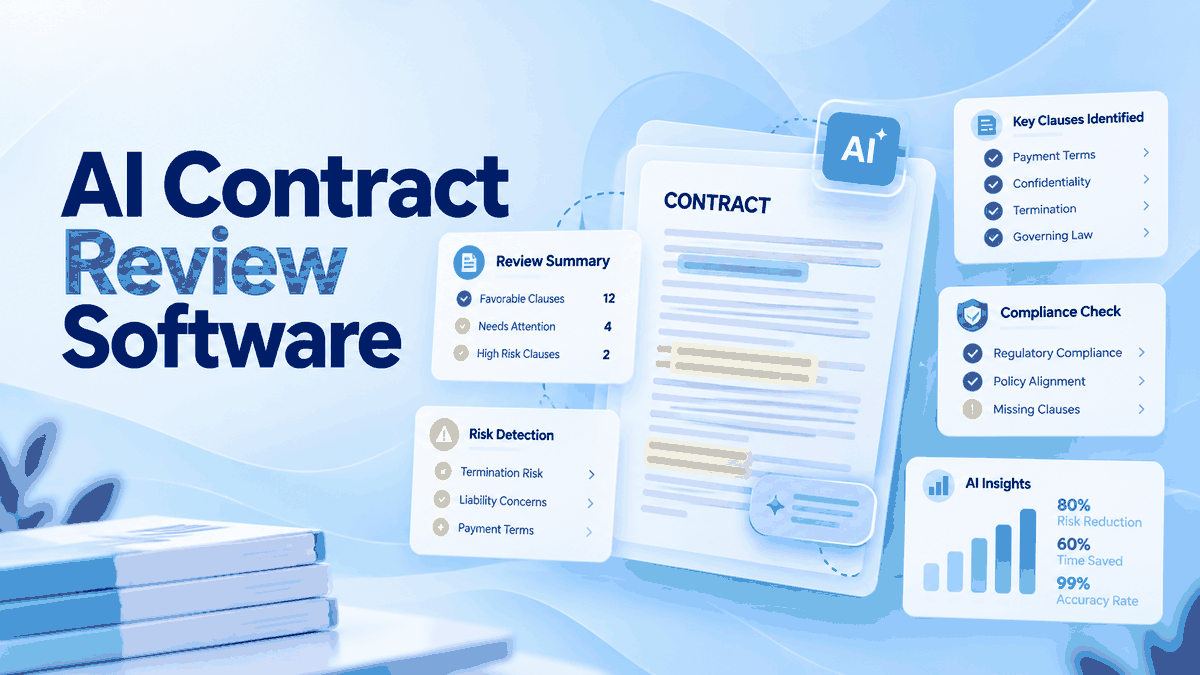
AI Contract Review Software: Features, Benefits & How It Works
AI contract review software uses artificial intelligence to analyse contracts, identify key clauses, flag potential risks, extract key information, and speed up contract reviews. It helps legal and business teams reduce repetitive work, understand contractual obligations, and review agreements more efficiently.
Instead of manually reading every page to locate payment terms, renewal conditions, liability clauses, or missing information, teams can use AI-assisted analysis to surface the areas that require attention.
However, AI does not replace legal expertise. It supports the review process by helping professionals identify relevant information and make better-informed decisions.
In this guide, we'll explain how AI contract review software works, its most useful features, key benefits, practical business applications, and what to consider before choosing a solution.
Table of Contents
What Is AI Contract Review Software?
How Does AI Contract Review Software Work?
Key Features of AI Contract Review Software
Benefits of Using AI for Contract Review
Example: How AI Reviews a Vendor Agreement
AI Contract Review vs Manual Contract Review
Which Businesses Need AI Contract Review Software?
What Types of Contracts Can AI Review?
Can AI Contract Review Software Identify Legal Risks?
Limitations of AI Contract Review
How to Choose the Right AI Contract Review Software
AI Contract Review vs Contract Lifecycle Management
How SprintContractX Supports AI-Powered Contract Review
Frequently Asked Questions
Conclusion
What Is AI Contract Review Software?
AI contract review software uses technologies such as natural language processing (NLP), machine learning, and large language models to analyse contractual language and extract useful information.
Traditional contract review often requires professionals to read agreements line by line, compare clauses against approved terms, identify unusual conditions, and communicate requested changes.
These activities remain important, but many involve repetitive checks that AI can help streamline.
For example, AI-assisted contract review can help identify:
Unusual liability or indemnity clauses
Missing or unclear termination conditions
Automatic renewal provisions
Payment terms and penalties
Confidentiality requirements
Contractual obligations and deadlines
Differences from approved contract language
The objective is not to approve agreements automatically. It is to make relevant contractual information easier to find, assess, and act on.
In simple terms, AI contract review software helps teams understand what a contract says, which terms need attention, and what should be reviewed before signing.
How Does AI Contract Review Software Work?
AI contract review generally follows a structured process, although the exact steps vary across platforms.
Step 1: Upload or Import the Contract
The user uploads a contract or imports it from an existing document system.
Depending on the software, supported formats may include PDF and Word documents. Some tools also use optical character recognition (OCR) to read scanned contracts.
Document quality matters. Poor scans, unclear formatting, or missing pages can affect the accuracy of extracted information.
Step 2: Analyse Contract Language
The AI processes the document and identifies sections such as payment terms, confidentiality provisions, liability clauses, renewal conditions, and termination rights.
It may also extract structured information such as parties, effective dates, expiry dates, and contract values.
Step 3: Identify Potential Risks and Unusual Clauses
The software can highlight provisions requiring additional review.
For example, a vendor contract might contain unlimited liability, automatic renewal, or a termination notice period that does not align with company policy.
Advanced systems may compare the contract against an organisation's approved clauses or legal playbook.
Step 4: Generate Review Insights
The platform presents findings in a form that is easier to understand.
Depending on its capabilities, it may provide clause summaries, extracted obligations, risk flags, or suggested changes.
These outputs help reviewers prioritise the parts of the contract that deserve closer attention.
Step 5: Review Findings and Make Decisions
Legal or authorised business professionals verify the AI-generated findings and decide whether to accept a clause, request changes, escalate an issue, or approve the agreement.
This human review is essential because AI may misinterpret contract language or overlook important context.
Step 6: Continue the Contract Workflow
Once the review is completed, the agreement can move towards negotiation, approval, signing, and ongoing management.
A contract lifecycle management platform can connect these activities so the review outcome remains linked to the final agreement.
Key Features of AI Contract Review Software
When evaluating AI contract review software, businesses should look beyond basic document summarisation.
The most useful capabilities help users identify, understand, and manage contractual information throughout the review process.
1. AI-Powered Clause Analysis
AI clause analysis helps identify important provisions within an agreement.
For example, the software can highlight clauses relating to:
Indemnification
Limitation of liability
Confidentiality
Termination
Dispute resolution
Payment obligations
Data protection
Renewal conditions
This makes it easier to locate critical terms without manually searching through the entire document.
2. Contract Risk Identification
Contract risk analysis helps flag potentially unfavourable or unusual terms.
For example, a business may want to review a clause that imposes excessive penalties for delayed performance.
A risk flag should be treated as a review prompt rather than a final legal conclusion.
3. Automated Contract Summaries
Long agreements can be difficult to understand quickly.
AI-generated summaries help stakeholders identify the contract's purpose, major responsibilities, key dates, and important commercial conditions.
This can be useful when management or business teams need an overview before making a decision.
4. Key Information Extraction
AI can extract structured information from agreements, including:
Contract parties
Start and expiry dates
Contract value
Payment schedules
Notice periods
Renewal conditions
Important obligations
Extracted information can help teams organise contract records and manage future responsibilities.
5. Approved Clause and Playbook Comparison
Some AI contract review tools allow organisations to compare contracts against internal legal standards.
For example, a company may have an approved liability clause for vendor agreements. If a new agreement contains different wording, the software may highlight the deviation.
This supports more consistent reviews across teams, provided the underlying playbook is accurate and maintained.
6. Contract Review and Collaboration
Contract reviews often involve legal, procurement, finance, and business stakeholders.
Software that combines document review with comments, version history, and approval workflows can help reduce confusion over which contract version is being reviewed.
7. Contract Search and Visibility
Searchable contract records help users locate agreements, clauses, or important details without manually navigating multiple folders.
This is especially valuable when businesses manage a large portfolio of active agreements.
What Are the Benefits of AI Contract Review Software?
Faster Initial Contract Reviews
AI can automate repetitive document analysis and help reviewers locate important terms more quickly.
This allows professionals to spend more time on negotiation, exceptions, and business-critical decisions.
Reduced Manual Work
Instead of repeatedly searching for the same types of clauses, teams can use AI-assisted extraction and analysis to streamline routine review activities.
More Consistent Reviews
When connected to documented company policies and approved language, AI review tools can support a more consistent approach across similar agreements.
Better Visibility Into Contract Risks
Risk flags and clause summaries help teams identify provisions that may need further investigation before an agreement is approved.
Improved Collaboration
AI-generated summaries can help legal and non-legal stakeholders discuss agreements using a shared understanding of important terms.
Easier Contract Information Management
Extracted dates, obligations, and commercial details can support contract reporting, renewal tracking, and ongoing management.
More Time for Higher-Value Work
By reducing repetitive first-pass review tasks, legal professionals can focus on complex negotiations, regulatory considerations, and strategic decisions.
Example: How AI Reviews a Vendor Agreement
Consider a growing business entering into a two-year agreement with a technology vendor.
The contract includes service-level commitments, payment obligations, confidentiality provisions, termination rights, and renewal conditions.
During a manual review, the legal team must locate and assess these provisions before the agreement can proceed.
An AI-assisted review could help organise the following findings:
Illustrative example: these are hypothetical review findings, not results from a tested SprintContractX contract.
Instead of relying on a general statement that the agreement looks acceptable, the team now has a structured set of issues to investigate.
The actual decisions still depend on the contract, company policies, applicable law, and commercial context.
AI Contract Review vs Manual Contract Review
The most effective approach combines AI-assisted analysis with human legal judgment.
AI helps professionals find relevant information faster, while people remain responsible for interpreting contractual meaning and making decisions.
Which Businesses Need AI Contract Review Software?
AI contract review can be useful in any organisation managing frequent or complex agreements.
Banking and Financial Services
Banks, NBFCs, and financial service providers manage agreements involving technology vendors, service providers, outsourcing relationships, and business partnerships.
AI-assisted contract analysis can help teams locate service commitments, confidentiality requirements, payment conditions, and other contractual responsibilities.
Procurement and Vendor Management
Procurement teams often review supplier agreements, purchase contracts, and service-level agreements.
AI-assisted review can help identify renewal conditions, pricing provisions, liability terms, and supplier obligations.
Legal and Compliance Teams
In-house legal professionals can use AI to support routine document reviews, identify deviations, and prioritise contracts requiring detailed assessment.
Sales and Business Development
Sales teams manage NDAs, customer agreements, service contracts, and commercial terms.
A structured AI-assisted review process can help identify issues requiring legal approval before agreements move forward.
Insurance and Enterprise Operations
Insurance companies and large enterprises often coordinate contracts across departments and external partners.
Centralised contract review and management can improve visibility into responsibilities, approvals, and important dates.
What Types of Contracts Can AI Review?
Depending on the software and its configuration, AI contract review tools may support:
Non-disclosure agreements (NDAs)
Vendor and supplier agreements
Master service agreements (MSAs)
Statements of work (SOWs)
Service-level agreements (SLAs)
Employment agreements
Partnership agreements
Consulting agreements
Commercial lease agreements
Data processing agreements (DPAs)
The suitability of AI review depends on the contract's complexity, document quality, supported jurisdictions, and the review rules available in the platform.
Can AI Contract Review Software Identify Legal Risks?
Yes, AI contract review software can help identify potential contractual risks by analysing clauses, highlighting unusual wording, and comparing terms against defined standards.
However, identifying a potentially risky clause is different from determining its legal consequences.
For example, an AI tool may flag unlimited liability in a service agreement. Whether that provision is commercially acceptable depends on the transaction value, negotiation position, regulatory requirements, and wider contract terms.
Common areas for AI-assisted risk review include:
Unlimited or disproportionate liability
Unfavourable termination rights
Missing confidentiality protections
Unexpected automatic renewals
Ambiguous payment obligations
Inconsistent service commitments
Missing contractual protections
AI-generated risk assessments should be validated by appropriately qualified reviewers, especially for high-value or regulated transactions.
What Are the Limitations of AI Contract Review?
AI is useful, but businesses should understand its limitations before relying on automated analysis.
Incorrect interpretation: AI may misunderstand complex language, defined terms, or cross-references.
Missing context: It may not know the organisation's commercial priorities, negotiation history, or risk tolerance.
Incomplete identification: Some provisions may be overlooked, especially in unusually structured or poor-quality documents.
Unsupported legal conclusions: AI-generated explanations may sound convincing even when legally incorrect.
Confidentiality concerns: Uploading contracts into software requires appropriate data protection, access controls, and vendor due diligence.
Jurisdictional differences: Contract interpretation depends on applicable law, which may vary by agreement and location.
For these reasons, organisations should use AI as a review assistant rather than an autonomous legal decision-maker.
How to Choose the Right AI Contract Review Software
Before selecting software, businesses should evaluate whether it can solve their actual contract review problems.
1. Evaluate the Quality of Clause Analysis
Can the tool identify the clauses that matter for your agreements?
Test it against representative documents rather than relying only on a prepared demonstration.
2. Look for Relevant Risk Detection
Check whether the software can identify deviations from your policies and explain why particular clauses require attention.
3. Assess Ease of Use
Legal and business teams should be able to locate findings, review contracts, and understand the next steps without unnecessary complexity.
4. Consider Workflow Integration
Determine whether the solution supports or integrates with drafting, approvals, digital signing, contract storage, and renewal management.
5. Review Security and Access Controls
Ask about encryption, access permissions, retention policies, audit trails, data processing, and whether customer documents are used to train AI models.
6. Check Human Review Controls
Users should have a clear way to verify extracted information, accept or reject suggestions, and retain responsibility for final decisions.
7. Assess Reporting and Contract Visibility
Consider whether the platform provides useful information about contract status, review delays, approval bottlenecks, and upcoming deadlines.
8. Test the Software With Realistic Contracts
A useful evaluation involves contracts representing your organisation's actual workflows.
Compare the AI findings with a verified legal review to identify both correctly detected issues and missed or inaccurate findings.
AI Contract Review vs Contract Lifecycle Management Software
AI contract review software and contract lifecycle management (CLM) software are related, but they serve different purposes.
AI contract review software focuses on understanding and analysing agreements, extracting information, and highlighting issues during contract review.
Contract lifecycle management software supports the complete contract journey, including creation, review, negotiation, approvals, signing, storage, obligation monitoring, and renewals.
Some CLM platforms combine these capabilities in one system.
For businesses that only need document analysis, a specialised review tool may be sufficient.
For organisations managing contracts across multiple departments, an integrated CLM platform may offer greater value by connecting contract review to the rest of the workflow.
How SprintContractX Supports AI-Powered Contract Review
Managing contracts becomes more challenging when drafting, review, approvals, signatures, and renewal tracking happen across separate tools.
SprintContractX is PaySprint's AI-powered contract lifecycle management platform designed to help businesses manage agreements from creation to renewal.
It brings together contract review capabilities and broader lifecycle management functions.
AI-Assisted Clause Analysis
SprintContractX offers AI-driven analysis to highlight non-standard contract language and help teams identify clauses requiring additional attention.
AI Contract Drafting
Teams can use AI-assisted drafting and approved templates to support more consistent agreement preparation.
Intelligent Approval Workflows
Configurable approval workflows help route agreements to relevant stakeholders based on contract requirements and organisational policies.
Centralised Contract Repository
Contracts can be organised in one searchable location, making it easier to retrieve agreements, track versions, and access relevant information.
Obligation and Renewal Tracking
SprintContractX helps teams manage upcoming milestones, contractual obligations, expiry dates, and renewal-related reminders.
Integrated Digital Signing
Once contracts have completed the relevant review and approval process, the platform supports electronic signing and audit trails.
Contract Analytics and Reporting
Dashboards and reporting tools provide visibility into contract progress, approvals, and operational activity.
By bringing these capabilities together, SprintContractX helps organisations reduce fragmented contract processes and maintain greater control over agreements throughout their lifecycle.
Looking for a smarter way to review and manage business contracts?
Explore SprintContractX to understand how AI-assisted review, approval automation, contract tracking, and digital signing can work together in one platform.
Conclusion
AI contract review software is changing how businesses analyse agreements by making important clauses, contractual obligations, and potential risks easier to identify.
For legal, procurement, sales, and enterprise teams, AI-assisted review can reduce repetitive effort, support more consistent processes, and improve visibility into contractual information.
However, the greatest value comes when AI-generated insights are combined with clear organisational policies and professional human review.
Businesses should choose solutions based on their real contract workflows, required security controls, and the quality of review outcomes rather than AI features alone.
For organisations looking to connect AI-assisted contract analysis with drafting, approvals, digital signing, obligation tracking, and renewal management, SprintContractX provides an integrated approach to managing agreements throughout their lifecycle.
Explore SprintContractX and Book a Demo
Frequently Asked Questions About AI Contract Review Software
1. What is AI contract review software?
AI contract review software uses artificial intelligence to analyse agreements, extract important information, identify contractual clauses, and flag potential risks for human review.
2. How does AI contract review software work?
AI contract review software processes a contract, identifies relevant provisions, extracts key details, and produces findings that legal or business professionals can verify before approving the agreement.
3. Can AI review contracts accurately?
AI can help analyse contracts and identify relevant clauses, but accuracy depends on the software, document quality, configuration, and contract complexity. Important findings should always be verified.
4. Can AI replace lawyers for contract review?
No. AI can support repetitive analysis and information extraction, but professional legal judgment remains essential for contract interpretation, negotiations, regulatory issues, and final decisions.
5. What are the main benefits of automated contract review?
Potential benefits include faster initial reviews, less manual searching, easier information extraction, more consistent workflows, and better visibility into contractual risks and obligations.
6. Can AI identify risky clauses in contracts?
Yes. AI can help flag potentially risky or unusual clauses, including liability, termination, confidentiality, payment, and renewal provisions. Human reviewers must assess the legal and commercial significance.
7. Is AI contract review software suitable for small businesses?
Yes. Small businesses handling recurring agreements, supplier contracts, or customer documentation may benefit from AI-assisted reviews, depending on their budget, contract volume, and legal needs.
8. What is the difference between AI contract review and AI contract drafting?
AI contract drafting helps create or revise agreement language. AI contract review analyses an existing document to identify important terms, deviations, and potential issues.
9. Is AI contract review software secure?
Security varies by provider. Businesses should assess access controls, encryption, audit logging, data retention, processing locations, and AI training policies before uploading confidential contracts.
10. What is the best AI contract review software for a business?
The best option depends on the business's agreement types, contract volume, required review depth, security needs, available integrations, and whether it needs standalone review or complete lifecycle management.
11. Can AI contract review software help procurement teams?
Yes. Procurement teams can use AI-assisted review to help identify supplier obligations, payment conditions, service commitments, termination rights, and renewal provisions.
12. Does SprintContractX support AI-powered contract review?
SprintContractX includes AI-assisted clause analysis and risk identification within its wider contract lifecycle management platform. It also provides contract drafting, approval workflows, eSignature capabilities, centralised storage, and renewal tracking.
Related Posts
What is E-Banking? Meaning, Types, Benefits & How It Works in India.
E-banking is the digital way of accessing banking services through mobile apps, websites, ATMs, and biometric systems. It enables secure, fast, and branchless financial transactions anytime and anywhere in India.
Read More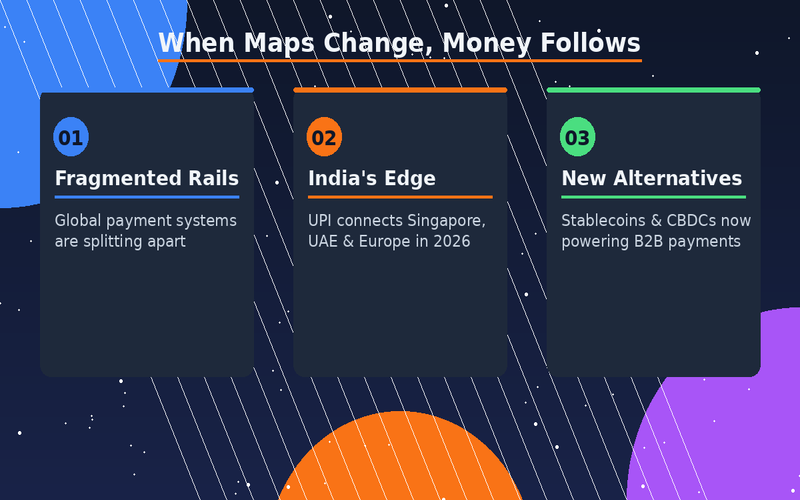
When Maps Change, Money Follows: How Geopolitics Is Rewiring B2B Payments in 2026
Payments are no longer just a plumbing problem — they're a geopolitical one. Explore how Indian B2B businesses can navigate a fragmented, fast-changing global payment landscape
Read More
What Happens Inside an Escrow Release Event? A Step-by-Step Breakdown for Businesses
A complete breakdown of escrow release events—covering triggers, validation, vendor response, and access to source code—helping businesses ensure continuity and minimize vendor risk.
Read MoreReady to Protect Your Core Systems?
Join enterprises that trust SprintEX-Code to safeguard their mission-critical software. Get started with a consultation to discuss your specific escrow requirements.