
Why Contracts Get Delayed After Legal Approval—and How to Resolve Them
Nov 25, 2026
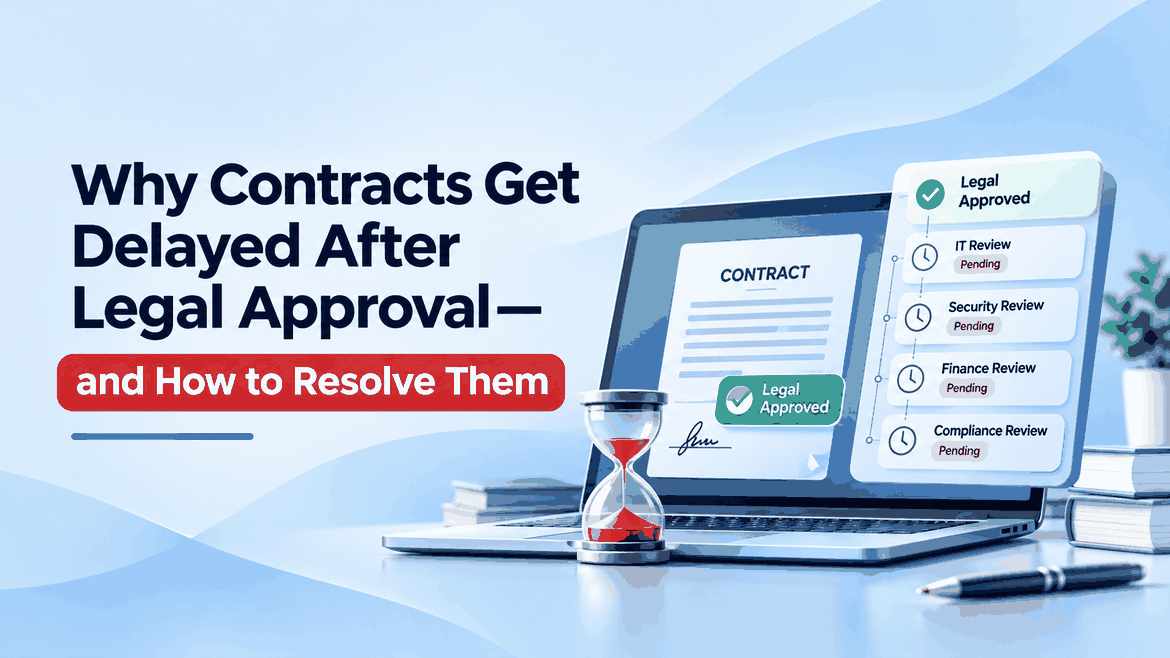
Why Contracts Get Delayed After Legal Approval—and How to Resolve Them
Contracts can remain pending after legal approval because other required decisions are unfinished. IT may need to confirm technical requirements, Security may need answers about data handling, and Finance may still need to approve commercial commitments. Missing documents, changed versions, and unresolved signing authority can also hold up execution. The practical fix is to identify the outstanding decision, assign its owner, and provide the information needed to complete it.
For legal teams and CDIOs, the challenge is keeping a contract moving across departments without losing control of its terms. A clear contract approval workflow helps every reviewer understand what has been approved, what remains open, and who must act next.
Key takeaways
Legal clearance, internal approval, and readiness to sign are distinct stages.
Assign one person to coordinate progress and name the owner of every outstanding decision.
Involve IT, Security, Finance and Compliance according to the agreement's requirements.
Run independent reviews together where policy permits; keep necessary dependencies in sequence.
Record approvals against the correct version and reassess relevant changes before signing.
Prepare signing details and the handover of obligations while reviews are underway.
What does legal approval mean in a contract workflow
Legal approval means the legal team has cleared a specific contract version within its assigned remit, subject to any conditions recorded with that approval. A completed review does not necessarily mean approval: Legal may have identified an unresolved issue that prevents clearance. The organisation's approval policy should clearly define these outcomes.
A useful workflow distinguishes four states:
Approval and signing authority should also be clear. W3C's published contract policy, for example, addresses legal review separately from its signing-authority and delegation rules. It illustrates why an approved document still needs an appropriately authorised signatory.
When a dashboard uses one broad label such as "Approved", teams can misunderstand which of these stages has actually finished. More precise statuses make the remaining work visible.
Eight reasons contracts get delayed after legal approval
No one owns the next action
Legal completes its review and sends an email to several stakeholders. Everyone can see the agreement, but no one is responsible for coordinating the next decision. The contract waits while the business assumes another team is handling it.
Assign a coordinating owner who tracks the agreement through the remaining reviews. For each open item, record the requested decision, responsible reviewer, information needed and agreed response date. The coordinating owner moves the process forward; the authorised reviewer makes the decision.
Clear ownership is a recognised governance practice. The UK Government's contract management principles call for defined responsibilities, documented management arrangements and governance proportionate to contract size and risk. These provide a useful management reference when designing an internal workflow.
IT and Security receive incomplete information
A technology contract may reach IT with no implementation scope or reach Security without enough detail about data access. Reviewers then have to reconstruct the proposal through emails, questionnaires and calls, even though Legal has already completed its assigned review.
Agree the review package with these teams early. Depending on the agreement, it may include the service scope, relevant technical schedules, integration responsibilities, data flows and the vendor's responses to security questions.
Track missing information as a specific action. "Waiting for vendor response on administrator access" is more useful than "Pending with Security" because it identifies the dependency and the next step.
Finance has not approved the commercial commitments
Legal may accept the wording while Finance still needs to evaluate the payment schedule, pricing changes, renewal terms or budget allocation. A contract can therefore be legally reviewed and commercially unresolved at the same time.
Provide Finance with a short commercial summary linked to the current agreement. Include the proposed cost, payment milestones, renewal arrangements, relevant termination commitments, and the budget owner. Identify any terms that differ from what was previously agreed.
Route the decision according to the organisation's approval matrix. Some agreements may require the CFO; others may fall within delegated finance or business authority. The workflow should reflect the applicable policy.
Independent reviews wait unnecessarily for one another
A fixed sequence can create avoidable waiting when one team's review does not depend on another team's conclusion. Finance may already have enough information to assess pricing while IT evaluates implementation requirements.
Map the dependencies before deciding the review order. Allow independent reviews to proceed together where policy permits. Retain sequential checks when an earlier decision could change the next reviewer's inputs.
For example, Finance may need revised pricing before giving final approval if a security requirement adds implementation costs. Parallel review can begin earlier, but the resulting changes still need to reach affected reviewers.
The agreement changes after approval
The version cleared by Legal may differ from the copy later sent for signature. Changes to scope, payment terms, liability, data handling or renewal provisions can leave teams unsure whether earlier approvals still apply.
Record the version associated with each decision. When the draft changes, provide a short change summary and identify which stakeholders need to reassess it under the approval policy.
For example, a revised payment milestone may need Finance's attention, while a change to a negotiated legal term may need Legal's review. Avoid assuming that every edit requires every team to restart. Confirm that the final execution copy reflects the approvals and conditions that remain applicable.
Compliance requirements are checked too late
An agreement can reach the final stage before someone identifies a missing review record, unresolved condition or required supporting document. The resulting delay may involve collecting evidence that could have been prepared earlier.
Identify applicable requirements during intake and assign an owner to each item. Keep the review outcome, supporting evidence and outstanding conditions with the contract record.
Involve Compliance at the stages relevant to its remit. A final completeness check can help, but it should draw on work recorded throughout the process. Completing an approval sequence does not, by itself, establish compliance with every applicable requirement.
Exceptions and absences have no escalation route
A reviewer may be unavailable, a vendor may reject a requested term, or two departments may disagree about an exception. If the process only records "Pending", the agreement can remain in that state indefinitely.
Give each exception a clear description, decision owner and escalation route. Record whether the next action belongs to an internal team or the counterparty. Use authorised deputies where the organisation's policy permits them.
An escalation should obtain a decision from the appropriate person. Keep any conditions attached to that decision visible to the teams preparing the final agreement.
Signature preparation starts at the end
Reviews may be complete while signatory details, authority, attachments or counterparty readiness remain unresolved. Sending a signature request then can trigger another round of follow-ups.
Prepare execution details while reviews are underway. Confirm the relevant legal entities, proposed signatories, required attachments, and intended signing method. Before sending, verify the approved version and any conditions that must be satisfied first.
Electronic signatures can support the execution stage, but sending an agreement electronically does not resolve an outstanding commercial decision or missing authority.
How should Legal, IT, Security, Finance, and Compliance work together
For an agreement requiring all five functions, an illustrative route is:
Legal review ? IT evaluation ? Security review ? Finance approval ? Compliance validation ? Authorised signature
Use this as a planning example. The actual participants and order should depend on the contract's scope, risk, value, and company policy. Compliance may need to participate earlier, and some reviews may proceed together.
One coordinating owner should be able to explain the current position without reopening every email thread. That person needs a clear answer to three questions: what decision is outstanding, who can make it and what information is missing?
For the broader process, read our guide to contract approval workflow software.
What should a handoff after legal approval include
A useful handoff gives the next reviewer enough context to act. Keep the following information with the agreement:
Contract identity: counterparty, contract type, business owner, and service or transaction scope.
Current version: the reviewed agreement, its schedules, and a summary of subsequent changes.
Legal decision: clearance, conditions, exceptions, and any unresolved questions.
Remaining decisions: required reviewers, the decision requested from each, and the next-action owner.
Commercial context: cost, payment terms, renewal arrangements and budget owner.
Supporting inputs: technical information, security responses and compliance evidence relevant to the agreement.
Timing and execution: business deadline, agreed review targets, escalation route and proposed signatories.
Keep this information in a shared contract record with appropriate access permissions. As decisions change, update the record so reviewers can work from the same current information.
Example of resolving a contract stuck after legal review
Consider a business purchasing a cloud-based service. Legal has cleared the agreement subject to its recorded conditions, but the status remains pending.
This is an illustrative example, not a customer case study.
Security needs the vendor to explain administrator access. Finance is waiting for a schedule that describes renewal pricing. The business owner expects a launch date but has not assigned either follow-up.
The coordinating owner can move the agreement forward in five steps:
1. Separate the outstanding decisions. Record the administrator-access question and missing renewal schedule as individual actions.
2. Assign responsibility. Name the person collecting the vendor's responses and the reviewer responsible for each decision.
3. Complete the review package. Attach the responses and current schedule to the same contract record.
4. Run eligible reviews together. Let Security and Finance review their respective information in parallel where policy permits. If a response changes the agreement, send the relevant change to affected reviewers.
5. Prepare the execution copy. Once required approvals and conditions are complete, confirm the final version, attachments and authorised signatories before sending it for signature.
The improvement comes from making the unresolved decisions explicit. Each reviewer can see what they need to decide, and the business owner can identify the actual dependency.
Which metrics help identify approval bottlenecks
Measure the stage after legal clearance separately from the entire contract lifecycle. Otherwise, a dashboard may show a long approval cycle without explaining where the delay occurred.
Useful measures include:
Compare similar contract types and risk categories. Define whether each measure uses calendar or business days, and record the reason for pauses. Review-time targets should reflect the work involved and the organisation's policy; a single target for every agreement can hide meaningful differences.
How SprintContractX supports contract approvals
SprintContractX brings several relevant activities into one contract lifecycle management platform. Its published capabilities include:
Multi-level approval routing based on criteria such as contract value, risk tier and agreement type.
Approval-status visibility to help stakeholders see progress.
Collaboration and version history to support review of changing drafts.
A centralised repository with role-based access for storing and retrieving agreements.
Audit trails, integrated e-signatures, obligation tracking and renewal alerts across the wider lifecycle.
These capabilities can support a defined approval process. Teams still need to establish their review responsibilities, approval rules, and the decisions that require human judgment. A demonstration should show how the platform handles your organisation's actual workflow.
What should happen after the contract is signed?
Close the approval stage with a clear handover. Retain the executed agreement, relevant approval history and supporting schedules. Assign owners to the commitments that need ongoing attention, including deliverables, payment milestones, notice periods and renewals.
The UK Government's commercial standard provides a management reference for this continuity: it describes communicating contract obligations, assigning delivery responsibilities and retaining controlled change records. These are useful process principles to adapt to an organisation's own requirements. [3]
Our guide to contract compliance management explains how to organise ongoing monitoring and responsibility after execution.
Conclusion
Resolving contract approval delays starts with a precise account of what remains unfinished. Give each outstanding decision an owner, provide the necessary information, and keep approvals connected to the correct version. Legal, IT, Security, Finance and Compliance can then coordinate the remaining work with clear responsibilities and a reliable record.
See how SprintContractX can support your contract approval workflow. Book a Demo.
Frequently asked questions
Why do contracts get delayed after legal approval
Other required decisions may still be pending. IT or Security may need further information, Finance may need to approve commercial terms, or signing details may be incomplete. Unclear ownership and changes to an approved version can also delay execution. Identify the outstanding decision and its owner before escalating the whole agreement.
Does legal approval mean a contract is ready to sign
No. It means Legal has cleared a specific version within its assigned remit, subject to any recorded conditions. Readiness to sign also depends on the remaining approvals, the correct final version, authorised signatories and relevant execution requirements. Define these statuses separately in the workflow.
Who should own the contract after legal approval
The organisation should name a coordinating owner. Depending on its operating model, this may be the business owner, procurement team, contract manager or legal operations team. That person tracks progress and dependencies; each authorised reviewer remains responsible for their own decision.
Can IT Security and Finance review a contract at the same time
Yes, when their reviews are sufficiently independent and company policy allows it. If one review changes the information another team relies on, such as pricing or service scope, the affected team should assess the change before giving final approval.
Does a contract need approval again if its terms change
Assess the change against the organisation's approval policy. Changes affecting a prior decision may require renewed review by the relevant stakeholder. Record what changed, who reassessed it and which version received approval. The scope of renewed review should reflect the change.
How can AI help reduce contract approval delays
AI can assist with tasks such as highlighting non-standard language or summarising material for review. Configured workflow rules can route agreements and track decisions. Legal, security and financial judgments still require the appropriate people, and AI-generated summaries should be checked against the contract.
How long should a contract take after legal approval
There is no single turnaround time suitable for every agreement. Remaining reviews, contract complexity, counterparty responses and execution requirements affect the timeline. Use your own stage-level data to set realistic targets for comparable agreements and investigate repeated delays.
Related Posts

What is E-Banking? Meaning, Types, Benefits & How It Works in India.
E-banking is the digital way of accessing banking services through mobile apps, websites, ATMs, and biometric systems. It enables secure, fast, and branchless financial transactions anytime and anywhere in India.
Read More
When Maps Change, Money Follows: How Geopolitics Is Rewiring B2B Payments in 2026
Payments are no longer just a plumbing problem — they're a geopolitical one. Explore how Indian B2B businesses can navigate a fragmented, fast-changing global payment landscape
Read More
What Happens Inside an Escrow Release Event? A Step-by-Step Breakdown for Businesses
A complete breakdown of escrow release events—covering triggers, validation, vendor response, and access to source code—helping businesses ensure continuity and minimize vendor risk.
Read MoreReady to Protect Your Core Systems?
Join enterprises that trust SprintEX-Code to safeguard their mission-critical software. Get started with a consultation to discuss your specific escrow requirements.