
Contract Document Management Software: Complete Guide for 2026
Oct 21, 2026
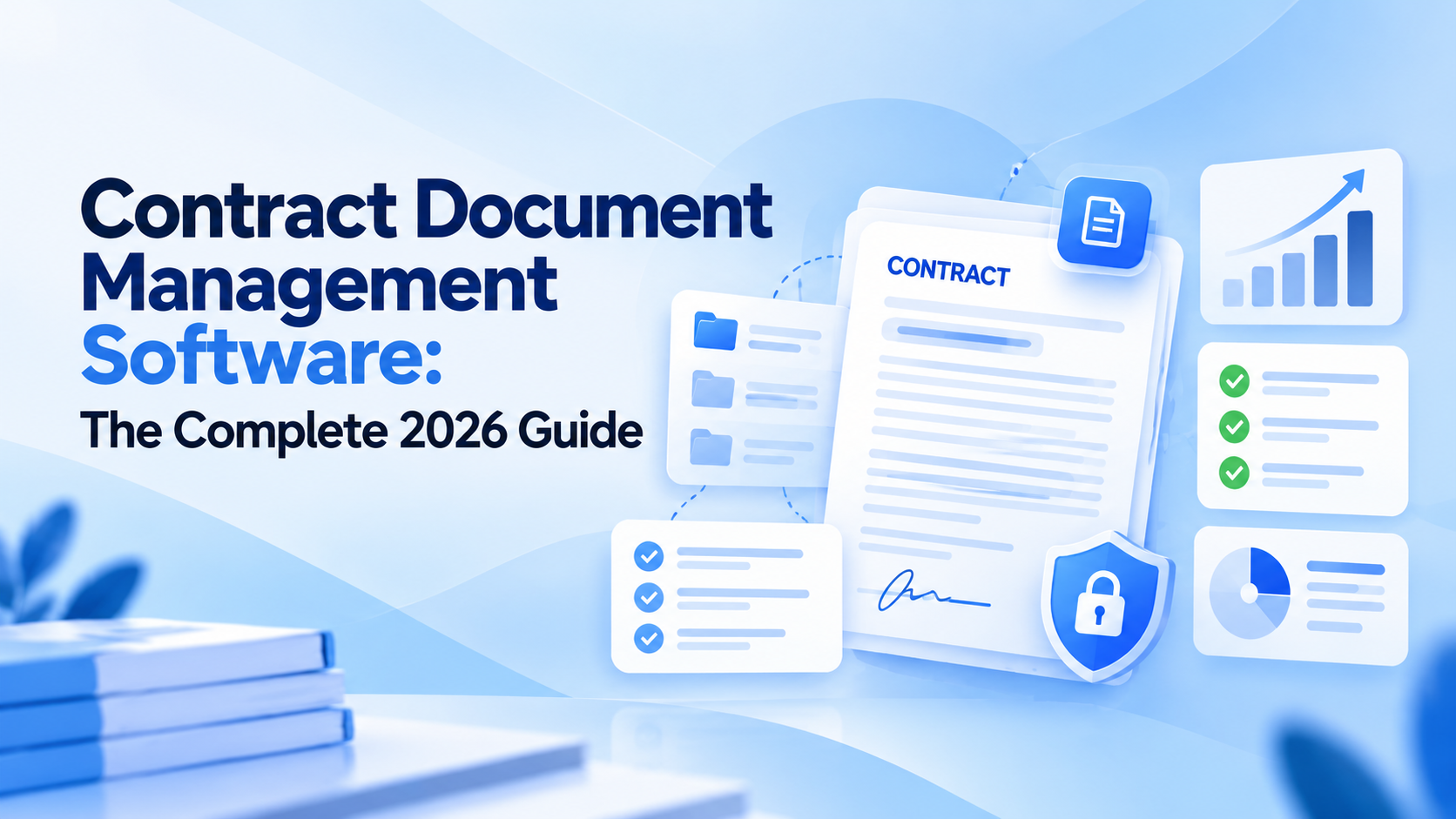
Contract Document Management Software: Features, Benefits & Complete Guide for Businesses in 2026
Contract document management software helps businesses store, organise, manage, track and securely access contracts from a centralised digital platform. It replaces scattered agreements, manual document handling and inefficient approval processes with structured, automated contract workflows.
Modern contract document management software goes beyond basic file storage. With artificial intelligence (AI), searchable contract repositories, automated approvals and renewal tracking, businesses can simplify contract operations and improve visibility throughout the agreement lifecycle.
For Indian businesses managing large volumes of vendor agreements, NDAs, service contracts, employment agreements, and other legal documents, choosing the right contract management solution can help reduce administrative work, prevent missed deadlines, and improve collaboration.
In this guide, we explain what contract document management software is, how it works, its essential features and benefits, and how AI-powered solutions help businesses manage contracts more efficiently.
What Is Contract Document Management Software?
Contract document management software is a digital solution that helps businesses create, store, organise, retrieve, track and manage contractual documents throughout their lifecycle.
Unlike general document management software, which handles different types of business files, contract document management focuses specifically on legal agreements and the activities associated with them.
Businesses can use contract document management systems to manage documents such as:
Vendor and supplier agreements
Non-Disclosure Agreements (NDAs)
Service Level Agreements (SLAs)
Employment contracts
Partnership agreements
Customer and sales contracts
Lease and rental agreements
Procurement contracts
Master Service Agreements (MSAs)
For example, consider a company managing hundreds of vendor agreements across multiple departments.
Without a centralised system, employees may spend time searching emails, checking shared folders and contacting colleagues to find the latest approved contract.
With contract document management software, authorised users can locate agreements, review contract details, track approval status and monitor important deadlines from one platform.
This helps organisations move beyond traditional document storage towards more efficient contract management.
How Does Contract Document Management Software Work?
Contract document management software provides a structured environment where agreements can be created, reviewed, approved, signed, stored and monitored.
The process generally involves six stages.
Step 1: Contract Creation and Upload
Businesses can upload existing contracts or create new agreements using available templates and drafting tools.
Depending on the platform, supported formats may include PDFs, Word documents and other common document types.
Some systems also use Optical Character Recognition (OCR) to extract searchable text from scanned agreements.
Step 2: Contract Classification and Organisation
Contracts are organised based on document type, department, contract owner, business partner or other relevant information.
For example, a business may classify agreements into vendor contracts, employee agreements, client contracts and procurement documents.
AI-powered contract management systems may automatically identify document types and extract important information.
Step 3: Contract Review and Approval
Contracts are sent to the appropriate stakeholders for review.
Legal teams may check contractual terms, procurement teams may verify commercial conditions and management may approve the final agreement.
Automated approval workflows help reduce manual email follow-ups and provide visibility into pending actions.
Step 4: Contract Signing
Once approved, agreements can be sent for electronic signatures through supported eSigning capabilities or integrations.
This reduces the need for printing, scanning and physically exchanging signed documents.
Step 5: Secure Contract Storage
After execution, contracts can be stored in a centralised repository.
Access controls help ensure that only authorised individuals can view, edit or share sensitive agreements.
Step 6: Contract Tracking and Renewal Management
Contract management does not end when an agreement is signed.
Businesses must continue monitoring renewal dates, contractual obligations, deliverables and important milestones.
Advanced contract document management systems can provide alerts and reminders to help teams stay informed.
Contract Created Reviewed Approved Signed Stored Tracked & Renewed
This structured process helps businesses manage agreements throughout their lifecycle rather than treating contracts as documents that only need to be filed.
Why Do Businesses Need Contract Document Management Software?
As businesses grow, the number of agreements they handle increases.
Sales teams manage customer contracts, procurement departments handle supplier agreements, HR teams maintain employment contracts and legal teams review business obligations.
When these documents are distributed across emails, shared drives and physical folders, contract management becomes difficult.
Difficulty Finding Important Contracts
Employees may spend unnecessary time searching for agreements stored across multiple systems.
A centralised contract repository makes it easier to locate relevant documents.
Multiple Contract Versions
Contracts often go through several rounds of drafting, negotiation and approval.
Without proper version control, teams may accidentally refer to outdated agreements.
Contract document management software helps maintain visibility into revisions and approved versions.
Delayed Contract Approvals
Manual reviews and email-based approvals can delay business transactions.
Automated workflows help move agreements through the necessary approval stages.
Missed Contract Renewals
Contracts frequently contain renewal dates, notice periods and termination conditions.
Without proper tracking, organisations may miss important deadlines or experience unwanted renewals.
Limited Visibility Into Contractual Obligations
Contracts contain responsibilities, payment conditions, service requirements and other commitments.
When these details are not centrally tracked, teams may struggle to monitor their obligations.
Contract Security and Access Concerns
Business agreements may contain sensitive commercial, legal and financial information.
Uncontrolled sharing creates unnecessary exposure.
Contract document management software helps businesses improve organisation, accessibility, workflow visibility and contractual control.
Key Features of Contract Document Management Software
The best contract document management software should do more than store agreements. It should help businesses manage contractual information and simplify everyday workflows.
Centralised Contract Repository
A centralised contract repository brings business agreements into one organised digital location.
Employees can access relevant contracts without maintaining disconnected copies across emails and shared folders.
A well-structured repository helps legal, procurement, sales and finance teams work with consistent contract information.
Advanced Contract Search
Contract search capabilities help users locate agreements based on document names, keywords, dates, business parties, contract types and other available metadata.
AI-powered platforms may also support natural-language searches.
For example, users may ask:
Find all vendor agreements expiring next month.
Show contracts awaiting legal approval.
Locate agreements containing termination clauses.
Find all active agreements with a particular supplier.
These capabilities can reduce manual searches and improve access to important contract information.
Contract Version Control
Contracts often undergo multiple revisions before they are finalised.
Version control helps teams maintain a record of changes, review previous versions and identify the current agreement.
This reduces confusion and supports better collaboration during contract negotiations.
Role-Based Access Control
Businesses can assign contract permissions based on employee roles and responsibilities.
For example, legal teams may receive editing access, while other departments may have permission only to view approved agreements.
This helps protect sensitive contractual information.
Automated Contract Approval Workflows
Contract workflow automation allows agreements to move between stakeholders according to predefined approval rules.
A typical process may involve:
Contract Drafted? Legal Review ? Management Approval ? Electronic Signature
This helps reduce manual coordination and makes it easier to track contract progress.
Electronic Signatures
Electronic signature functionality allows businesses to complete agreements digitally.
Depending on the solution, contracts may be sent to multiple signatories through sequential or parallel signing workflows.
This reduces paperwork and simplifies the signing process.
Contract Renewal and Expiry Alerts
Contract renewal tracking helps organisations stay informed about upcoming expiry dates and renewal deadlines.
Automated reminders can help contract owners take action before important dates.
AI-Powered Contract Analysis
AI-enabled contract management platforms may identify important clauses, extract contractual information, summarise agreements and highlight potential risks.
These capabilities help legal and business teams review large volumes of agreements more efficiently.
However, AI-generated legal findings should still be reviewed by qualified professionals where appropriate.
Contract Obligation Tracking
Contracts often include deliverables, payment terms, notice periods and service commitments.
Obligation tracking helps businesses monitor these responsibilities throughout the contract lifecycle.
Contract Analytics and Reporting
Contract analytics helps organisations understand agreement status, approval delays, upcoming renewals, and other relevant contract information.
Dashboards can provide better visibility into ongoing contractual activities.
Benefits of Using Contract Document Management Software
Contract document management software helps businesses improve contract visibility, reduce manual work, and make agreement-related processes more efficient.
Improved Employee Productivity
Employees can retrieve relevant contracts more quickly and spend less time searching through disconnected systems.
Reduced Administrative Work
Automated reminders, approval routing, and structured contract workflows reduce repetitive administrative tasks.
Better Collaboration Between Departments
Legal, procurement, sales, HR, and finance teams can work through a more consistent process.
Better Management of Contractual Obligations
Centralised contract information makes it easier to identify responsibilities, commitments and important deadlines.
Improved Operational Efficiency
As contract volumes increase, a structured digital system helps businesses maintain consistent processes without relying entirely on manual tracking.
How AI Is Transforming Contract Document Management
AI-powered contract document management software uses artificial intelligence to help businesses analyse, search, review, and manage contractual documents with less manual effort.
Traditional contract storage primarily focuses on organising and retrieving documents.
AI-powered contract management platforms can go further by analysing the contents of agreements and assisting with contract-related decisions.
AI-Powered Contract Drafting
AI can assist legal and business teams in preparing agreements based on templates, instructions, and existing contractual information.
This can reduce repetitive drafting work while allowing authorised professionals to review the final document.
Intelligent Contract Review
AI-assisted review tools can analyse contractual language and help identify potentially missing provisions, unusual clauses or inconsistencies.
For example, AI may help flag:
Unfavourable termination conditions
Unclear payment obligations
Missing confidentiality provisions
Unusual liability clauses
Contract terms that differ from preferred standards
AI-generated observations should be validated before making legal or commercial decisions.
Automated Contract Data Extraction
AI can identify and extract information such as:
Contract parties
Effective dates
Expiry and renewal dates
Payment terms
Important obligations
Termination provisions
This reduces the need to manually review every agreement for basic contractual information.
AI-Powered Contract Search
Instead of searching contracts only by file names, users may be able to search using natural-language queries.
For example:
“Show all vendor agreements expiring within the next 60 days.”
AI-powered search can help employees locate relevant agreements and understand their contents more efficiently.
Contract Risk Identification
AI can assist with identifying contractual provisions that may require further review.
This is particularly useful when businesses manage large volumes of commercial agreements.
Contract Summarisation
AI-generated summaries can help teams quickly understand important terms and responsibilities within lengthy contracts.
Together, these capabilities are changing how businesses manage contractual information, moving from simple document storage towards more intelligent contract operations.
Contract Document Management Software vs Traditional Document Storage
Although traditional file storage and contract document management software both store digital files, their purposes are different.
Traditional storage solutions may be sufficient for businesses that only need to save and share a limited number of agreements.
However, organisations handling complex contracts, approval processes, renewal deadlines and compliance requirements may benefit from dedicated contract document management software.
Types of Contract Document Management Software
Different contract management solutions serve different business requirements.
Cloud-Based Contract Management Software
Cloud-based platforms allow authorised users to access agreements through an internet-connected system.
These solutions can support remote collaboration, centralised administration and scalable contract storage.
Enterprise Contract Management Software
Enterprise platforms are designed for organisations handling large contract volumes, multiple departments and complex approval processes.
They may include advanced integrations, reporting and configurable workflows.
AI-Powered Contract Management Software
AI-driven solutions support tasks such as contract drafting, clause analysis, summarisation, search and information extraction.
Legal Document Management Software
Legal document management platforms help teams organise and manage legal records.
Specialised solutions may also provide contract review, approval management and eSignature functionality.
Contract Lifecycle Management Software
Contract Lifecycle Management (CLM) software manages the broader contract process, from initial request and drafting to approvals, execution, obligations and renewals.
Businesses that need more than document storage may find a CLM platform better suited to their requirements.
Contract Document Management Software for Different Industries
Contract management requirements vary across industries, but most organisations share the need to maintain accurate agreements and track contractual obligations.
Banking and Financial Services
Banks, NBFCs and financial institutions manage vendor agreements, service contracts and other business documentation.
Contract document management software can support organised contract storage, controlled access and agreement tracking.
Manufacturing
Manufacturing organisations frequently manage supplier agreements, procurement contracts and service agreements.
Centralised contract management helps improve coordination between procurement, finance and legal teams.
Real Estate
Real estate businesses handle lease agreements, property-related contracts and vendor agreements.
Digital contract management helps teams organise contractual documents and monitor expiry dates.
IT and Professional Services
IT companies and professional service providers regularly manage NDAs, Master Service Agreements, Statements of Work and customer contracts.
Automated workflows can simplify reviews, approvals and agreement tracking.
Healthcare
Healthcare organisations manage supplier contracts, service agreements and other commercial arrangements.
Structured repositories and access controls help organisations manage contractual information more effectively.
Retail and E-Commerce
Retailers and e-commerce businesses manage supplier agreements, logistics contracts, service agreements, and commercial partnerships.
Contract document management can improve visibility into these agreements and their associated deadlines.
Contract Document Management Software vs Contract Lifecycle Management Software
Contract document management software and Contract Lifecycle Management (CLM) software are closely related, but they are not always identical.
Contract document management software primarily focuses on organising, storing, retrieving, and controlling contractual documents. CLM software manages the entire contract lifecycle, including drafting, negotiation, approvals, execution, obligations, and renewals.
For businesses that simply need to store and retrieve agreements, a dedicated contract repository may be sufficient.
However, organisations handling complex approval processes, ongoing obligations and recurring contract renewals may benefit from a complete contract lifecycle management platform.
How to Choose the Best Contract Document Management Software
Selecting the right contract management solution requires an understanding of your organisation's agreements, workflows and business requirements.
1. Identify Your Contract Management Requirements
Start by understanding the types and volumes of contracts your organisation handles.
Determine whether you need basic contract storage, automated approvals, AI contract analysis, or complete lifecycle management.
2. Evaluate Contract Search and Organisation
Look for a searchable centralised repository, contract classification and metadata management.
The system should help users find agreements without unnecessary manual effort.
3. Review Contract Security Features
Evaluate access controls, authentication, encryption, audit trails and administrative permissions.
Indian businesses should also assess applicable privacy, data protection and regulatory obligations.
4. Check Workflow Automation Capabilities
Review whether the platform supports contract approvals, notifications, reminders, and configurable workflows.
5. Assess AI Features
If AI functionality is important, evaluate the software using realistic business agreements.
Test its ability to identify clauses, extract contractual information, and assist with reviews.
6. Evaluate Contract Renewal Tracking
Look for contract expiry alerts, renewal reminders, and obligation tracking.
These capabilities can help teams monitor important commitments.
7. Consider Integrations
Check whether the software integrates with your existing CRM, ERP, electronic signature systems and other relevant applications.
8. Compare Pricing and Implementation
Evaluate subscription fees, onboarding, integration costs, user limits and support requirements.
The best contract document management software is one that addresses your organisation's actual contract challenges without introducing unnecessary complexity.
How SprintContractX Simplifies Contract Document Management
For businesses managing legal agreements and commercial contracts, simply storing documents is often not enough.
Agreements need to be drafted, reviewed, approved, signed, monitored and renewed.
This is where SprintContractX, an AI-powered Contract Lifecycle Management platform by PaySprint, can help businesses simplify their contract operations.
SprintContractX brings contract-related workflows together to improve visibility and reduce manual coordination.
Centralised Contract Repository
Businesses can organise agreements within a centralised repository rather than maintaining contracts across disconnected systems.
Teams can search and retrieve relevant documents more easily.
SprintContractX supports AI-assisted drafting and contract analysis to help teams prepare agreements, review clauses and identify potential contractual risks.
Configurable approval workflows help route agreements to the appropriate stakeholders.
This reduces dependence on manual email follow-ups and provides better visibility into approval progress.
Electronic Signatures
SprintContractX supports digital signing workflows, helping businesses complete agreements without relying on physical paperwork.
Contract Renewal and Obligation Tracking
Businesses can track contractual responsibilities, renewal dates and important milestones.
Automated alerts help teams stay informed about upcoming actions.
AI-Powered Contract Intelligence
SprintContractX's AI capabilities help teams extract contractual information, identify relevant clauses, and obtain useful insights from agreements.
Better Collaboration Across Departments
Legal, procurement, sales, HR and finance teams can manage contract-related activities through a more structured process.
By bringing these capabilities together, SprintContractX helps organisations move beyond basic contract storage towards automated and intelligent contract lifecycle management.
Looking to simplify your contract management process?
Explore how SprintContractX can help your business centralise agreements, automate contract workflows and improve visibility into contractual obligations.
Book a Free SprintContractX Demo
Conclusion
Contract document management software helps businesses organise agreements, automate approvals, track renewals and manage contractual obligations efficiently. With AI-powered capabilities, businesses can simplify contract reviews, reduce manual work, and improve overall productivity.
For Indian businesses, SprintContractX offers an AI-powered Contract Lifecycle Management solution that brings drafting, approvals, eSignatures, risk analysis, and renewal tracking into one platform.
Manage Contracts Smarter with SprintContractX.
Frequently Asked Questions About Contract Document Management Software
1. What is contract document management software?
Contract document management software is a digital platform that helps businesses store, organise, search, track, and manage contracts. It provides a centralised location for agreements and may support automated approvals, version control, eSignatures and renewal tracking.
2. What is the difference between document management software and contract document management software?
Document management software handles different types of business files, including invoices, employee records, and internal documents. Contract document management software focuses specifically on agreements and their related workflows, including contract storage, reviews, approvals, and renewals.
3. What is the best contract document management software for businesses in India?
The best contract document management software depends on an organisation's contract volumes, workflow requirements, security needs, and budget. Businesses looking for AI-assisted contract drafting, review, automated approvals, and lifecycle management can evaluate solutions such as SprintContractX.
4. How does AI improve contract document management?
AI helps businesses analyse agreements, extract important information, identify relevant clauses, generate summaries, and assist with contract reviews. These capabilities can reduce manual effort and improve access to contractual information.
5. Can contract document management software automate approvals?
Yes. Many contract management platforms support configurable approval workflows. Agreements can be routed to designated stakeholders, with notifications and status tracking to simplify review and approval processes.
6. How does contract management software help track renewals?
Contract management software can store renewal dates, track agreement expiry periods and generate reminders. This helps contract owners identify upcoming deadlines and take appropriate action.
7. Is contract document management software suitable for small businesses?
Yes. Small businesses can benefit from centralised contract storage, easier document retrieval and simplified approval workflows. The appropriate solution depends on contract volume, business complexity and budget.
8. What is a contract repository?
A contract repository is a centralised digital location where businesses store and organise agreements. It allows authorised users to search, retrieve and manage contractual documents without relying on scattered files or email attachments.
9. Is contract document management software secure?
Contract document management software can support security through role-based access controls, encryption, authentication, and audit trails. Actual security depends on the platform's features, configuration and the organisation's internal practices.
10. What is the difference between contract document management software and CLM software?
Contract document management software focuses primarily on organising and managing contractual documents. CLM software provides broader capabilities covering contract drafting, review, negotiation, approval, signing, obligation management, and renewals.
11. What types of contracts can businesses manage using contract management software?
Businesses can manage vendor agreements, customer contracts, NDAs, employment contracts, service agreements, procurement contracts, lease agreements, and other commercial documents.
12. How much does contract document management software cost in India?
Pricing varies depending on the provider, number of users, contract volumes, AI features, integrations, and implementation requirements. Some platforms offer subscription pricing, while enterprise solutions may require customised quotations.
Related Posts
What is E-Banking? Meaning, Types, Benefits & How It Works in India.
E-banking is the digital way of accessing banking services through mobile apps, websites, ATMs, and biometric systems. It enables secure, fast, and branchless financial transactions anytime and anywhere in India.
Read More
When Maps Change, Money Follows: How Geopolitics Is Rewiring B2B Payments in 2026
Payments are no longer just a plumbing problem — they're a geopolitical one. Explore how Indian B2B businesses can navigate a fragmented, fast-changing global payment landscape
Read More
What Happens Inside an Escrow Release Event? A Step-by-Step Breakdown for Businesses
A complete breakdown of escrow release events—covering triggers, validation, vendor response, and access to source code—helping businesses ensure continuity and minimize vendor risk.
Read MoreReady to Protect Your Core Systems?
Join enterprises that trust SprintEX-Code to safeguard their mission-critical software. Get started with a consultation to discuss your specific escrow requirements.