
What Is Payment Orchestration and How Does It Work?
Jul 23, 2026
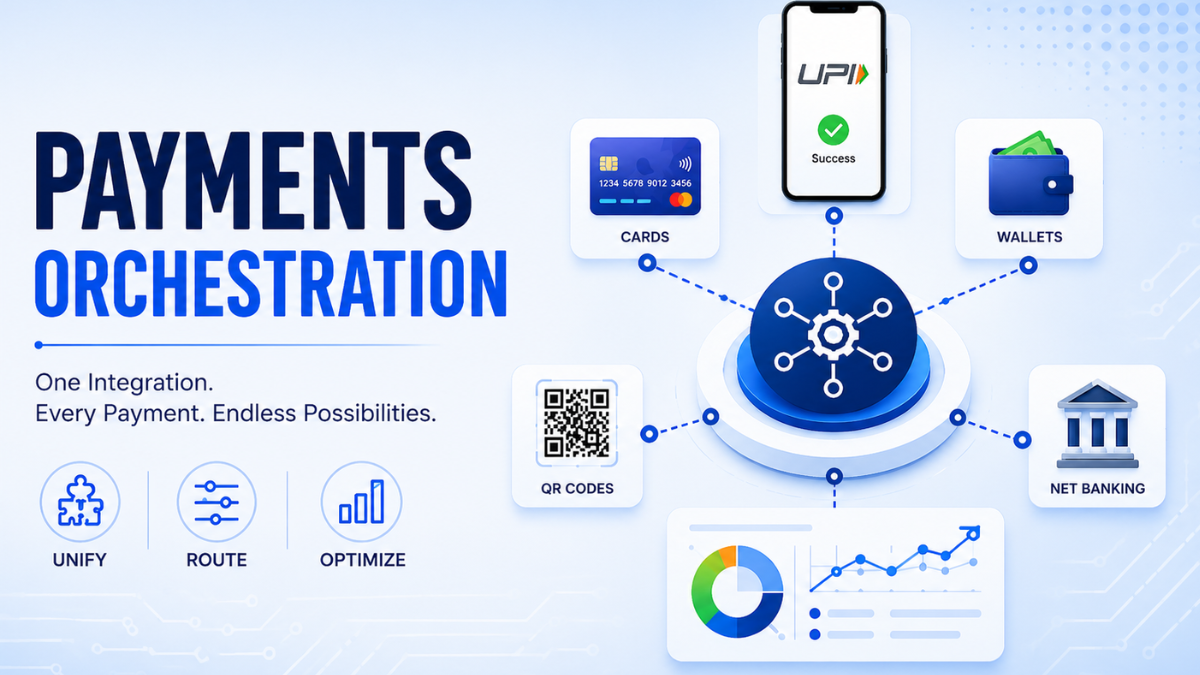
What Is Payment Orchestration and How Does It Work?
Payment orchestration is the layer that decides which bank, gateway, or UPI PSP should process each transaction — in real time, before anything reaches the customer. Every provider has an off day: a gateway goes down, a bank slows its approvals, a UPI app struggles at peak hours. Without orchestration, that failure is final and the sale is lost. With it, the transaction simply reroutes invisibly through a better path in milliseconds.
It's become one of the most-searched, least-understood terms in Indian fintech. This guide answers the real questions people ask about it, in plain language, with Paysprint's take on where it fits.
What is payment orchestration?
Payment orchestration is a software layer that sits between your checkout and all your payment providers — gateways, banks, UPI switches, wallets — and decides, in real time, which one should process each transaction.
Instead of your app talking to Razorpay, Paytm, a bank's API, and a UPI switch separately, it talks to one orchestration layer. That layer talks to all of them for you, and picks the best path for every single transaction based on rules you define.
Think of it less like a single toll booth and more like a smart traffic signal system that watches every road into the city and reroutes cars the instant one road gets jammed.
Why does this even matter? Isn't one good payment gateway enough?
It's enough — until it isn't. Most businesses start with orchestration only after they feel one of these three pains:
Transactions are failing for reasons that have nothing to do with the customer. The card was valid, the balance was there, but the payment still bounced because of a provider-side issue.
Engineering time is being eaten by payment maintenance. Every time you want to add a new UPI app, a new bank, or a BNPL option, it's another integration, another testing cycle, another few weeks gone.
Nobody has a single view of what's actually happening. Finance is pulling settlement reports from four different dashboards and trying to make them agree with each other.
None of these are edge cases in India. UPI alone processes tens of billions of transactions a month, spread across dozens of PSP banks and apps, each with its own quirks, downtime windows, and success-rate patterns by issuer and time of day.
A single provider simply cannot be the best option for every customer, every bank, every hour of the day.
How Does It Work?
Here's what happens behind the scenes on a well-orchestrated transaction:
The customer chooses how to pay. UPI, card, net banking, wallet — the orchestration layer shows the methods relevant to that customer, not a generic list.
The system checks its live scoreboard. Before sending the transaction anywhere, the orchestration engine looks at how each connected provider has been performing in the last few minutes — for that bank, that payment method, that transaction size.
It routes to the provider with the best odds. Not the provider you like best on paper, but the one statistically most likely to get this specific transaction approved right now.
If it fails, it doesn't just give up. A declined or timed-out transaction can be automatically retried through a second provider, invisibly, before the customer even notices a delay.
Everything gets logged in one place. Success, failure, the reason for failure, the fee charged, the settlement timeline — all pulled into one dashboard instead of scattered across provider portals.
The customer never sees any of this. All they know is that the payment worked the first time — or seemed to.
What's the actual difference between a payment gateway and a payment orchestrator?
This is the single most common point of confusion, so it's worth being precise:
A gateway is a single door into a bank. An orchestrator is the hallway that decides which door to open.
What are the real, measurable benefits — not just the marketing version?
Set aside the buzzwords for a second. Here's what orchestration is actually doing for the businesses that use it well:
Higher payment success rates. By routing each transaction through the provider most likely to succeed for that bank, card type, or UPI app — and retrying instantly on failure — orchestration recovers transactions that would otherwise just be lost revenue. This is usually the single biggest, most quantifiable win, and it's the reason most businesses adopt orchestration in the first place.
Lower cost per transaction. Not every provider charges the same fee for the same transaction type. With visibility into cost alongside success rate, you can route low-risk, low-value transactions to your cheapest provider and reserve premium routes for where they're actually needed.
Faster rollout of new payment methods. Want to add a new UPI app, a regional wallet, or a BNPL provider? With orchestration already in place, that's a configuration task, not an engineering sprint.
One source of truth for finance and operations. Instead of stitching together CSVs from five dashboards every month, reconciliation, chargebacks, and settlement data live in one system.
Resilience against provider downtime. Banks and gateways do go down — during festival sales, during month-end, at the worst possible moments. Orchestration means one provider's bad day doesn't become your bad quarter.
Built-in redundancy for fraud and risk tools. You're not locked into a single fraud engine's judgment call; rules can be layered and adjusted per market or payment method without touching core code.
Does my business actually need payment orchestration, or is this overkill?
Fair question — orchestration isn't free, and it's not the right first step for everyone. A rough way to think about it:
You're probably ready for it if:
You already work with two or more payment providers and manage them as separate integrations
Your team can point to specific transactions that failed for provider-side, not customer-side, reasons
You're spending real engineering hours every quarter just maintaining payment integrations
You're expanding into new geographies, payment methods, or customer segments and don't want each one to be a fresh integration project
Finance is manually reconciling numbers across multiple dashboards
You can probably wait if:
You run through a single, reliable provider and volumes are modest
You have no near-term plans to add payment methods, geographies, or providers
Nobody on your team has time to own routing rules and monitor performance — orchestration needs a driver, not just an install
How is AI changing payment orchestration right now?
The routing logic that used to be static "if-this-bank-then-that-provider" rules is increasingly being replaced by systems that learn from live transaction data — adjusting routing decisions by the hour based on which bank is having a good or bad day, which BIN ranges are seeing more declines, and which retries are actually converting versus wasting a second attempt.
The other shift worth watching is where checkout itself is happening. As more purchase journeys start inside AI assistants and chat-based interfaces rather than a traditional website, the orchestration layer becomes the thing that makes a business's catalog "payable" wherever the customer happens to be — website, app, or conversational interface — without rebuilding payment logic for each surface.
How Do You Solve This for Indian Businesses?
No single bank or PSP performs best for every transaction, every UPI handle, every region, or every hour of the day — and Indian merchants shouldn't have to pick just one and hope for the best.
The answer is an API-first fintech infrastructure layer that gives businesses a single integration point to a wide network of banking partners, UPI rails, AEPS, payment collection, and payout services — so routing, redundancy, and reconciliation are handled at the infrastructure level instead of being rebuilt by every merchant from scratch. For businesses that are done losing sales to provider downtime and done stitching together reports by hand, that's the practical, unglamorous value orchestration is supposed to deliver.
Conclusion
Payment orchestration, stripped of the jargon, comes down to one idea: don't let a single provider decide whether your business gets paid. Every gateway, every bank, every UPI PSP has an off day — and in a market as fragmented as India's, that's not rare, it's routine.
Orchestration doesn't replace the providers you trust; it just makes sure one bad connection never becomes a lost sale. If you're already juggling multiple providers or watching transactions fail for reasons that have nothing to do with your customers, that's the sign it's time to stop patching the problem manually and let an orchestration layer handle it.
Frequently asked questions
Is payment orchestration the same as a payment aggregator?
No. An aggregator (like a typical PG) is itself one processing entity that merchants plug into. Orchestration sits a level above — it can manage and route across multiple aggregators, gateways, and banks at once.
Will orchestration slow down checkout?
Done properly, no. Routing decisions happen in milliseconds, before the transaction is even sent to a bank, so customers don't experience any added delay.
Do I have to give up my existing payment gateway to use orchestration?
No — orchestration is built to sit on top of your existing providers, not replace them. You keep your current relationships and simply gain a smarter layer for deciding how they're used.
What's the biggest mistake businesses make when adopting orchestration?
Treating it as a "set it and forget it" tool. Routing rules and provider performance need regular review — orchestration gives you the data, but someone still needs to act on it.
Does payment orchestration help with UPI specifically?
Yes, and in India this is often the biggest use case. UPI success rates vary by issuing bank, PSP, time of day, and even app version. Orchestration platforms that route intelligently across multiple UPI PSPs typically see meaningfully better success rates than a single-PSP setup.
Related Posts
What is E-Banking? Meaning, Types, Benefits & How It Works in India.
E-banking is the digital way of accessing banking services through mobile apps, websites, ATMs, and biometric systems. It enables secure, fast, and branchless financial transactions anytime and anywhere in India.
Read More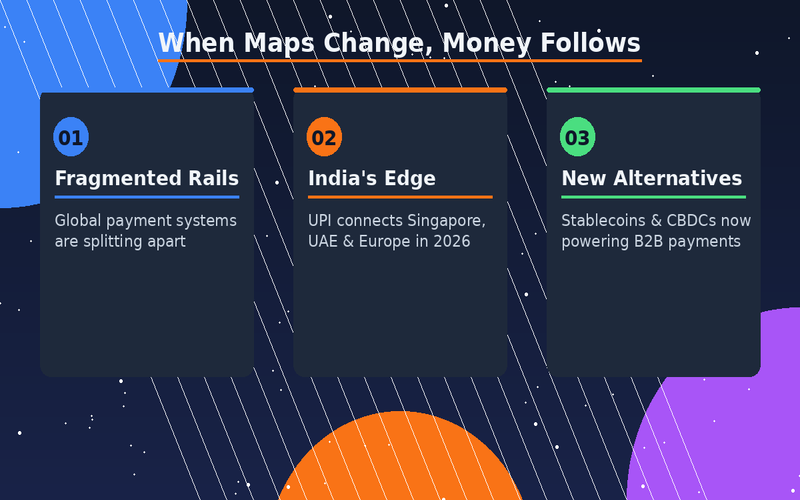
When Maps Change, Money Follows: How Geopolitics Is Rewiring B2B Payments in 2026
Payments are no longer just a plumbing problem — they're a geopolitical one. Explore how Indian B2B businesses can navigate a fragmented, fast-changing global payment landscape
Read More
What Happens Inside an Escrow Release Event? A Step-by-Step Breakdown for Businesses
A complete breakdown of escrow release events—covering triggers, validation, vendor response, and access to source code—helping businesses ensure continuity and minimize vendor risk.
Read MoreReady to Protect Your Core Systems?
Join enterprises that trust SprintEX-Code to safeguard their mission-critical software. Get started with a consultation to discuss your specific escrow requirements.