
Escrow Orchestration: The 2026 Guide to Programmable Trust
Jun 26, 2026
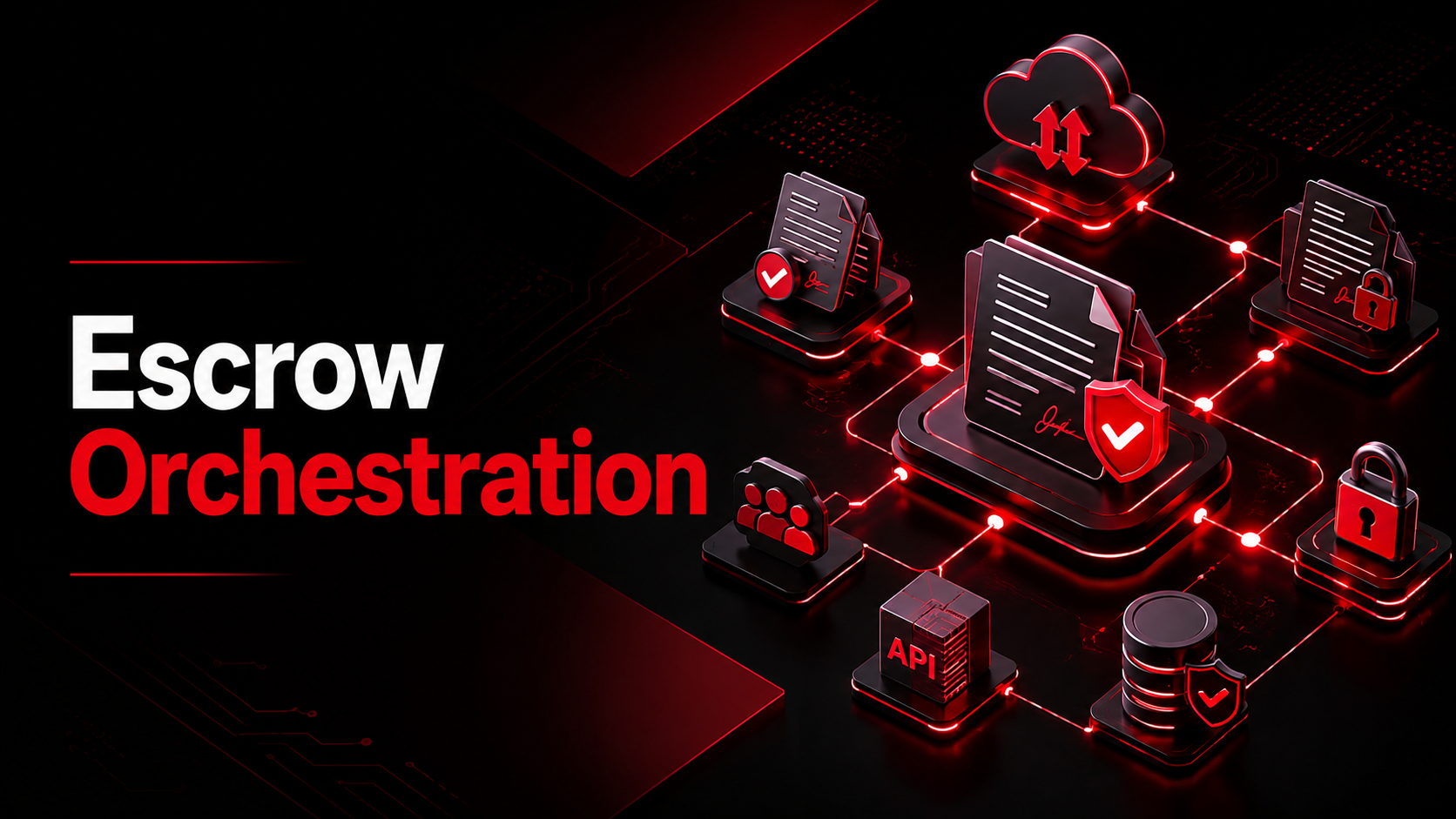
Escrow Orchestration: The 2026 Guide to Programmable Trust
Escrow orchestration is the automated coordination of multi-party fund holding and conditional release across a transaction lifecycle — replacing human escrow agents with API-connected services, smart contracts, and programmable trigger rules. Unlike traditional escrow, which relies on manual review and institutional intermediaries, orchestrated escrow responds in real time to verified events (delivery confirmations, milestone completions, regulatory clearances) and releases funds automatically.
Table of Contents:
What is Escrow Orchestration?
Why 2026 Is the Inflection Point
How Escrow Orchestration Works: Architecture & Flow
Real-World Escrow Orchestration Examples
Oracle Integration: Connecting Smart Contracts to the Real World
Orchestrated vs. Traditional Escrow
The PACE Framework: Implementing Escrow Orchestration in 4 Phases
Conclusion
Frequently Asked Questions
What Is Escrow Orchestration?
At its core, escrow has always done one thing: hold value on behalf of two parties until an agreed condition is satisfied. What has changed radically is who does the holding — and how fast it happens.
Traditional escrow runs on human timelines. A bank or title company receives funds, a processor reviews paperwork, a manager approves disbursement. The average residential escrow cycle runs 30–50 days. Commercial M&A escrow can stretch months.
Escrow orchestration replaces that linear, human-supervised pipeline with a software layer that:
• Receives structured trigger events via API (shipment confirmed, milestone accepted, KYC passed)
• Applies pre-coded conditional logic to validate release criteria
• Executes fund movements automatically — to one or many counterparties simultaneously
• Logs every action with an immutable audit trail for compliance
• Think of it as the 'orchestration layer' in a payment stack — the same way an API gateway routes and sequences API calls, an escrow orchestration engine routes and sequences fund flows across a deal's lifecycle.
Why 2026 Is the Inflection Point
Three converging forces have made escrow orchestration a strategic priority for every fintech, marketplace, and financial institution building in 2026.
1. The Market Is Now Too Large to Ignore
• $16.5B — Global escrow agent services market in 2026
• 14.3% CAGR through 2035 (reaching $34.5B)
• 20% CAGR for EaaS specifically (to $21.5B by 2033)
• 11.7% CAGR for digital escrow platforms through 2033
The underlying escrow market was valued at $5.2 billion in digital platforms in 2024 alone, with the total escrow agent services sector at $14.4 billion. By any measure, this is high-growth infrastructure.
2. API Adoption in Fintech Is Creating the Plumbing
APIs now hold a 39.1% share of fintech technology infrastructure in 2026. Use of API-integrated escrow services in fintech platforms grew 35% in a single year. When 600+ fintech platforms have already embedded escrow features, orchestration becomes the competitive differentiator — not just access to escrow itself.
• Over 1,000 fintech and legaltech platforms launched escrow-integrated offerings in 2023 alone. Automation in these systems reduced transaction time by 42%, and processing times have fallen 28% compared to 2021 benchmarks.
3. Digital Trust Is Now a Product Expectation
Around 68% of businesses use escrow services to secure digital transactions. 59% rely on them for cross-border financial settlements. As cross-border B2B e-commerce expands, the complexity of multi-jurisdiction compliance, currency conversion, and counterparty risk makes orchestrated escrow not a nice-to-have — but the only scalable solution.
• E-commerce escrow usage is on track to hit $2 billion by 2026
• Cross-border trade escrow is growing at 2× the rate of domestic services
• The gig economy — projected at $455 billion by 2026 — depends on milestone-based payments that escrow orchestration enables natively
How Escrow Orchestration Works: Architecture & Flow
Escrow orchestration is not a single product — it is a design pattern implemented across three primary architectural approaches.
The Core Orchestration Loop
• Deal Initiation & Account Provisioning: API call creates an isolated escrow account (or smart contract vault) for the transaction. Parties, amounts, release conditions, and dispute paths are registered programmatically — no paper forms.
• Funds Deposit & Verification: Buyer/initiating party deposits funds. The orchestration layer triggers KYC/AML checks, validates the source of funds, and confirms receipt via webhook — all automated.
• Event Monitoring: The engine listens for trigger events from integrated systems: delivery APIs, IoT sensors, Oracle data feeds, e-signature completions, milestone approvals, and regulatory clearances.
• Condition Evaluation: When trigger events arrive, a rules engine evaluates whether all release conditions are satisfied. For smart contract escrow, this evaluation runs on-chain — deterministic and publicly verifiable.
• Automatic Fund Release (or Dispute Routing): Conditions met ? funds disbursed instantly. Conditions disputed ? transaction routed to arbitration. Conditions expired ? funds returned to depositor automatically.
• Audit Trail & Reporting: Every event, decision, and fund movement is logged with timestamps and actor IDs. Compliance reports generated automatically — AML, KYC, and RESPA-aligned outputs without manual compilation.
Real-World Escrow Orchestration Examples
Example 01 — Blockchain-Powered Title and Escrow Real Estate · Propy
• Propy, a real estate platform operating in the US, replaced traditional title and escrow companies with a blockchain-based orchestration system. A buyer deposits purchase funds into a smart contract. Property title data is tokenized on-chain. Once regulatory checks, notary confirmations, and due diligence are complete, the smart contract simultaneously transfers funds to the seller and title ownership to the buyer — in minutes, not weeks. No escrow officer reviews paperwork. No settlement delay.
• The result: What previously required 30–50 days of back-office coordination now executes in a single blockchain transaction session, with all conditions verifiable by any party on the ledger.
Example 02 — Smart Escrow for Acquisition Earnouts M&A · Earnout Automation
• A typical M&A deal includes earnout provisions — 'pay $2M extra if the acquired company hits $5M revenue in Q3.' Traditional earnout management requires audits, lawyer reviews, and manual wire transfers. With escrow orchestration, those terms are encoded at signing. When audited financials are fed into the system via an oracle, the payment triggers automatically on the day results are confirmed — eliminating disputes about timing.
• Escrow services for M&A transactions increased 15% in volume between 2020 and 2022, and earnout automation is a primary driver of that growth.
Example 03 — International Marketplace Protection Cross-Border E-Commerce
• A buyer on a cross-border marketplace purchases industrial equipment from a supplier in another country. Payment is deposited into an orchestrated escrow. The engine monitors three triggers: shipping confirmation from the logistics API, customs clearance from the trade compliance service, and buyer receipt acknowledgment. When all three fire, payment releases instantly. If any condition expires without fulfillment, funds return automatically.
• Over 750,000 transactions in Southeast Asia alone were processed using mobile-first escrow tools in 2023, and this pattern is rapidly expanding globally.
Example 04 — Milestone-Based Mortgage Disbursement Construction Finance · Banks
• Banks and fintechs are now piloting blockchain escrow for mortgage disbursements in construction projects. Rather than releasing the full loan amount at closing, funds are released in tranches as building milestones are verified — foundation complete, framing complete, electrical done. IoT sensors on-site can automatically confirm milestone completion, triggering the next disbursement without a site inspector's manual sign-off.
• This dramatically reduces fraud in construction finance and improves cash flow predictability for developers, with banks reporting fewer disputes and faster project completions.
Oracle Integration: Connecting Smart Contracts to the Real World
Oracles are trusted data feeds that submit off-chain information on-chain so smart contracts can evaluate release conditions. For escrow orchestration, oracles provide:
• Logistics data: DHL/FedEx delivery confirmations pushed to the contract
• Financial data: Revenue figures or EBITDA metrics for M&A earnouts
• Identity data: KYC pass/fail from providers like Jumio or Onfido
• IoT sensor data: Physical milestone confirmation (temperature, location, completion)
• Risk Warning: Critical risk: Smart contract escrow is only as trustworthy as its oracle. If the data feed is compromised, the contract executes on bad data. The DAO hack ($60M) and $2.2B stolen from smart contract exploits in 2024 illustrate that code immutability is a double-edged sword — get the logic right before deployment. Third-party security audits are non-negotiable.
The global smart contracts market was valued at $2.14 billion in 2024 and is projected to reach $12.07 billion by 2032. Smart contract TVL (total value locked) on Ethereum alone reached $10 billion in escrow-style contracts.
Orchestrated vs. Traditional Escrow
Automated escrow software reduces transaction closing time by 20% in conservative implementations. At Best-in-Class automation levels, the cost per transaction falls from $9.84 to approximately $2.07 — a 79% reduction — with processing times 79% faster and exception rates 47% lower.
The PACE Framework: Implementing Escrow Orchestration in 4 Phases
P — Pattern Selection (Phase 1 · Weeks 1–3)
• Define your transaction type (marketplace, real estate, M&A, cross-border)
• Choose orchestration approach: API-only (fastest), hybrid API + rules engine, or smart contract (maximum autonomy)
• Map all trigger events required for release: what signals will you listen to?
• Document every conditional branch: release, dispute, expiry, partial release
A — Architecture & Integration (Phase 2 · Weeks 4–8)
• Select your EaaS provider (or build on top of banking-as-a-service layer)
• Integrate KYC/AML provider — automate identity verification at account creation
• Set up webhook infrastructure to receive external trigger events
• If using smart contracts: choose blockchain, audit contract logic, deploy to testnet first
• Define oracle sources for off-chain data; validate data reliability
C — Compliance & Controls (Phase 3 · Weeks 8–12)
• Map to applicable regulations: RESPA (US real estate), PSD2 (EU payments), AML directives
• Build immutable audit logging for every event, decision, and fund movement
• Define dispute escalation: automated first (rules-based), human fallback
• Stress-test expiry scenarios: what happens when conditions time out?
• For smart contracts: third-party security audit is non-negotiable
E — Evaluate & Expand (Phase 4 · Ongoing)
• Track: settlement velocity, dispute rate, manual intervention rate, exception rate
• Target KPIs: <4hr settlement, <5% dispute rate, <1% manual interventions
• Expand trigger event coverage — more oracles, more data sources = fewer exceptions
• Layer multi-party release (royalty splits, milestone tranches, multi-beneficiary deals)
• Build toward fully autonomous escrow for your highest-volume transaction types
Conclusion
Escrow orchestration is no longer a back-office function — it is the trust layer that modern commerce runs on. What once required lawyers, float, and weeks of manual coordination now executes autonomously, verifiably, and at scale. The shift from analog escrow to programmable trust is not simply a technology upgrade; it is a fundamental redesign of how counterparties make commitments to each other across distance, jurisdiction, and time.
Frequently Asked Questions
Q: What is the difference between escrow orchestration and traditional escrow?
• Traditional escrow relies on a human intermediary who manually verifies conditions and authorizes fund release.
Escrow orchestration replaces that intermediary with software — an API layer or smart contract that monitors trigger events, evaluates conditions automatically, and releases funds without human review. Key differences: speed (minutes vs. days), cost (up to 79% lower per transaction), and scalability (software handles 10,000 transactions as easily as 10).
Q: Is a smart contract escrow legally enforceable?
• Legal recognition varies by jurisdiction. In the US, several states (Arizona, Tennessee, Wyoming) have passed laws recognizing smart contracts. The EU's eIDAS regulation and MiCA framework provide pathways for blockchain-based contracts. The safest 2026 approach is a hybrid model: smart contract execution + a mirrored traditional legal contract. This gives you automation speed with legal enforceability.
Q: What are the main risks of escrow orchestration?
• Four primary risks: (1) Oracle risk — bad data feed = incorrect fund release; (2) Smart contract bugs — immutable code with bugs can lock funds permanently; (3) Regulatory uncertainty — not all jurisdictions recognize automated escrow; (4) Integration failure — lost connectivity stalls transactions. Mitigations: use reputable oracle networks, conduct security audits, use hybrid models in unclear jurisdictions, and build timeout/fallback mechanisms.
Q: How big is the Escrow as a Service (EaaS) market in 2026?
• The global EaaS market is valued at approximately $3.46 billion in 2025 and is projected to reach $21.49 billion by 2033 at a 20% CAGR. The broader escrow agent services market reaches $16.46 billion in 2026 and $34.5 billion by 2035 at 14.3% CAGR. North America holds ~39% of the global share; Asia-Pacific is the fastest-growing region.
Q: What industries benefit most from escrow orchestration?
• Highest-impact industries: (1) Real estate — 13M+ property transfers used escrow in 2023; (2) M&A — earnout automation and complex deal structures; (3) Cross-border e-commerce — protecting buyers and sellers across jurisdictions; (4) Construction finance — milestone-based mortgage disbursements; (5) Gig economy — milestone project payments; (6) SaaS/software licensing — source code escrow with automated vendor-failure release.
Q: What is an oracle in smart contract escrow?
• An oracle is a trusted data provider that submits real-world information to the blockchain so the smart contract can evaluate release conditions. Since blockchains cannot natively access off-chain data, oracles bridge the gap — delivering logistics confirmations, financial figures, identity results, and IoT sensor data. Chainlink is the largest decentralized oracle network; enterprise escrow uses custom oracle integrations.
Q: How does escrow orchestration handle disputes?
• Modern orchestrated escrow uses a tiered dispute model. Tier 1: automated resolution — verifiable data resolves the case with no human intervention.
Tier 2: rule-based arbitration — pre-coded logic routes the case to a designated arbiter who approves or rejects release.
Tier 3: human arbitration — complex disputes route to a human review team while funds remain locked in the vault. Every decision is logged immutably.
Related Posts
What is E-Banking? Meaning, Types, Benefits & How It Works in India.
E-banking is the digital way of accessing banking services through mobile apps, websites, ATMs, and biometric systems. It enables secure, fast, and branchless financial transactions anytime and anywhere in India.
Read More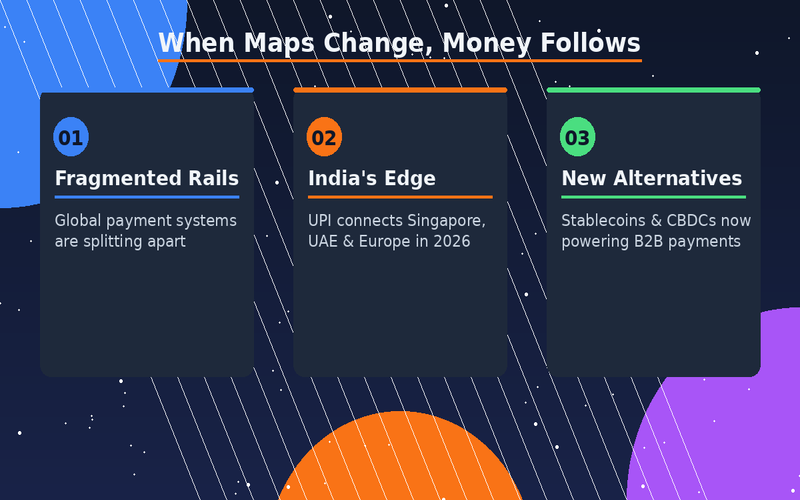
When Maps Change, Money Follows: How Geopolitics Is Rewiring B2B Payments in 2026
Payments are no longer just a plumbing problem — they're a geopolitical one. Explore how Indian B2B businesses can navigate a fragmented, fast-changing global payment landscape
Read More
What Happens Inside an Escrow Release Event? A Step-by-Step Breakdown for Businesses
A complete breakdown of escrow release events—covering triggers, validation, vendor response, and access to source code—helping businesses ensure continuity and minimize vendor risk.
Read MoreReady to Protect Your Core Systems?
Join enterprises that trust SprintEX-Code to safeguard their mission-critical software. Get started with a consultation to discuss your specific escrow requirements.