
Payment Protection for B2B Companies: How to Secure Your Revenue Pipeline Against Any Disruption
May 15, 2026
Payment Protection for B2B Companies: How to Secure Your Revenue Pipeline Against Any Disruption
Payment protection for B2B companies operates on a completely different scale from what consumer-facing businesses require. When a B2C payment fails, you lose a transaction. When a B2B payment fails, you can lose a quarter. High-value invoices, 30-to-90-day credit cycles, multi-party supplier chains, and cross-border FX exposure mean that a single disruption in your payment infrastructure can cascade into cash flow failures, broken supplier relationships, and regulatory penalties simultaneously.
Yet most payment resilience frameworks are designed with retail businesses in mind. This guide fills that gap - addressing the specific threats B2B firms face, the protection architecture that enterprise finance and operations leaders need to build, and the practical checklist for auditing your current exposure before the next disruption finds you.
The businesses that survive market chaos are not necessarily the best-funded or the most innovative. They are the ones whose revenue infrastructure was built to absorb shocks. For B2B firms, that infrastructure starts with payment protection.
Table of Contents
1. What Is Payment Protection — and Why B2B Is a Different Beast
2. Why Payment Protection Is a Board-Level Priority for B2B Firms
3. The Payment Threats That Hit B2B Companies Hardest
4. How Fintech Is Closing the B2B Payment Resilience Gap
5. B2B Payment Protection Checklist
What Is Payment Protection - and Why B2B Is a Different Beast
Payment protection is the full architecture of systems, policies, and strategies that ensure a business can reliably send and receive money regardless of what is happening externally. For B2B firms specifically, this spans six dimensions that look very different in practice from a retail context:
• Accounts receivable protection - securing high-value invoices against client default, payment delay, and commercial disputes
• Supplier payment continuity - guaranteeing that vendor, procurement, and contractor payments are never interrupted mid-cycle
• Business email compromise and fraud prevention - defending against invoice diversion, impersonation fraud, and authorised push payment scams
• Cross-border and FX risk management - protecting the value of international contracts against currency volatility between invoice and settlement
• Regulatory and trade compliance - maintaining KYC/AML, FEMA, transfer pricing, and cross-border capital flow compliance across all operating markets
• Working capital and liquidity protection - maintaining credit facilities and cash buffers when receivables are delayed
Where a B2C business might lose thousands to a failed consumer transaction, a B2B firm can lose crores to a single compromised wire transfer, a defaulting enterprise client, or a frozen cross-border payment corridor. The stakes - and the protection infrastructure required - are categorically different.
Why Payment Protection Is a Board-Level Priority for B2B Firms
Receivables Concentration Creates Catastrophic Exposure
B2B firms routinely extend credit terms of 30, 60, or 90 days to clients. This creates a structural vulnerability: revenue is earned but not yet received, concentrated in a small number of high-value counterparties. When a payment disruption hits — whether from a banking failure, a client liquidity crisis, or a frozen payment gateway — the impact is not a trickle of lost transactions. It is a sudden, large hole in your operating cash position. A single enterprise client's delayed payment can destabilise an entire quarter.
B2B Is the Primary Target of Payment Fraud
Business email compromise (BEC) — where fraudsters impersonate executives or suppliers to redirect large payments — is overwhelmingly a B2B crime. B2B companies process large individual transactions with less friction than consumer banking channels, making them the highest-value targets in the global payment fraud ecosystem. The average BEC loss per incident is orders of magnitude higher than retail fraud. For B2B firms, fraud prevention is not an IT concern. It is a financial controls imperative.
Supplier Chain Failures Cascade Rapidly
When a B2B company cannot pay its suppliers — due to a banking failure, a gateway outage, or a frozen account — the disruption does not stop at one relationship. Suppliers withdraw credit terms, apply penalty clauses, and reprioritise fulfilment capacity. A payment failure at one node in a B2B supply chain propagates across multiple tiers within days, compounding the operational and reputational damage far beyond the original financial loss.
Regulatory Exposure Is Disproportionate
B2B firms operating across markets face compounding compliance obligations that consumer businesses do not: transfer pricing scrutiny, withholding tax requirements, FEMA compliance for cross-border settlements, AML screening for counterparty payments, and evolving data localisation rules. A single compliance gap discovered in a regulatory review can generate penalties and reputational damage that dwarf the cost of a full compliance programme. In B2B, regulatory risk and payment risk are the same risk.
The Payment Threats That Hit B2B Companies Hardest
Business Email Compromise and Invoice Fraud
Fraudsters intercept or spoof supplier email communications to redirect large B2B wire transfers to controlled accounts. With average losses per incident running into tens of lakhs - and often into crores for enterprise targets - BEC is the single highest-value payment threat specific to B2B operations. The attack vector is human, not technical: your finance team receives what looks like a legitimate payment instruction change. Verification protocols for any modification to banking details are non-negotiable.
Geopolitical Disruption and Sanctions Exposure
B2B firms with international supply chains or global client portfolios face payment corridor risk that domestic-only businesses do not. The overnight imposition of SWIFT sanctions on Russia in 2022 stranded bilateral payments and supply relationships with zero warning. Any B2B firm with significant revenue or procurement exposure to a single trade corridor carries concentration risk that requires active monitoring and contingency routing — not just awareness.
Banking Concentration and Counterparty Risk
The collapse of Silicon Valley Bank in 2023 demonstrated that concentration in a single banking partner is a systemic vulnerability even for well-capitalised, professionally managed businesses. B2B firms that hold operating accounts, payroll, receivables clearing, and FX facilities all within one banking relationship have no buffer when that institution comes under stress. Multi-bank treasury management is a baseline risk control requirement for any B2B firm with material cash balances.
Long-Cycle Receivables and Client Default
Extended payment terms create an extended window of counterparty risk. A client that appeared financially sound when a 90-day invoice was issued may be under severe liquidity stress by the time payment falls due — particularly during macro downturns. B2B firms without credit monitoring on key accounts, receivables insurance, or factoring facilities have limited options when a major client defaults. The time to build those options is not when the default notice arrives.
FX Volatility on International Contracts
For B2B exporters and firms with overseas procurement, currency movements between contract signing and payment settlement can materially erode margins on contracts that appeared profitable at the outset. A 5-to-10% FX move — entirely plausible across a 60 or 90-day payment cycle — can eliminate profit entirely on thin-margin B2B contracts. Without forward contracts or structured hedging, international revenue is always partially unhedged.
How Fintech Is Closing the B2B Payment Resilience Gap
Historically, enterprise-grade payment protection tools were accessible only to large corporations with dedicated treasury teams and banking relationships. The fintech ecosystem has significantly democratised this access. B2B firms of all sizes can now leverage:
• AI-powered fraud detection and BEC alert systems integrated into payment workflows
• Automated accounts receivable platforms with credit monitoring and early-warning delinquency alerts
• Multi-currency virtual account infrastructure for international trade settlement
• Invoice financing and supply chain finance platforms that convert receivables into immediate liquidity
• Automated KYC and AML compliance tools for counterparty screening
• Real-time treasury dashboards that aggregate cash positions across multiple banks and geographies
• Embedded trade credit insurance and payment default protection products
The selection principle for B2B fintech adoption should be precision, not breadth: identify the specific payment vulnerabilities in your business model, then select tools that directly address those gaps. Technology layered without a clear risk framework creates complexity without protection.
B2B Payment Protection Checklist
Use this checklist to assess your current payment resilience posture. Each unchecked item represents an active exposure that needs to be addressed:
Banking & Infrastructure
Minimum two banking relationships across separate institutions are active
Incoming receivables, outgoing payments, and payroll can each be routed through an alternative channel
Multi-currency accounts maintained for all active international trade currencies
Fraud & Security Controls
Mandatory call-back verification protocol in place for all payment instruction changes
Dual-authorisation enforced for all outgoing payments above defined thresholds
Staff trained on BEC, invoice fraud, and social engineering on a recurring basis
Real-time anomaly detection and payment monitoring active
PCI-DSS compliance maintained and audited regularly
Receivables & Credit Risk
Credit assessments conducted on enterprise clients before payment terms are extended
Ongoing financial health monitoring in place for major accounts
Receivables insurance or factoring facility available for high-concentration exposures
Overdue invoice escalation protocols trigger early and are followed consistently
FX & Liquidity
FX hedging strategy documented and reviewed quarterly against actual exposure
Forward contracts in place for material known future foreign currency settlements
Revolving credit facility available as a working capital buffer during receivables delays
Compliance & Continuity
Regulatory compliance monitored continuously across all operating markets
FEMA compliance framework active for all cross-border payment activity (Indian firms)
Business continuity plan explicitly covers payment system failure scenarios
Incident response plan for payment system failure has been tested
Frequently Asked Questions (FAQs)
Q1. How is payment protection for B2B firms different from B2C payment security?
B2C payment security is primarily focused on protecting individual consumer transactions from fraud and data breaches. B2B payment protection addresses a much broader set of risks: high-value receivables concentration, extended credit cycle exposure, business email compromise fraud, multi-party supplier chain continuity, cross-border FX risk, and complex regulatory compliance obligations. The financial impact of a single B2B payment failure can exceed months of B2C transaction losses.
Q2. What is the biggest payment fraud risk specific to B2B companies?
Business email compromise (BEC) is consistently the highest-value payment fraud threat for B2B firms globally. Fraudsters impersonate executives, clients, or suppliers to redirect large wire transfers to controlled accounts. Because B2B transactions involve large individual amounts and are authorised by a small number of people, a single successful BEC attack can result in losses of lakhs to crores of rupees. Mandatory call-back verification for payment instruction changes is the most effective single control.
Q3. How should B2B firms manage the risk of a major client defaulting on a large invoice?
The primary tools are: credit assessment before extending payment terms, ongoing financial health monitoring of major accounts, trade credit insurance that covers client default, and invoice factoring or receivables financing to convert high-value invoices into immediate liquidity. Diversifying the client base to reduce receivables concentration is a structural protection that no single financial product can fully replace.
Q4. How do Indian B2B exporters manage cross-border payment protection?
Indian exporters should combine FEMA-compliant multi-currency virtual accounts, forward contracts to hedge FX exposure on known future settlements, and regular FEMA compliance monitoring. RBI-regulated payment platforms such as Razorpay, PayU, and Cashfree offer compliant cross-border settlement infrastructure. Legal counsel with specific FEMA expertise is advisable for firms with material international revenue.
Related Posts
What is E-Banking? Meaning, Types, Benefits & How It Works in India.
E-banking is the digital way of accessing banking services through mobile apps, websites, ATMs, and biometric systems. It enables secure, fast, and branchless financial transactions anytime and anywhere in India.
Read More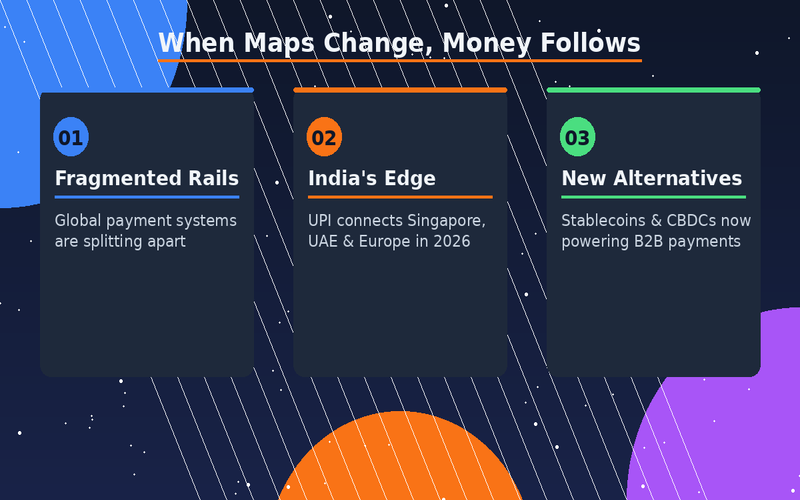
When Maps Change, Money Follows: How Geopolitics Is Rewiring B2B Payments in 2026
Payments are no longer just a plumbing problem — they're a geopolitical one. Explore how Indian B2B businesses can navigate a fragmented, fast-changing global payment landscape
Read More
What Happens Inside an Escrow Release Event? A Step-by-Step Breakdown for Businesses
A complete breakdown of escrow release events—covering triggers, validation, vendor response, and access to source code—helping businesses ensure continuity and minimize vendor risk.
Read MoreReady to Protect Your Core Systems?
Join enterprises that trust SprintEX-Code to safeguard their mission-critical software. Get started with a consultation to discuss your specific escrow requirements.