
Why Supply Chain Finance Needs Escrow: Protecting Buyers, Suppliers, and Financiers
May 20, 2026
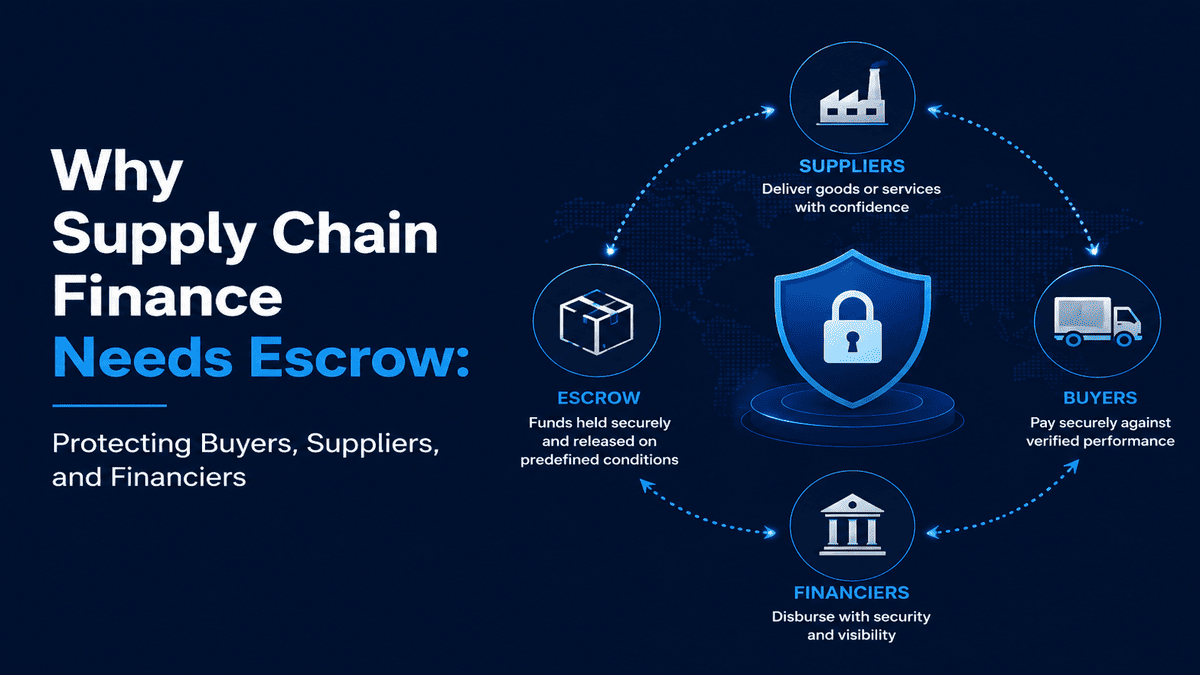
Why Supply Chain Finance Needs Escrow: Protecting Buyers, Suppliers, and Financiers
Supply chains run on trust. A manufacturer ships goods before payment is confirmed. A supplier delivers components on the promise of a 90-day credit cycle. A financier extends working capital against an invoice that has not yet been settled. At every step, someone is bearing risk on behalf of someone else — and hoping the chain holds.
Most of the time, it does. But when it does not — when a buyer delays payment, a supplier defaults mid-contract, or a financier’s disbursement lands in the wrong hands at the wrong time — the consequences ripple across the entire chain. For Indian MSMEs and mid-market suppliers, a single large buyer defaulting on payment can be an existential event.
This is the problem that escrow in supply chain finance is built to solve. And it is a problem that is growing in urgency as Indian supply chains become more complex, more digital, and more interconnected.
SprintExCode’s escrow platform places a layer of neutral, legally structured trust between every party in a supply chain finance transaction — ensuring that funds move only when the conditions are met, and that no single party bears all the risk alone.
Table of Contents
• Why Is Trust the Biggest Challenge in Supply Chain Finance?
• How Payment Risk Breaks the Supply Chain
• What Is Escrow — and Why Does Supply Chain Finance Need It?
• How Escrow Protects Each Party in the Chain
• How SprintExCode Powers Supply Chain Finance Escrow
• Key Use Cases: Where Escrow Fits in Supply Chain Finance
• Why Indian Supply Chains Face Unique Risk
• Cloud Escrow vs Physical Escrow for Supply Chain Platforms
• How SprintExCode Works: 3 Steps
• Key Platform Features
• Conclusion
• Frequently Asked Questions (FAQs)
Why Is Trust the Biggest Challenge in Supply Chain Finance?
Supply chain finance — the set of financial instruments that help buyers, suppliers, and lenders optimise cash flow across a supply chain — is one of the fastest-growing segments of trade finance in India. Programmes like invoice discounting, reverse factoring, dynamic discounting, and purchase order financing are being adopted at scale by enterprises of all sizes. But all of these instruments share a foundational vulnerability: they require parties who do not fully trust each other to exchange value before the underlying obligation is completely settled. A supplier discounting an invoice is trusting that the buyer will honour it.
A buyer releasing early payment is trusting that goods will arrive as specified. A financier disbursing against a purchase order is trusting that both the buyer and the supplier will perform. When any link in that chain of trust breaks, the financial consequences are immediate and often severe.Escrow does not eliminate risk — but it neutralises it. By placing funds or assets with a trusted third party until defined conditions are met, escrow transforms a trust problem into a process problem. And processes can be managed.
How Payment Risk Breaks the Supply Chain
Payment risk in supply chains is not an edge case. It is a structural feature of how trade credit works — and it manifests in ways that damage suppliers, buyers, and financiers alike.
For Suppliers
• Buyers delay payment beyond agreed credit terms, creating working capital gaps that force suppliers to seek expensive bridge financing
• Buyers dispute invoices after goods are delivered, withholding payment while the dispute is resolved — sometimes for months
• Large buyers use their negotiating power to extract extended credit terms that MSMEs cannot sustainably absorb
• In the worst cases, buyers default entirely, leaving suppliers with delivered goods and no payment
For Buyers
• Suppliers fail to deliver goods as specified, leaving buyers with payment obligations against non-performing contracts
• Pre-payments made to suppliers are not matched by corresponding delivery performance
• Supplier insolvency mid-contract leaves buyers without fulfilment and with recovery costs
For Financiers
• Disbursements made against invoices or purchase orders are diverted rather than used for the intended supply chain transaction
• Collateral — typically the invoice or underlying goods — is disputed, diluted, or misrepresented
• Fraud in the underlying trade transaction means the financier holds a claim against a non-existent or inflated obligation
What Is Escrow — and Why Does Supply Chain Finance Need It?
Escrow is a legal arrangement in which funds, assets, or documents are held by a neutral third party — the escrow agent — and released only when pre-defined conditions are met by one or more parties to an agreement.
In the context of supply chain finance, escrow functions as a conditional payment mechanism. Instead of a buyer paying a supplier directly — and trusting that performance will follow — or a supplier delivering goods — and trusting that payment will follow — the funds are held in escrow and released only when the agreed milestone is verified.
This simple structural change resolves the core trust problem in supply chain finance:
• Suppliers know funds exist and are committed before they deliver
• Buyers know funds are only released upon verified performance
• Financiers know their disbursements are ring-fenced for the specific transaction and released under controlled conditions
The result is a supply chain finance ecosystem where all three parties can transact with greater confidence, lower risk premiums, and fewer disputes.
How Escrow Protects Each Party in the Chain
Protection for Suppliers
For suppliers — especially MSMEs with limited negotiating power relative to large enterprise buyers — escrow provides the single most important assurance in any trade transaction: that payment is committed and ring-fenced before they begin performing.
When a buyer places funds in escrow at the time of purchase order issuance, the supplier is no longer extending unsecured credit. They are performing against a secured commitment. This fundamentally changes the risk profile of the transaction and the supplier’s willingness to offer competitive pricing and terms.
Protection for Buyers
For buyers, escrow ensures that pre-payments, advance payments, and milestone payments are not released until the supplier has met the agreed performance criteria. This is particularly critical in long-cycle manufacturing, construction, and project-based supply chains where large upfront payments are common.
Escrow also gives buyers a structured mechanism for managing disputed invoices — funds remain in escrow while the dispute is resolved, rather than creating a deadlock between payment and delivery obligations.
Protection for Financiers
For NBFCs, banks, and supply chain finance platforms extending credit against trade transactions, escrow provides the most direct form of control over disbursed funds. When a financier’s disbursement flows into an escrow account rather than directly to the supplier, the financier has assurance that the funds are applied to the specific transaction against which credit was extended.
This directly reduces fraud risk, diversion risk, and the risk of financing a trade transaction that does not exist or is materially different from what was represented.
How SprintExCode Powers Supply Chain Finance Escrow
SprintExCode is India’s leading escrow platform, providing the legal, technical, and operational infrastructure for escrow-based supply chain finance arrangements. The platform supports structured, multi-party escrow with configurable release conditions — making it adaptable to the wide variety of payment structures used across Indian supply chains.
For Supply Chain Finance Platforms and NBFCs
• Integrate escrow as a core payment infrastructure layer within your supply chain finance product
• Configure release conditions tied to invoice approval, goods receipt confirmation, quality sign-off, or any other milestone
• Full audit trails on every fund movement, providing a clean paper trail for regulatory reporting and dispute resolution
• Multi-party access controls enabling buyers, suppliers, and financiers to have appropriate visibility into escrow status
For Enterprise Buyers
• Place purchase order payments in escrow at the time of order, giving suppliers payment security without releasing funds prematurely
• Define milestone-based release schedules for complex, multi-stage supply contracts
• Reduce disputes by establishing agreed release conditions in advance
For Suppliers and MSMEs
• Receive confirmation of secured payment before committing to production or delivery
• Access escrow-backed receivables for early payment financing at significantly better rates
• Reduce dependence on unsecured trade credit from buyers with superior negotiating power
Key Use Cases: Where Escrow Fits in Supply Chain Finance
Purchase Order Financing
A supplier receives a large purchase order from an enterprise buyer but lacks the working capital to fulfil it. A financier extends credit against the purchase order — and the disbursement flows into an escrow account. Funds are released to the supplier in tranches as production milestones are verified, and the final tranche is released upon goods delivery and buyer acceptance. The financier has full visibility and control throughout.
Invoice Discounting and Factoring
A supplier discounts an invoice with a financier, receiving early payment against a receivable that will be settled by the buyer in 60 or 90 days. When the buyer’s payment is due, it flows into an escrow account from which the financier’s claim is satisfied first, and any balance is remitted to the supplier. This eliminates the risk of the buyer paying the supplier directly and the financier being left exposed.
Advance Payment Protection
A buyer makes an advance payment to a supplier for a custom manufacturing contract. Rather than paying directly — and losing leverage if the supplier underperforms — the advance is placed in escrow and released against defined delivery and quality milestones. The supplier has certainty of payment; the buyer has certainty of performance.
Reverse Factoring Programmes
Large enterprise buyers running reverse factoring programmes use escrow to ensure that early payment flows to the correct supplier entity, against verified invoices, without the risk of misdirection or fraud. SprintExCode’s multi-party escrow structure supports the three-way relationship between buyer, supplier, and financier.
Why Indian Supply Chains Face Unique Risk
India’s supply chains are characterised by a set of structural features that make payment risk particularly acute — and escrow particularly valuable.
The MSME-Enterprise Power Imbalance
India’s manufacturing and services supply chains are dominated by large enterprise buyers working with thousands of MSME suppliers. The power asymmetry in these relationships means that payment terms, dispute resolution, and credit risk are typically borne disproportionately by the smaller party. Escrow rebalances this by giving suppliers payment security that does not depend on the buyer’s goodwill.
Extended and Inconsistent Credit Cycles
Payment cycles of 60, 90, or even 120 days are common across Indian industries. For MSMEs operating on thin margins and limited working capital, this creates chronic liquidity pressure. Escrow-backed financing against secured receivables allows suppliers to access early payment at rates that reflect the secured nature of the underlying obligation.
Fragmented Trade Finance Infrastructure
India’s trade finance ecosystem remains fragmented, with limited standardisation of documentation, verification, and payment processes across sectors. This fragmentation creates gaps where fraud and disputes flourish. SprintExCode’s platform provides a standardised escrow layer that works across sectors and supply chain structures.
Regulatory Tailwinds
The RBI’s Trade Receivables Discounting System (TReDS) and the government’s push to improve MSME payment timelines through the MSME Development Act are creating regulatory momentum toward more transparent, structured payment flows in supply chains — directly aligned with what escrow delivers.
Cloud Escrow vs Physical Escrow for Supply Chain Platforms
Cloud Escrow Model
SprintExCode’s Cloud Escrow Model is the primary delivery mechanism for supply chain finance applications. It integrates directly with supply chain finance platforms, ERP systems, and banking APIs, enabling automated, milestone-triggered escrow management at scale. Release conditions are configured programmatically, and full audit trails are accessible in real time via the SprintExCode dashboard.
For supply chain finance platforms processing high transaction volumes across large buyer-supplier networks, cloud escrow provides the scalability and automation needed to make escrow economically viable at the transaction level.
Physical Escrow Model
For high-value, long-cycle supply contracts — particularly in sectors like infrastructure, defence, and capital equipment — where physical documentation and sovereign storage are required, SprintExCode’s Physical Escrow Model provides tamper-proof, fire-resistant (FRFC) storage at facilities in Delhi, Mumbai, and Bengaluru.
How SprintExCode Works: 3 Steps
Structure the Escrow Agreement: A legally structured multi-party agreement is drafted, defining the parties, the funds or assets to be held in escrow, and the precise conditions under which release is triggered. For supply chain finance, this typically covers milestone verification, invoice approval, delivery confirmation, or dispute resolution protocols.
Fund and Manage the Escrow: Funds are deposited into the SprintExCode escrow account by the buyer or financier. The platform monitors the defined conditions and provides all parties with real-time visibility into escrow status via a secure dashboard.
Trigger-Based Release: When the defined conditions are met and verified, funds are released to the appropriate party automatically. In the event of a dispute, the escrow holds funds while resolution is pursued — ensuring no party can unilaterally access funds outside the agreed terms.
Key Platform Features
• Multi-Party Escrow Architecture — supports buyer, supplier, financier, and platform as separate parties with granular access controls
• Configurable Release Triggers — milestone-based, time-based, approval-based, or event-based release conditions
• Real-Time Audit Trails — full visibility into fund movements, condition verification, and release history
• ERP and API Integration — connects with existing supply chain finance platforms, procurement systems, and banking infrastructure
• ISO 27001 Certified Platform — end-to-end encryption in transit and at rest
• VAPT by CERT-In Empanelled Auditor — independently assessed for security vulnerabilities
• Escrow as a Service (EaaS) — milestone monitoring, real-time alerts, and master control panel
• Physical Vaults in Delhi, Mumbai & Bengaluru — FRFC tamper-proof storage for high-value or regulated contracts
• Independent Verification — all deposits and conditions independently verified before release
Conclusion
Supply chain finance has the potential to unlock trillions of rupees in working capital for Indian businesses, reduce the cost of trade credit for MSMEs, and strengthen the financial resilience of the supply chains that underpin the Indian economy. But that potential is held back by a trust deficit that conventional financing instruments cannot resolve on their own.
Escrow is not a complex or exotic solution. It is a structurally simple mechanism that places neutral, conditional control over funds at the point where trust is most needed — between parties who are commercially dependent on each other but cannot fully verify each other’s performance in advance.
SprintExCode brings that mechanism to Indian supply chain finance in a form that is legally robust, operationally practical, and scalable across the full complexity of modern supply chain structures. Whether you are a buyer protecting advance payments, a supplier securing receivables, or a financier controlling disbursements, SprintExCode gives you the trust infrastructure that supply chain finance has always needed.
The supply chain that pays on time, every time, is not a fantasy. It is a process design decision. And escrow is where that process starts.
Frequently Asked Questions (FAQs)
Q: What is supply chain finance escrow and how does it work?
Supply chain finance escrow is an arrangement in which a neutral third party — SprintExCode — holds funds from a buyer or financier in a secure escrow account and releases them to the supplier only when pre-defined conditions are met, such as delivery confirmation, invoice approval, or quality sign-off. This protects all parties by ensuring that funds move only when obligations are fulfilled.
Q: How does escrow help MSMEs in supply chains?
For MSMEs, escrow provides payment security before they begin production or delivery — removing the need to extend unsecured credit to large buyers. Escrow-backed receivables also improve the quality of collateral for early payment financing, enabling MSMEs to access working capital at lower rates than unsecured trade credit.
Q: Can escrow be used for invoice discounting and factoring?
Yes. Escrow is particularly valuable in invoice discounting and factoring arrangements, where it ensures that buyer payments flow into a controlled account from which the financier’s claim is satisfied first. This eliminates the risk of the buyer paying the supplier directly, bypassing the financier’s security interest in the receivable.
Q: How does SprintExCode integrate with supply chain finance platforms?
SprintExCode’s Cloud Escrow Model provides API-based integration with supply chain finance platforms, ERP systems, and banking infrastructure. Release conditions are configured programmatically and monitored automatically, enabling escrow to operate at scale across large buyer-supplier networks without manual intervention.
Related Posts
What is E-Banking? Meaning, Types, Benefits & How It Works in India.
E-banking is the digital way of accessing banking services through mobile apps, websites, ATMs, and biometric systems. It enables secure, fast, and branchless financial transactions anytime and anywhere in India.
Read More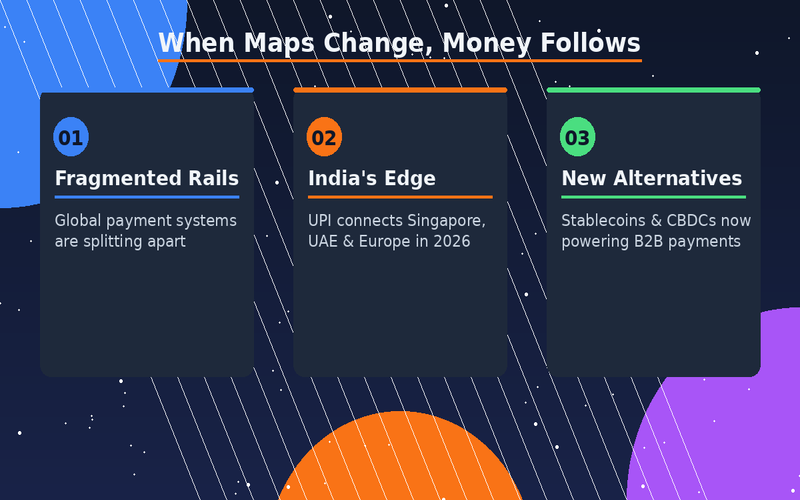
When Maps Change, Money Follows: How Geopolitics Is Rewiring B2B Payments in 2026
Payments are no longer just a plumbing problem — they're a geopolitical one. Explore how Indian B2B businesses can navigate a fragmented, fast-changing global payment landscape
Read More
What Happens Inside an Escrow Release Event? A Step-by-Step Breakdown for Businesses
A complete breakdown of escrow release events—covering triggers, validation, vendor response, and access to source code—helping businesses ensure continuity and minimize vendor risk.
Read MoreReady to Protect Your Core Systems?
Join enterprises that trust SprintEX-Code to safeguard their mission-critical software. Get started with a consultation to discuss your specific escrow requirements.