
Legal Protection for Software Assets: Why Every Business Needs Source Code Escrow
May 26, 2026
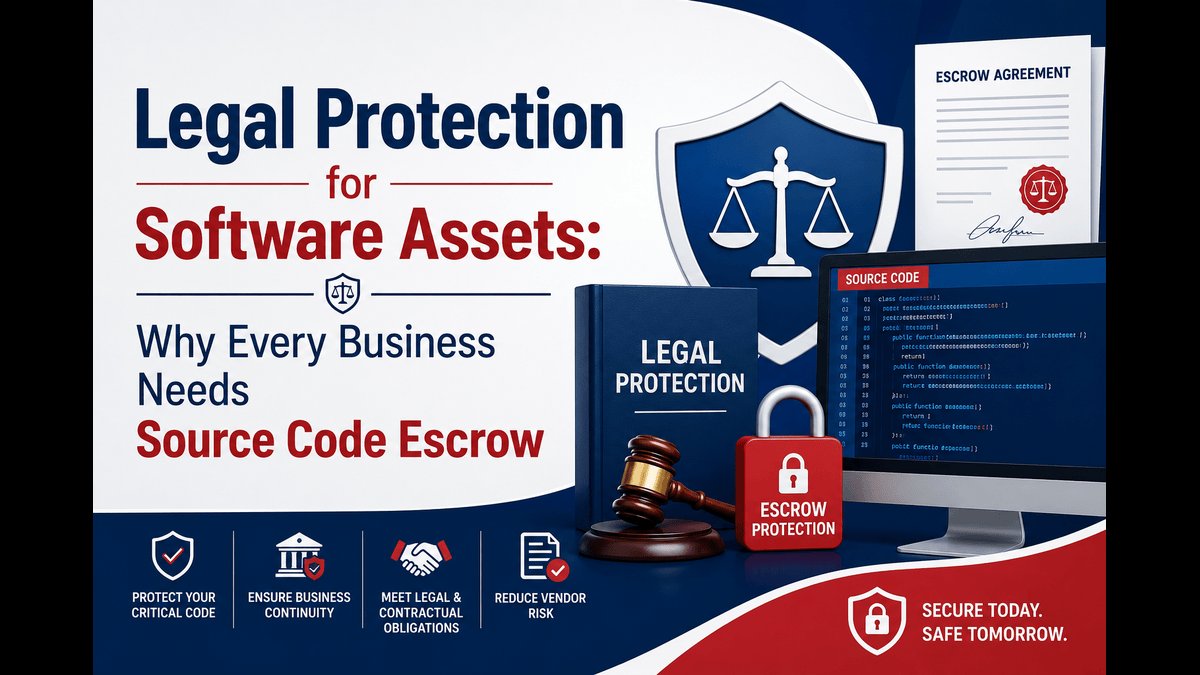
Legal Protection for Software Assets: Why Every Business Needs Source Code Escrow
Legal protection for software is one of the most overlooked areas of business risk management in India. Companies invest heavily in contracts, compliance teams, and regulatory frameworks — yet when it comes to the technology that powers their entire operation, they leave the most critical asset entirely unprotected.
Think about what your business actually runs on. A core banking system. A proprietary CRM. A custom ERP developed by an external vendor. The software that processes transactions, manages customer data, generates reports, and keeps the business moving. Now ask: if that vendor went bankrupt tomorrow, would you have legal access to the source code? Would you be able to keep operating?
For most businesses, the answer is no. And that is not a technology problem. It is a legal problem.
Source code escrow is the legal mechanism that closes this gap. It is a formal, enforceable arrangement in which a neutral third-party escrow agent holds a copy of the vendor's source code, documentation, and related assets — and releases them to the licensee when defined legal trigger events occur: vendor bankruptcy, breach of contract, prolonged service failure, or cessation of business.
SprintEX-Code by PaySprint brings this legal protection to Indian businesses through a platform built for the compliance requirements, regulatory frameworks, and technical realities of the Indian market. This is your complete guide — published on Legal Tech Hub, PaySprint's dedicated vertical for the intersection of law, technology, and business continuity.
Table of Contents
1. What Is the Legal Basis for Source Code Escrow?
2. Why Is Legal Protection for Software a Business-Critical Issue?
3. What Are the Legal Trigger Events That Release Escrowed Code?
4. What Should a Legally Sound Escrow Agreement Include?
5. How Does SprintEX-Code Deliver Legal-Grade Software Protection?
6. Who in Your Organisation Needs to Be Involved in Escrow Agreements?
7. Conclusion
8. Frequently Asked Questions (FAQs)
What Is the Legal Basis for Source Code Escrow?
Source code escrow is grounded in contract law. At its simplest, it is a tripartite agreement between three parties: the software vendor (depositor), the business licensee (beneficiary), and the escrow agent (neutral custodian). Each party has defined legal obligations, rights, and remedies — and the agreement is enforceable under Indian contract law and relevant sector regulations.
The escrow agreement specifies what is deposited (source code, build instructions, documentation, data), the conditions under which it is released (trigger events), the verification procedures that confirm the deposit is complete and functional, and the dispute resolution mechanisms if either party contests a release.
For regulated industries — banks, NBFCs, insurance companies, healthcare platforms, and government technology projects — source code escrow is not just a best practice. It is a regulatory expectation. RBI Master Directions on IT Framework, for example, require regulated entities to have contractual protections for business continuity when technology is sourced from third-party vendors. Source code escrow directly satisfies this requirement.
Why Is Legal Protection for Software a Business-Critical Issue?
Most businesses sign software licences with a standard set of assumptions: the vendor will keep supporting the product, the code will keep working, and if something goes wrong, the contract will protect them. In practice, none of these assumptions are guaranteed — and when they fail, the consequences are severe.
What Happens When a Software Vendor Fails?
Vendor failure is more common than most organisations anticipate. A vendor may go bankrupt, be acquired and have the product discontinued, face a legal injunction that prevents them from distributing the software, or simply cease operations with little notice. In every one of these scenarios, the licensee — who has often built years of operational dependency on the software — is left without access to the underlying code.
Without source code escrow, the business has no legal right to access, modify, or maintain the software. The licence agreement grants the right to use the compiled product — not the underlying code. When the vendor disappears, so does the ability to fix bugs, adapt to new regulatory requirements, or migrate to a new platform.
Is a Standard Licence Agreement Enough Legal Protection?
A software licence agreement establishes the terms of use, payment, intellectual property ownership, and liability — but it does not give the licensee access to the source code. That access is held by the vendor, and it disappears when the vendor does. Source code escrow creates a separate, independent legal channel for access that survives vendor failure — precisely because it is managed by a neutral third party, not the vendor.
What Are the Legal Trigger Events That Release Escrowed Code?
The release trigger is the legal heart of any escrow agreement. It defines the precise circumstances under which the escrowed materials are released to the beneficiary — and it must be drafted with enough specificity to be enforceable, while remaining broad enough to cover the full range of scenarios in which the licensee genuinely needs access.
The most commonly defined trigger events in source code escrow agreements include:
• Vendor insolvency or bankruptcy: The vendor is placed in liquidation, receivership, or voluntary administration. This is the most fundamental trigger — when the vendor ceases to exist as a legal entity, the licensee's ability to continue operating the software must be preserved.
• Material breach of the software agreement: The vendor fails to provide contracted support, maintenance, or updates within a defined period and does not remedy the breach after notice.
• Cessation of software support: The vendor announces end-of-life for the product or discontinues support without providing an agreed migration path.
• Prolonged service failure: The software fails to operate as specified and the vendor fails to restore functionality within an agreed resolution window.
• Change of control: The vendor is acquired, merged, or undergoes a change of ownership that results in the licensee's support being discontinued or materially degraded.
• Regulatory trigger: A regulatory body requires the licensee to demonstrate access to source code as a condition of continued operation — as may be required under RBI IT framework directions.
What Should a Legally Sound Escrow Agreement Include?
Not all escrow agreements offer the same level of legal protection. A poorly drafted agreement can leave the beneficiary with technically held assets they cannot access when they need them most. These are the elements that make the difference between an escrow agreement that holds up legally and one that does not.
Is the Deposit Obligation Clearly Defined?
The agreement must specify exactly what must be deposited: source code, build files, configuration scripts, database schemas, API documentation, third-party dependencies, and any other materials required to compile, deploy, and operate the software. Vague deposit obligations — "source code and related materials" — invite disputes about completeness at the time of release.
Are Verification Procedures Legally Binding?
A deposit that has never been verified is a legal liability, not an asset. The escrow agreement should require periodic independent verification of deposited materials — confirming that the code compiles, that the build instructions are complete, and that the software operates as described. SprintEX-Code's independent verification service satisfies this requirement, giving beneficiaries a legally defensible confirmation that what is held in escrow is what they would actually need.
Is the Dispute Resolution Process Enforceable?
When a release is contested — typically by the vendor, who may dispute that a trigger event has occurred — the agreement needs a clear, time-bound dispute resolution process. This should include an independent determination mechanism, defined timelines for response, and a fallback arbitration or court jurisdiction clause. Without this, a legitimate release request can be stalled indefinitely while the beneficiary's operations deteriorate.
Does the Agreement Cover Regulatory Requirements?
For regulated entities, the escrow agreement must align with sector-specific regulatory expectations. SprintEX-Code agreements are structured in compliance with RBI Master Directions on IT Framework, ISO 27001, and PCI-DSS — ensuring that the escrow arrangement itself passes regulatory scrutiny, not just the deposit.
How Does SprintEX-Code Deliver Legal-Grade Software Protection?
SprintEX-Code by PaySprint is India's dedicated source code escrow platform, built from the ground up to deliver the legal, technical, and regulatory standards that Indian businesses and regulators require. Here is how the platform delivers on each dimension of legal protection.
Legally Structured Tripartite Agreements
Every SprintEX-Code engagement begins with a formally drafted tripartite escrow agreement between the vendor, the licensee, and PaySprint as escrow agent. The agreement is structured for enforceability under Indian contract law and aligned with applicable sector regulations — giving all parties a legally sound foundation from day one.
Dual-Mode Secure Deposit
SprintEX-Code offers two deposit modes to match the risk profile and regulatory requirements of each engagement. Physical escrow uses tamper-proof, fire-resistant (FRFC) lockers in secure facilities across Delhi, Mumbai, and Bengaluru. Cloud escrow integrates directly with GitHub, GitLab, Bitbucket, AWS, Azure, and GCP — with automated deposit via CI/CD pipelines ensuring that the escrowed version is always current.
Independent Verification
Every deposit on the SprintEX-Code platform undergoes independent verification by PaySprint. Tiered verification options range from basic integrity checks (checksum and hash validation) through to full environment replication with runtime validation — providing the legal-grade evidence that the deposited materials are complete and functional.
Automated Release on Legal Trigger
SprintEX-Code's release engine is designed for both speed and legal certainty. When a defined trigger event occurs and is validated, the platform releases the escrowed materials to the beneficiary through a controlled, audited process. Every step — deposit, verification, trigger notification, release instruction — is recorded in an immutable audit trail that serves as legal evidence in any subsequent dispute.
Who in Your Organisation Needs to Be Involved in Escrow Agreements?
Source code escrow is a cross-functional legal and operational instrument. Getting the right stakeholders involved from the start prevents gaps in coverage, delays in enforcement, and misalignment between what the agreement says and what the business actually needs.
Legal and Compliance Teams
Legal teams are responsible for reviewing and approving the tripartite agreement, ensuring that trigger events are correctly defined, that dispute resolution mechanisms are enforceable, and that the agreement aligns with the organisation's broader IP and data protection framework. For regulated entities, compliance teams must confirm that the escrow arrangement satisfies applicable regulatory requirements.
Technology and IT Leadership
IT teams define what must be deposited — the specific code repositories, configuration files, documentation, and dependencies that would be needed to maintain and operate the software in the event of a release. They also manage the technical integration with SprintEX-Code's CI/CD pipeline for automated deposits, and participate in verification exercises to confirm that deposited materials are complete and functional.
Procurement and Vendor Management
Procurement teams are often the first point of contact for vendor escrow negotiations. They need to understand the legal and commercial value of escrow in the context of total vendor risk, and ensure that escrow obligations — deposit frequency, verification schedule, update requirements — are reflected in the primary software agreement with the vendor.
Whether you are negotiating with technology vendors, managing source code deposits, or ensuring regulatory compliance for your software stack — optimising your escrow agreements ensures better legal protection, operational continuity, and regulatory confidence.
Conclusion
Legal protection for software assets is not a formality reserved for large enterprises with dedicated legal teams. It is a business necessity for every organisation that depends on software it does not fully own — which, in the modern economy, means virtually every business operating in India today.
The legal framework is available. The technology is mature. The regulatory expectations are clear. What most businesses are missing is the structured, enforceable mechanism that translates legal intent into operational protection. That mechanism is source code escrow — and SprintEX-Code is the platform that makes it practical, compliant, and scalable for Indian businesses of every size.
From legally structured tripartite agreements and independent verification to automated release on defined triggers, SprintEX-Code gives legal and technology teams the tools to close the most dangerous gap in their vendor risk framework. Because when a vendor fails, the only thing standing between your business and operational shutdown is the legal protection you put in place before it happened.
Frequently Asked Questions (FAQs)
Q: What is source code escrow and why is it a legal requirement?
Source code escrow is a legally enforceable tripartite arrangement in which a neutral escrow agent holds a software vendor's source code and releases it to the licensee when defined trigger events occur — such as vendor bankruptcy, material breach, or cessation of support. For regulated industries in India, including banks, NBFCs, and insurance companies, source code escrow directly satisfies RBI IT Framework requirements for third-party technology risk management and business continuity planning.
Q: What makes a source code escrow agreement legally enforceable?
A legally enforceable escrow agreement must include a clearly defined deposit obligation specifying all materials to be held, precise trigger event definitions that leave no room for ambiguity, independent verification procedures confirming the deposit is complete and functional, a time-bound dispute resolution process with an enforceable fallback arbitration clause, and alignment with applicable sector regulations. SprintEX-Code agreements are structured to meet all of these requirements under Indian contract law and RBI regulatory framework.
Q: How does SprintEX-Code's platform work for legal teams?
SprintEX-Code provides legal teams with a formally structured tripartite agreement, a complete audit trail of every deposit, verification, and release event, and tiered verification services that produce legally defensible evidence of deposit completeness and functionality. The platform supports both physical escrow in FRFC-secured facilities across Delhi, Mumbai, and Bengaluru, and cloud escrow integrated with major repository platforms and cloud providers — giving legal teams the flexibility to match the escrow structure to the specific risk profile of each vendor relationship.
Q: Is SprintEX-Code suitable for SaaS and cloud-based software agreements?
Yes. SprintEX-Code is designed specifically to address the legal protection challenges of SaaS and cloud-based software, where traditional physical escrow models are insufficient. The platform supports automated deposit via CI/CD pipelines directly integrated with GitHub, GitLab, Bitbucket, AWS, Azure, and GCP — ensuring that cloud-hosted source code, configuration files, and deployment scripts are continuously deposited and independently verified. The legal agreement is structured to reflect the specific continuity risks of SaaS arrangements, including platform migration rights and data export obligations.
Related Posts
What is E-Banking? Meaning, Types, Benefits & How It Works in India.
E-banking is the digital way of accessing banking services through mobile apps, websites, ATMs, and biometric systems. It enables secure, fast, and branchless financial transactions anytime and anywhere in India.
Read More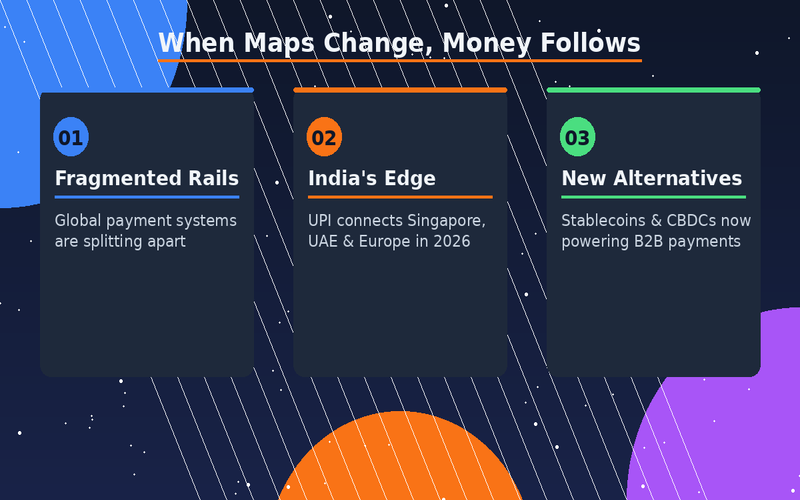
When Maps Change, Money Follows: How Geopolitics Is Rewiring B2B Payments in 2026
Payments are no longer just a plumbing problem — they're a geopolitical one. Explore how Indian B2B businesses can navigate a fragmented, fast-changing global payment landscape
Read More
What Happens Inside an Escrow Release Event? A Step-by-Step Breakdown for Businesses
A complete breakdown of escrow release events—covering triggers, validation, vendor response, and access to source code—helping businesses ensure continuity and minimize vendor risk.
Read MoreReady to Protect Your Core Systems?
Join enterprises that trust SprintEX-Code to safeguard their mission-critical software. Get started with a consultation to discuss your specific escrow requirements.