
Contract Renewal Management: Process, Best Practices & Software
Oct 12, 2026
Contract Renewal Management: How to Track Deadlines and Avoid Unwanted Renewals
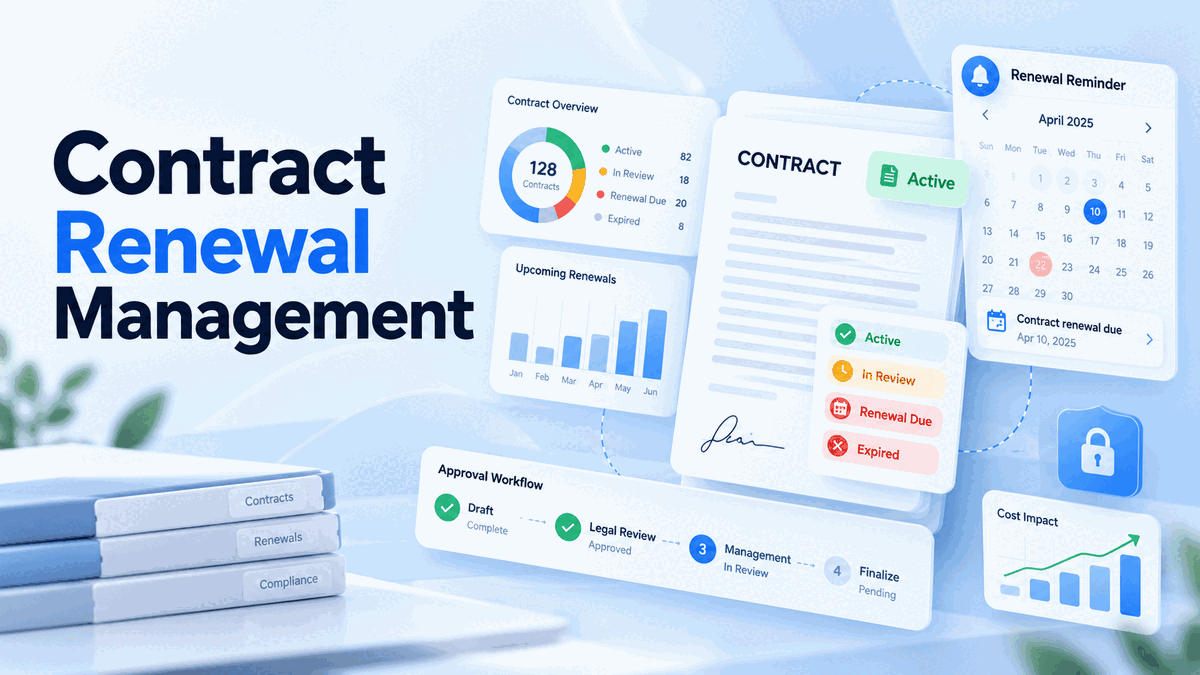
Contract renewal management is the process of tracking contract deadlines, reviewing an agreement’s performance and terms, and deciding whether to renew, renegotiate, extend or end the relationship. It connects important dates with the people, approvals and actions needed to make an informed decision before the relevant deadline.
Key Takeaways
Track notice deadlines separately from expiry dates. An expiry reminder can arrive after the window for opting out of renewal has closed.
Assign a clear owner and review the business need. A contract should not continue simply because no one took responsibility for checking it.
Connect reminders with decisions and approvals. Early visibility gives teams time to assess performance, discuss changes and complete the required action.
Table of Contents
Why Is Contract Renewal Management Important?
What Is the Difference Between an Expiry Date and a Notice Deadline?
How Does the Contract Renewal Process Work?
When Should You Start a Contract Renewal Review?
How Does SprintContractX Support Contract Renewal Management?
How Can You Measure Your Renewal Process?
Frequently Asked Questions
Conclusion
Why Is Contract Renewal Management Important?
Contract renewal management helps businesses avoid unplanned commitments, prepare for negotiations and maintain agreements they still need. Without a review, an agreement may continue on unsuitable terms—or an important service may expire without the necessary renewal action.
The business review matters just as much as the date.
For a vendor agreement, the review should consider whether the service is still needed, whether performance has met expectations and whether the next term offers appropriate value. Involving the people who use the service gives the decision practical context.
Ownership matters too. World Commerce & Contracting identifies disconnected contract information and unclear accountability as barriers to managing obligations, performance and commercial outcomes.
A useful internal rule is:
Every upcoming renewal should have a known deadline, a responsible person and a recorded decision.
What Is the Difference Between an Expiry Date and a Notice Deadline?
The expiry date marks the end of the current contract term. A notice deadline is the date by which a party must take a specified action, such as giving notice that it does not intend to renew. These dates can be different and should be tracked separately.
For your internal renewal register, use distinct fields rather than one column labelled “contract date”:
The first two fields should reflect the agreement. The internal dates are planning controls your team sets.
Example: a reminder before expiry can still be too late
This is an illustrative scenario, not a customer case study.
A vendor agreement’s current term ends on 31 March. The agreement expressly sets 31 January as the deadline for providing non-renewal notice.
Your team schedules a reminder for 1 March.
The reminder arrives before the contract ends, but after the stated notice deadline.
The process should therefore work backwards from the January action deadline, not only the March expiry date. Confirm notice requirements against the signed agreement, with legal review where needed.
How Does the Contract Renewal Process Work?
A practical contract renewal process moves from a complete contract record to an approved decision and documented action. The following six-step workflow provides a starting point for your team.
1. Gather the latest agreement and supporting documents
Begin with the signed contract, relevant amendments and previous renewal documents. Keep them accessible in one place so reviewers can assess the current arrangement rather than an outdated version.
Before starting the review, ask:
“Do we have everything that changes the terms of this agreement?”
2. Confirm the renewal mechanism and dates
Check whether the agreement renews automatically, requires active agreement or ends unless another action is taken. Record the applicable dates and requirements, including any separate renewal opt-out deadline.
Do not assume that every agreement follows the same notice period. Flag unclear wording for review before configuring reminders.
3. Assign a contract owner and the necessary reviewers
Choose one person to coordinate the renewal. Identify who needs to assess the commercial terms, service performance, budget and contractual requirements.
Clear accountability helps prevent decisions from becoming lost between departments. A shared folder alone does not establish who is responsible for acting.
Recommended practice: Name a backup owner and record who should receive an escalation when a decision is overdue.
4. Review performance, usage and business needs
Evaluate whether the agreement still supports the business. Consider the service received, actual usage, current pricing, unresolved issues and any change in requirements.
A simple review note can answer three questions:
What should continue? What should change? What evidence supports the recommendation?
5. Approve the next step before the action deadline
Decide whether to continue on the current terms, negotiate changes, agree an appropriate extension or follow the applicable process for ending the relationship. Include the necessary reviewers and approvers before completing the action.
Recommended practice: Give the approver a short decision summary containing the proposed outcome, commercial impact, unresolved questions and deadline.
6. Complete the action and update the record
Save the relevant approval, communication and final documentation. Update the contract status and dates so the next renewal cycle is tracked correctly. Renewal workflows need this record maintenance after the current decision is completed.
Treat “decision approved” and “required action completed” as separate statuses. This makes unfinished work visible.
When Should You Start a Contract Renewal Review?
Start early enough to complete the review, negotiation, approval and required communication before the relevant notice or action deadline. The appropriate lead time depends on the agreement’s complexity, value and importance to the business. There is no single review window that suits every contract.
The following is a suggested internal schedule, not a legal requirement or industry benchmark:
Adjust the schedule to the agreement. For a business-critical service, work backwards from the time needed to evaluate alternatives and manage a transition—not just from the time needed to send a notice.
How Does SprintContractX Support Contract Renewal Management?
SprintContractX is PaySprint’s AI-powered contract lifecycle management platform. It supports renewal management through notice-period and renewal alerts, obligation tracking, approval workflows and a centralised contract repository. These capabilities connect upcoming deadlines with the agreement and the people responsible for reviewing it.
These features are described on the SprintContractX product page.
When evaluating the platform, use a representative agreement from your business. Ask the team to demonstrate how its notice deadline, owner, reminders and approval process would be configured.
See how your renewal workflow could work with SprintContractX.
How Can You Measure Your Renewal Process?
Use measures that show whether your team is making and completing decisions on time—not simply receiving reminders.
The following are suggested internal measures, rather than published industry benchmarks.
On-time decision rate
Formula:
Renewals with an approved decision by the internal decision deadline ÷ all renewals with a decision due in the period × 100.
This separates timely decisions from those completed at the last minute or after the deadline.
Verified-record coverage
Formula:
Active renewable agreements with verified dates and a named owner ÷ all active renewable agreements × 100.
Use this measure to identify gaps before those agreements reach their review window.
Open actions past their internal deadline
Count renewal actions that remain unfinished after the internal deadline. Review each one by owner, blocker and next step.
Keep this separate from the decision rate. An approved decision does not necessarily mean the required notice or documentation has been completed.
A useful reporting question is:
“Which agreements still need action, and what is preventing completion?”
Conclusion
Contract renewal management should give your team enough time and information to make a decision—not simply announce that an agreement is about to expire. Begin with verified dates, assign a clear owner, review whether the agreement still serves the business and record the completed action. Connect those steps so that no decision is left between an inbox, a spreadsheet and an approval request.
Make your next renewal a planned business decision—not a last-minute surprise.
Explore SprintContractX. Book a Demo
Frequently Asked Questions
What is contract renewal management software?
Contract renewal management software helps teams organise agreement records, track important dates, send reminders and coordinate renewal decisions. These capabilities may sit within a wider contract lifecycle management platform rather than a standalone renewal tool.
Does an automatically renewing contract still need a review?
Yes, as a business practice. Automatic renewal does not establish whether the agreement still suits current requirements. A review provides an opportunity to assess the terms and decide whether continuation is appropriate before the relevant deadline.
Can a spreadsheet be used to manage contract renewals?
A spreadsheet can serve as a register when the process remains controlled. The practical test is whether your team can reliably maintain the dates, assign ownership, issue reminders and record decisions.
Consider a more structured workflow when those activities depend on repeated follow-ups or a single person’s private tracker.
Can automated reminders guarantee that no renewal will be missed?
No. A reminder cannot ensure that the underlying date is correct or that someone completes the action. Treat automation as a control within the process—not a substitute for verified information, ownership and follow-through.
Does SprintContractX provide contract renewal alerts?
Yes. SprintContractX’s published capabilities include alerts for milestones, notice periods and renewals, with notifications directed to the responsible owner.
Related Posts

What is E-Banking? Meaning, Types, Benefits & How It Works in India.
E-banking is the digital way of accessing banking services through mobile apps, websites, ATMs, and biometric systems. It enables secure, fast, and branchless financial transactions anytime and anywhere in India.
Read More
When Maps Change, Money Follows: How Geopolitics Is Rewiring B2B Payments in 2026
Payments are no longer just a plumbing problem — they're a geopolitical one. Explore how Indian B2B businesses can navigate a fragmented, fast-changing global payment landscape
Read More
What Happens Inside an Escrow Release Event? A Step-by-Step Breakdown for Businesses
A complete breakdown of escrow release events—covering triggers, validation, vendor response, and access to source code—helping businesses ensure continuity and minimize vendor risk.
Read MoreReady to Protect Your Core Systems?
Join enterprises that trust SprintEX-Code to safeguard their mission-critical software. Get started with a consultation to discuss your specific escrow requirements.