
We Trust Our Vendors: Why That Sentence Is Costing Indian B2B Businesses More Than They Think
May 06, 2026

We Trust Our Vendors: Why That Sentence Is Costing Indian B2B Businesses More Than They Think
Vendor trust is a relationship asset, not a financial control. In India’s B2B economy in 2026, businesses that use trust as a substitute for payment structure are carrying unpriced risk. SprintEXcrow gives you both.
Vendor trust is valuable , but it is not a payment policy. Across Indian B2B businesses today, the phrase “we’ve worked with them for years, we trust them” functions as the default answer to why advance payments go out without conditions, why delivery goes unverified, and why 2 crore contracts carry no structured payment hold. That answer reflects real relationships. The problem is the job it is being asked to do.
Table of Contents
1. What Is the “Vendor Trust” Problem?
2. Why Informal Trust Made Sense , And Why It No Longer Does
3. Three Ways “We Trust Our Vendors” Fails as a Financial Control
4. Trust vs. Structure: What’s the Difference?
5. How SprintEXcrow Separates Trust from Risk
6. The Negotiation Advantage Nobody Talks About
What Is the “Vendor Trust” Problem?
The vendor trust problem is the systematic substitution of relationship confidence for structured payment controls.
When businesses release advance payments, skip delivery verification, or set payment terms based on familiarity rather than documented conditions, they are using trust as a financial instrument. This creates a risk exposure that grows quietly as transaction values rise, vendor financial conditions change, and counterparty networks expand beyond established relationships. The problem is not that vendor trust is wrong. The problem is that it is doing a job it was never designed to do.
Why Informal Trust Made Sense , And Why It No Longer Does
India’s commercial ecosystem has historically been built on dense, long-standing personal and business networks. A vendor who has supplied reliably for a decade carries reputational stakes and social accountability that function as informal enforcement. Advance payments without formal conditions were rational , the social infrastructure provided enough accountability to make formal structure redundant.
What has changed is not the vendors. It is the environment they are operating in.
Three structural shifts have eroded those conditions: widespread vendor financial stress from post-pandemic cost inflation and tighter credit; rapidly expanding counterparty networks that go beyond established relationships; and transaction values scaling faster than payment controls. A percentage advance that was manageable on a 20 lakh contract carries a very different risk profile on a 2 crore one.
Three Ways “We Trust Our Vendors” Fails as a Financial Control
It is binary where controls need to be graduated
Trust is essentially on or off. Financial controls are calibrated to transaction value, counterparty risk profile, and delivery complexity. A payment framework that defaults to “we trust them” has no mechanism for increasing rigour as values grow and no graduation between a 5 lakh order and a 5 crore one.
It has no enforcement mechanism when circumstances change
Trust works as a control because it is reinforced by consequences , reputational and relational. But those consequences depend on the vendor continuing to operate in the same network and caring about future business. When any of those conditions change, the trust-based control has no fallback.
It is invisible to everyone except the people who established it
Relationship trust exists in the heads of the individuals who built it, not in the systems that govern business operations. When those individuals leave , and in India’s current talent market, they do , the institutional knowledge of why a vendor is trusted leaves with them.
Trust vs. Structure: What’s the Difference?
Vendor trust governs the relationship. Payment structure governs the transaction. The most effective Indian B2B businesses operate with both.
How SprintEXcrow Separates Trust from Risk
PaySprint’s SprintEXcrow lets businesses maintain vendor relationships while introducing payment structure that protects both parties.
Milestone-linked fund release: Buyers and vendors define payment milestones at transaction initiation. Funds held in escrow are released when conditions are verified , not when either party decides the timing feels right.
Bilateral protection: SprintEXcrow protects vendors as well as buyers. A vendor working through SprintEXcrow has confirmation that buyer funds are committed and held , they are delivering against secured payment, not a promise.
Neutral trustee oversight: Neither buyer nor vendor can unilaterally trigger or block a release. The trustee evaluates evidence against defined conditions, keeping payment structure intact even when the relationship is under strain.
Documented audit trail: Every SprintEXcrow transaction generates a complete record , conditions defined, verification events, release authorisations, fund movements. This creates institutional memory that outlasts any individual relationship manager.
The Negotiation Advantage Nobody Talks About
When a buyer approaches a vendor with an escrow-structured payment proposal, they are demonstrating financial seriousness. Funds will be placed in escrow at deal signing , not released contingently on future cash positions or internal approval processes. Vendors who have experienced payment delays respond with measurable commercial flexibility: better pricing, shorter negotiation cycles, and improved capacity access.
The traditional advance payment model benefits only the vendor , the buyer takes on delivery risk in exchange for securing supply. SprintEXcrow restructures this so that the buyer secures supply and the vendor secures payment, simultaneously, through the same mechanism.
Conclusion
“We trust our vendors” will remain one of the most important sentences in Indian B2B commerce.
Trust is real, it is valuable, and it is not going away. What is going away , or should be , is its use as a substitute for payment structure. In a B2B economy where vendor financial stability is more volatile, transaction values are larger, and counterparty networks are broader, trust and structure are both necessary. Neither is sufficient alone.
SprintEXcrow gives Indian businesses the infrastructure to honour their vendor relationships and protect their treasury positions at the same time. The businesses that understand this distinction in 2026 will be the ones their vendors trust most in 2030.
Frequently Asked Questions
Q1. What does “vendor trust as a treasury strategy” mean?
Using relationship confidence as a substitute for formal payment controls , releasing advances, skipping delivery verification, or setting terms based on familiarity rather than documented conditions. It creates unpriced financial risk that grows as transaction values increase.
Q2. What is SprintEXcrow and how does it work?
SprintEXcrow is PaySprint’s digital escrow-as-a-service platform for B2B transactions. Buyer funds are held in a regulated escrow account until defined delivery or milestone conditions are verified by a neutral trustee. Neither party can unilaterally trigger or block a release. Every transaction generates a tamper-evident audit trail.
Q3. Does using SprintEXcrow signal distrust to long-term vendors?
No. When introduced correctly, escrow-structured payments are received as a mutual protection mechanism. Vendors benefit because their payment is committed and held from deal signing , they are delivering against secured payment, not a promise. Present escrow as a standard structure applied consistently across all significant transactions.
Q4. How does SprintEXcrow handle advance payments vendors need for production?
SprintEXcrow supports milestone-tranche advance payment structures. Advance funds are placed into escrow and released in tranches tied to verified production milestones. The vendor gets the working capital they need at each stage; the buyer retains structured recourse if conditions are not met.
Q5. Is digital escrow practical for high-volume vendor networks?
Yes. SprintEXcrow’s API-first architecture is designed for high-volume B2B environments. Businesses can integrate escrow logic into existing procurement and ERP systems, making it the default payment structure for defined transaction types rather than a manual, case-by-case process.
Related Posts
What is E-Banking? Meaning, Types, Benefits & How It Works in India.
E-banking is the digital way of accessing banking services through mobile apps, websites, ATMs, and biometric systems. It enables secure, fast, and branchless financial transactions anytime and anywhere in India.
Read More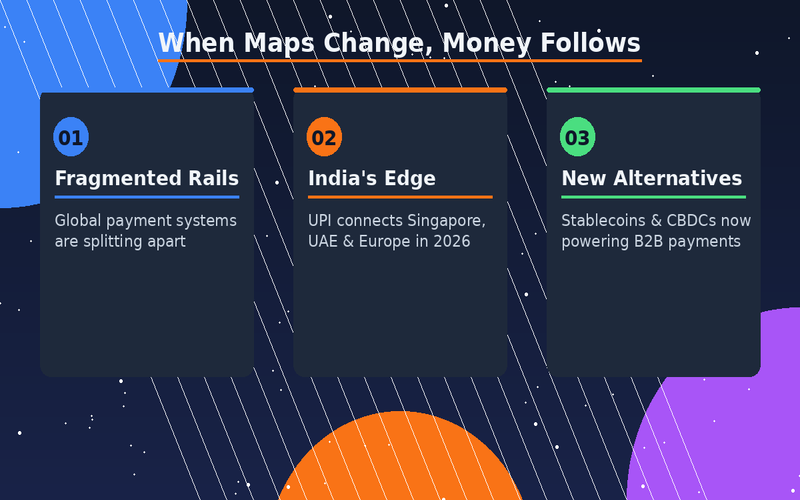
When Maps Change, Money Follows: How Geopolitics Is Rewiring B2B Payments in 2026
Payments are no longer just a plumbing problem — they're a geopolitical one. Explore how Indian B2B businesses can navigate a fragmented, fast-changing global payment landscape
Read More
What Happens Inside an Escrow Release Event? A Step-by-Step Breakdown for Businesses
A complete breakdown of escrow release events—covering triggers, validation, vendor response, and access to source code—helping businesses ensure continuity and minimize vendor risk.
Read MoreReady to Protect Your Core Systems?
Join enterprises that trust SprintEX-Code to safeguard their mission-critical software. Get started with a consultation to discuss your specific escrow requirements.