
Software Escrow Agreement: A Complete Guide for Fintech & SaaS Businesses in India (2025)
Jun 18, 2026
Software Escrow Agreement: A Complete Guide for Fintech & SaaS Businesses in India (2025)
A software escrow agreement is a legally binding, three-party contract between a Software Developer (Depositor), a Client or End User (Beneficiary), and a neutral third-party Escrow Agent. The agent securely stores the software's source code, documentation, and related assets — and releases them to the Beneficiary only when specific trigger conditions are met, such as vendor bankruptcy or failure to provide support.
For Indian fintech and SaaS businesses, this agreement is the difference between business continuity and catastrophic operational failure.
Table of Contents
What Is a Software Escrow Agreement?
Why Fintech & SaaS Businesses in India Need It
The 3 Parties in a Software Escrow Agreement
What Gets Deposited?
Key Clauses Every Business Must Know
Release Conditions: When Is the Code Released?
Software Escrow vs SaaS Escrow: Key Differences
RBI & Regulatory Compliance Angle
How Sprint Excode's Digital Escrow Agreement Works
What Is a Software Escrow Agreement?
A software escrow agreement (also called a source code escrow agreement) is a formal contract that protects all parties in a software licensing relationship.
Here is how it works in simple terms:
A software vendor (Depositor) builds critical software for your business
You (the Beneficiary) depend on that software for your daily operations
A neutral third party (Escrow Agent, like SprintEX-Code) holds the source code in secure storage
If the vendor shuts down, goes bankrupt, or stops supporting the software, the Escrow Agent releases the code to you so your business can continue operating
Think of it as a safety deposit vault for your most critical business software — accessible only under conditions that protect everyone involved.
Who needs a software escrow agreement?
Any business that:
Relies on custom-built or third-party software to run operations
Uses SaaS platforms for payments, lending, KYC, or compliance
Has invested significantly in a software vendor relationship
Operates in a regulated sector like fintech, BFSI, healthcare, or manufacturing
Why Fintech & SaaS Businesses in India Need It?
India's fintech sector now has over 9,000 startups and is growing at an unprecedented pace. Payment gateways, lending platforms, neobanks, and insurance tech companies all run on third-party software infrastructure — UPI routing engines, fraud detection systems, KYC APIs, and compliance platforms.
The risk nobody talks about:
What happens to your business if your core software vendor:
Files for insolvency or shuts down overnight?
Gets acquired and discontinues your product?
Refuses to provide maintenance or critical security updates?
Experiences a major dispute that freezes their operations?
Without a software escrow agreement, your business is exposed to complete operational paralysis.
Real business risks for Indian fintechs without escrow:
A software escrow agreement is your legal and technical safety net against all of the above.
The 3 Parties in a Software Escrow Agreement
Every software escrow agreement involves exactly three parties. Understanding each role is essential before signing.
Party 1: The Depositor (Software Developer / Vendor)
The Depositor is the software company or developer who owns the intellectual property (IP) rights to the software. They are responsible for:
Depositing the source code, build documentation, and technical assets with the Escrow Agent
Keeping the deposit updated whenever a new version is released
Complying with the terms of the agreement
SprintEX-Code benefit for Depositors: Builds trust with enterprise clients and demonstrates commitment to business continuity — a powerful sales and credibility tool in B2B deals.
Party 2: The Beneficiary (Client / End User)
The Beneficiary is the business or individual who licenses and uses the software. They are responsible for:
Paying the escrow service fee (or sharing the cost with the Depositor)
Reviewing deposited materials and verifying they are complete
Initiating a release request only under agreed trigger conditions
Maintaining whitelisted IP addresses for secure code access upon release
Party 3: The Escrow Agent (Sprint Excode)
The Escrow Agent is the neutral, independent third party. SprintEX-Code, by PaySprint, acts as the trusted custodian who:
Securely stores the source code and related materials
Manages the agreement between all parties
Verifies deposits through V-Basic and V-Build verification reports
Executes the release process through a Maker-Checker approval workflow
Maintains a complete audit trail of all activity
What Gets Deposited in a Software Escrow Agreement?
The quality of a software escrow agreement depends entirely on what is deposited. An incomplete or outdated deposit is as good as no deposit at all.
Standard deposit materials include:
Source Code — Human-readable programming files that make the software run
Build Instructions — Step-by-step documentation to compile and deploy the code
Technical Documentation — Architecture diagrams, database schemas, API specs
Deployment Scripts — Infrastructure and configuration files
Third-Party Libraries and Dependencies — All external tools the software relies on
Encryption Keys and Access Credentials (for SaaS/cloud environments)
Test Cases and QA Documentation
For SaaS and Cloud-Based Software (Critical for Fintechs):
Traditional source code alone is not enough. A complete SaaS deposit also includes:
Cloud infrastructure configurations (AWS, Azure, GCP)
Database snapshots
API credentials and integration documentation
CI/CD pipeline scripts
SprintEX-Code supports both Software/SaaS deposits (via GitHub/Bitbucket integration or manual ZIP upload) and Physical Escrow deposits (hardware, devices, documentation in secure vaults).
Key Clauses Every Business Must Know
Before signing any software escrow agreement, your legal and technical teams must review these critical clauses:
Clause 1: Deposit Materials Definition
Precisely defines what the Depositor must place into escrow. Vague language here means the Beneficiary may receive incomplete or unusable code upon release.
What to check: Is the definition broad enough to include build environments, dependencies, and deployment documentation — not just raw source files?
Clause 2: Update Obligations
Specifies how frequently the Depositor must update the escrow deposit when a new version is released.
What to check: Is there a mandatory update timeline? Are penalties defined for failure to update? Sprint Excode sends automated notifications to both parties when a new deposit is made.
Clause 3: Verification Process
Defines how the Escrow Agent validates that deposited materials are complete, accurate, and usable.
SprintEX-Code offers two levels:
V-Basic (Inventory Validation): Confirms the deposit is complete and all files are present
V-Build (Build & Compilation Check): Verifies the deposited code can actually be compiled and run — the gold standard of verification
Clause 4: Release Conditions
The most critical clause in any escrow agreement. Defines the specific events that trigger the release of the source code to the Beneficiary. See Section 6 for full details.
Clause 5: IP Rights and Licensing Post-Release
Defines what the Beneficiary can legally do with the source code once it is released. This typically grants a limited, non-exclusive license to use the code for internal business continuity purposes only — not to resell or redistribute.
Clause 6: Confidentiality
Both parties must maintain strict confidentiality of the deposited materials. The Beneficiary cannot share the code even after a release event.
Clause 7: Dispute Resolution
Outlines the process for the Depositor to dispute the Beneficiary's release request. Sprint Excode's Maker-Checker workflow creates a structured, auditable dispute resolution pathway.
Clause 8: Termination and Renewal
Defines when the agreement ends and how it renews. Most agreements are annual with automatic renewals.
Release Conditions: When Is the Source Code Released?
Release conditions (also called release events or trigger events) are the heart of any software escrow agreement. These are the only circumstances under which the Escrow Agent is authorised to hand over the source code to the Beneficiary.
Standard Release Conditions:
Condition 1: Vendor Bankruptcy or Insolvency The Depositor files for bankruptcy, becomes insolvent, or is placed under liquidation proceedings. This is the most common trigger event.
Condition 2: Failure to Provide Maintenance The Depositor fails to provide agreed software support, maintenance, or security updates within a defined notice period (typically 10 business days after written notice).
Condition 3: Material Breach of License Agreement The software vendor commits a significant breach of the software license agreement that directly affects the Beneficiary's ability to use the software.
Condition 4: Cessation of Business Operations The Depositor permanently stops business operations or discontinues the software product.
Condition 5: Assignment of IP to a Third Party The Depositor transfers intellectual property rights to a third party that does not agree to honour the original escrow agreement within 60 days.
How SprintEX-Code Handles the Release Process:
Sprint Excode uses a dual-approval Maker-Checker release workflow for maximum security:
The beneficiary initiates a release request with documented grounds
Admin Maker reviews and approves the request
Admin Checker provides a second-level approval
Beneficiary receives a secure one-time password via registered email
Beneficiary downloads the code only from their pre-whitelisted IP address
Escrow is marked Inactive post-release
This process ensures no unauthorised or disputed release can occur without full documentation and dual approval.
Software Escrow vs SaaS Escrow: Key Differences
Many businesses confuse software escrow with SaaS escrow. Here is a clear breakdown:
Sprint Excode supports both models under a single, unified digital escrow platform — making it the most complete source code escrow solution for Indian businesses.
RBI & Regulatory Compliance Angle
For Indian fintech businesses, software escrow is increasingly a compliance requirement — not just a best practice.
RBI IT Framework and Business Continuity:
The Reserve Bank of India's IT framework for regulated entities explicitly stresses the importance of business continuity planning and third-party vendor risk management. Software escrow directly addresses these mandates by:
Ensuring access to critical software assets in the event of vendor failure
Providing documented audit trails for regulatory review
Reducing third-party IT dependency risk in BFSI operations
Regulated entities that benefit most:
Payment Aggregators and Payment Gateways (RBI-licensed)
Non-Banking Financial Companies (NBFCs)
Banks using third-party core banking or fraud management software
SEBI-registered brokers and wealth management platforms
IRDAI-regulated insurance tech companies
What auditors look for:
During IT audits, regulators increasingly ask:
"What happens to your operations if your core software vendor fails?"
"Do you have documented access to the source code of your critical systems?"
"Is there a business continuity plan for third-party software dependency?"
A signed and active software escrow agreement with SprintEX-Code is the clearest, most auditable answer to all three questions.
How does SprintEX-Code's Digital Escrow Agreement work?
SprintEX-Code, by PaySprint, is India's modern, digital-first software escrow platform built specifically for SaaS, fintech, and enterprise businesses. Unlike legacy escrow providers, SprintEX-Code offers a fully digital process from agreement to release.
The Sprint Excode Process in 8 Steps:
Step 1: Lead Inquiry Connect with SprintEX-Code via the website, direct inquiry, or telephonic conversation.
Step 2: Agreement Finalization A tripartite agreement is drafted and signed between the Depositor, Beneficiary, and SprintEX-Code (Admin).
Step 3: KYC & Onboarding: Admin completes KYC documentation (Service Agreement, COI, GST Certificate, PAN, Board Resolution, Director IDs) and onboards both parties to the platform.
Step 4: Code Deposit Depositor uploads source code via:
Manual ZIP file upload
GitHub or Bitbucket integration (for Software/SaaS escrows)
Secure locker deposit (for Physical escrows)
Step 5: V-Basic Verification An automated inventory validation report (V-Basic) is generated and made available to the Beneficiary upon deposit.
Step 6: V-Build Verification Admin uploads the V-Build verification report (Build & Compilation Check), confirming the deposited code is functional and deployable.
Step 7: Beneficiary Review & Activation Beneficiary reviews the agreement, verifies deposit reports, adds whitelisted IPs, and approves. Escrow is officially activated with a Digital Escrow Activation Certificate issued to both parties.
Step 8: Ongoing Management & Release Depositor continues updating code versions (each triggering a new verification report). In the event of a release trigger, the Maker-Checker release workflow ensures secure, auditable code delivery.
SprintEX-Code Key Differentiators:
100% digital platform — no paperwork-heavy legacy process
GitHub and Bitbucket integration for automated code deposits
Dual-level verification (V-Basic + V-Build) for maximum confidence
Maker-Checker release workflow for security and accountability
Complete audit trail for regulatory compliance
Supports both Software/SaaS and Physical escrow under one agreement
IP whitelisting for secure code access post-release
Frequently Asked Questions (FAQs)
How long does it take to set up a software escrow agreement in India?
With SprintEX-Code's digital platform, the agreement can be finalised and escrow activated within a few business days, depending on the readiness of KYC documentation and the agreement's complexity.
Who pays for the software escrow service?
The cost is typically borne by the Beneficiary, the Depositor, or shared between both parties — depending on the negotiated terms of the software license agreement. SprintEX-Code provides flexible pricing models.
What happens to existing deposits when the Depositor releases a new software version?
With SprintEX-Code, each new version deposit triggers a fresh V-Basic verification report and an email notification to the Beneficiary. The updated version replaces the previous deposit.
Can a software escrow agreement cover multiple software products?
Yes. SprintEX-Code can structure agreements to cover multiple software products or modules under a single escrow arrangement.
Is a software escrow agreement legally enforceable in India?
Yes. A software escrow agreement is a tripartite contract governed by Indian contract law. It is fully enforceable, and the release conditions and dispute resolution clauses are legally binding on all parties.
What is the difference between V-Basic and V-Build verification?
V-Basic (Inventory Validation) confirms that all required deposit materials are present and complete. V-Build (Build & Compilation Check) goes further — it verifies that the deposited source code can actually be compiled and deployed, making it the most comprehensive form of escrow verification.
What happens after the source code is released to the Beneficiary?
The Beneficiary receives a secure, one-time password via their registered email and can download the code only from their pre-whitelisted IP address. The escrow is then marked as Inactive, and the Beneficiary holds a limited, non-exclusive license to use the code solely for internal business continuity purposes.
Can international companies use Sprint Excode?
Yes. SprintEX-Code's digital platform supports both Indian and international clients, with agreements structured under applicable governing law as agreed between parties.
Conclusion: Why a Software Escrow Agreement Is Non-Negotiable in 2025
For Indian fintech companies, SaaS businesses, and enterprises operating on third-party software, a software escrow agreement is no longer optional — it is essential infrastructure.
The stakes are straightforward: without one, a single vendor failure can halt your operations, trigger regulatory penalties, and permanently damage your business. With one, you have a legally documented, technically verified safety net that protects your business continuity, satisfies regulatory auditors, and builds trust with your own enterprise clients.
SprintEX-Code, by PaySprint, makes this process entirely digital, fast, and verifiable — with dual-level verification, GitHub/Bitbucket integration, and a Maker-Checker release workflow designed for the speed and security demands of India's fintech ecosystem.
Related Posts
What is E-Banking? Meaning, Types, Benefits & How It Works in India.
E-banking is the digital way of accessing banking services through mobile apps, websites, ATMs, and biometric systems. It enables secure, fast, and branchless financial transactions anytime and anywhere in India.
Read More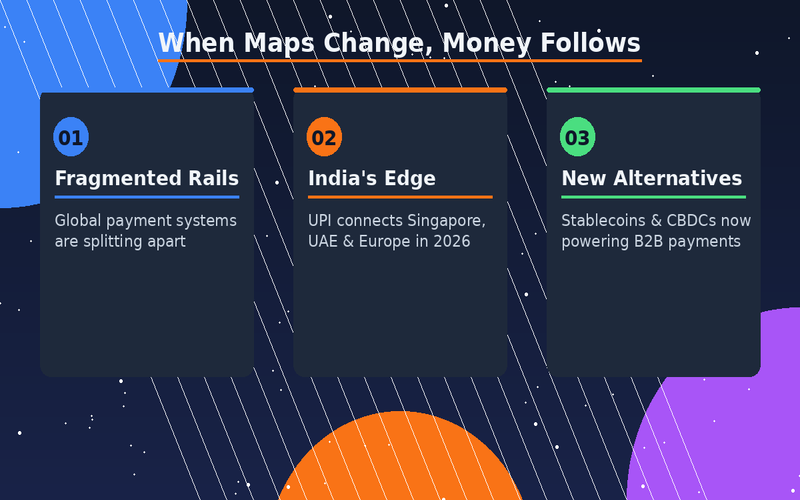
When Maps Change, Money Follows: How Geopolitics Is Rewiring B2B Payments in 2026
Payments are no longer just a plumbing problem — they're a geopolitical one. Explore how Indian B2B businesses can navigate a fragmented, fast-changing global payment landscape
Read More
What Happens Inside an Escrow Release Event? A Step-by-Step Breakdown for Businesses
A complete breakdown of escrow release events—covering triggers, validation, vendor response, and access to source code—helping businesses ensure continuity and minimize vendor risk.
Read MoreReady to Protect Your Core Systems?
Join enterprises that trust SprintEX-Code to safeguard their mission-critical software. Get started with a consultation to discuss your specific escrow requirements.