
Cash Leakage in Retail: Causes, Solutions & How to Prevent Revenue Loss
Jul 05, 2025
Cash Leakage in Retail: Causes, Solutions & How to Prevent Revenue Loss
Cash leakage—unaccounted losses during cash collection, handling, or reconciliation—can significantly impact the profitability of retail chains. Without proper controls, even small discrepancies across multiple outlets can compound into substantial financial losses.
Implementing robust cash management solutions enables retailers to gain end-to-end visibility, automate workflows, and minimize risks such as shrinkage, pilferage, and human error.
Table of Contents
Understanding Cash Leakage in Retail Chains
Why Retail Chains Are Prone to Cash Leakage
Cash Management Solutions for Retail Chains
Key Features of an Effective Cash Management System
Benefits of Implementing Cash Management Solutions
Who Should Adopt These Solutions
Final Thoughts
Understanding Cash Leakage in Retail Chains
Cash leakage refers to any instance where revenue collected from sales is not accurately reflected in company accounts.
Common causes include:
Errors at the point of sale (over-ringing or under-ringing)
Unsecured cash storage
Manual counting mistakes
Discrepancies during end-of-day reconciliation
Retail chains with multiple outlets and high transaction volumes are especially vulnerable, as minor losses at each location can scale into significant financial impact.
Why Retail Chains Are Prone to Cash Leakage
1. High Transaction Volume
Large volumes of daily transactions increase the likelihood of human error and unauthorized actions.
2. Distributed Operations
Managing multiple locations makes it difficult to maintain standardized cash-handling practices and centralized oversight.
3. Manual Processes
Tasks like cash counting, reconciliation, and deposit preparation are often manual, making them error-prone and susceptible to manipulation.
4. Limited Visibility
Without real-time insights, discrepancies may go unnoticed until audits, allowing leakage to persist over time.
Cash Management Solutions for Retail Chains
1. Integrated POS-Banking Interfaces
Connecting POS systems directly with banking infrastructure enables real-time settlement of transactions. This reduces manual intervention and ensures accurate recording of all cash flows.
2. Smart Safes and Cash Recyclers
Smart safes securely store and validate cash deposits throughout the day, while cash recyclers provide automated change management. Together, they reduce dependency on manual handling and improve accountability.
3. Centralized Cash Reconciliation Software
Cloud-based platforms consolidate data from multiple outlets into a single dashboard. Automated reconciliation highlights discrepancies instantly and generates detailed audit trails.
Key Features of an Effective Cash Management System
Real-Time Cash Visibility: Monitor cash positions across stores, tills, and cashiers
Automated Deposit Scheduling: Trigger deposits or pickups based on predefined thresholds
Role-Based Access Controls: Restrict sensitive operations to authorized personnel
Exception Alerts & Reporting: Get instant alerts for mismatches or suspicious activities
API Integrations: Seamlessly connect with ERP, accounting systems, and banking platforms
Benefits of Implementing Cash Management Solutions
Reduced Shrinkage and Pilferage
Automation and secure storage significantly reduce theft and mismanagement.
Improved Operational Efficiency
Eliminating manual processes allows staff to focus on customer service and revenue generation.
Enhanced Financial Accuracy
Real-time tracking ensures precise financial reporting and reduces reconciliation errors.
Lower Operational Costs
Optimized deposit schedules reduce banking and logistics costs.
Stronger Compliance and Auditing
Detailed logs and audit trails simplify compliance with financial regulations.
Who Should Adopt These Solutions
Multi-location Retailers needing centralized visibility and control
Franchise Chains requiring standardized processes across outlets
Supermarkets & High-Volume Stores with significant daily cash flow
Specialty Retailers (pharmacies, electronics, convenience stores) with higher theft risks
Digitally Transforming Businesses integrating financial systems with ERPs
Conclusion
Reducing cash leakage isn’t just about preventing financial loss—it’s about improving operational efficiency, building trust, and strengthening business resilience.
By adopting integrated cash management solutions—from smart safes to API-driven reconciliation systems—retailers can gain tighter control, better visibility, and long-term profitability.
For businesses looking to scale securely, investing in modern cash management infrastructure is no longer optional—it’s essential.
Frequently Asked Questions (FAQs)
What is cash leakage in retail?
Cash leakage refers to unaccounted losses during the sales-to-deposit cycle, often caused by errors, theft, or process inefficiencies.
How do smart safes reduce cash leakage?
They automate counting, securely store cash, and maintain detailed logs, reducing human error and theft opportunities.
Are these solutions affordable for small retailers?
Yes. Many platforms offer scalable pricing models, making them accessible even for small businesses.
How long does implementation take?
Typically 4–6 weeks for standard solutions and up to 12 weeks for advanced integrations.
Can these systems integrate with existing ERP software?
Yes, most solutions offer APIs or built-in connectors for seamless integration.
Related Posts
What is E-Banking? Meaning, Types, Benefits & How It Works in India.
E-banking is the digital way of accessing banking services through mobile apps, websites, ATMs, and biometric systems. It enables secure, fast, and branchless financial transactions anytime and anywhere in India.
Read More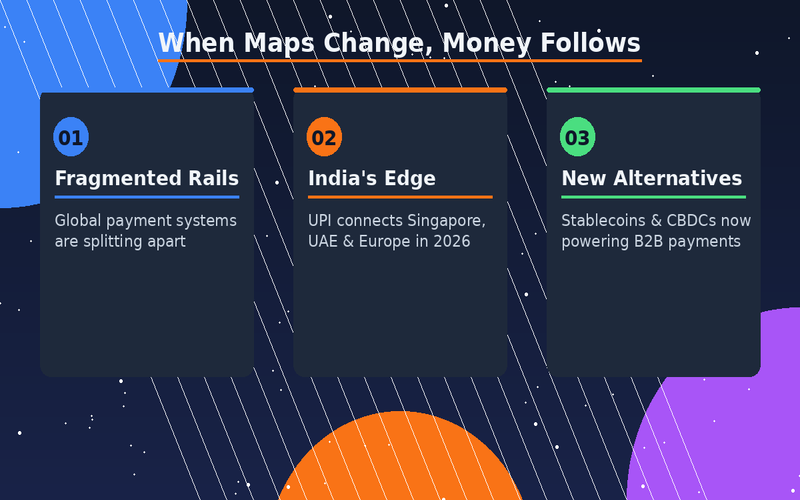
When Maps Change, Money Follows: How Geopolitics Is Rewiring B2B Payments in 2026
Payments are no longer just a plumbing problem — they're a geopolitical one. Explore how Indian B2B businesses can navigate a fragmented, fast-changing global payment landscape
Read More
What Happens Inside an Escrow Release Event? A Step-by-Step Breakdown for Businesses
A complete breakdown of escrow release events—covering triggers, validation, vendor response, and access to source code—helping businesses ensure continuity and minimize vendor risk.
Read MoreReady to Protect Your Core Systems?
Join enterprises that trust SprintEX-Code to safeguard their mission-critical software. Get started with a consultation to discuss your specific escrow requirements.